Faber Jens, Ballegaard Søren, Ørsted Nanna, Eldrup Ebbe, Karpatschof Benny, Gyntelberg Finn, Hecquet Sofie Korsgaard, Gjedde Albert
Department of Endocrinology, Herlev-Gentofte University Hospital, Herlev, Denmark.
Faculty of Health and Medical Sciences, University of Copenhagen, Copenhagen, Denmark.
Front Neurosci. 2023 Jun 14;17:1067098. doi: 10.3389/fnins.2023.1067098. eCollection 2023.
The autonomic nervous system (ANS) maintains glucose homeostasis. While higher than normal glucose levels stimulate the ANS toward reduction, previous findings suggest an association between sensitivity to, or pain from, pressure at the chest bone (pressure or pain sensitivity, PPS) and activity of the ANS. A recent randomized controlled trial (RCT) of type 2 diabetes (T2DM) suggested that addition of an experimental, non-pharmacological intervention more effectively than conventional treatment lowered the levels of both PPS and HbA1c.
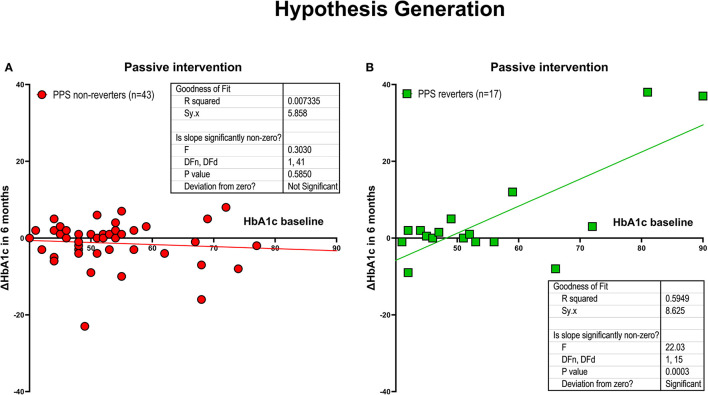
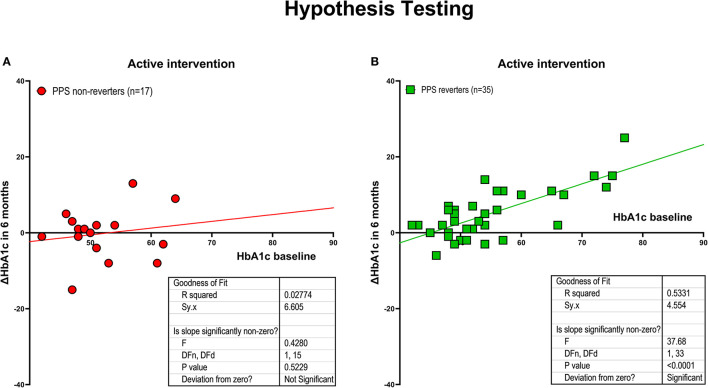
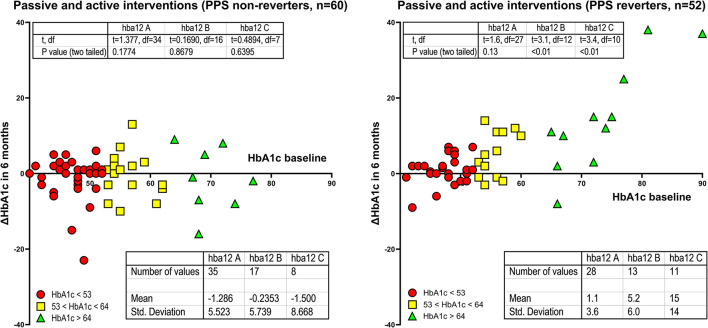
We tested the null hypothesis that conventional treatment ( = 60) would reveal no association between baseline HbA1c and normalization of HbA1c in 6 months, related to change of PPS. We compared the changes of HbA1c in PPS reverters who experienced a minimum reduction of 15 units of PPS and in PPS non-reverters who experienced no reduction. Depending on the result, we tested the association in a second group of participants with addition of the experimental program ( = 52).
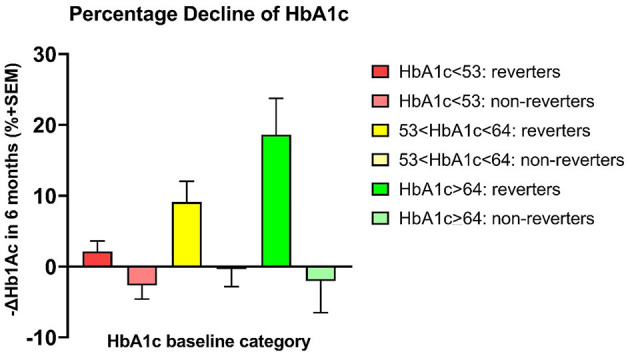
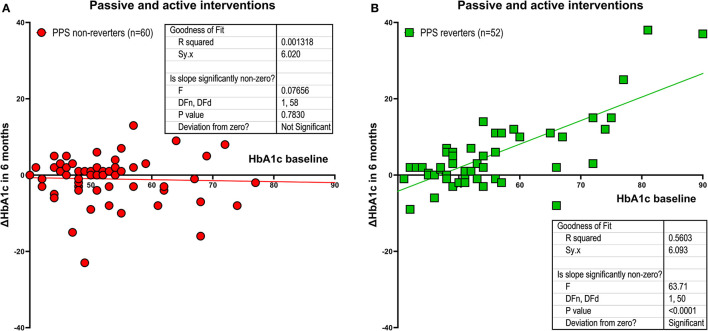
In the conventional group, PPS reverters experienced normalization of HbA1c that corrected the basal increase, thus disproving the null hypothesis. With the addition of the experimental program, PPS reverters experienced similar reduction. The reduction of HbA1c among reverters averaged 0.62 mmol/mol per mmol/mol increase of baseline HbA1c ( < 0.0001 compared to non-reverters). For baseline HbA1c ≥ 64 mmol/mol, reverters averaged 22% reduction of HbA1c ( < 0.01).
In consecutive analyses of two different populations of individuals with T2DM, we demonstrated that the higher the baseline HbA1c, the greater the reduction of HbA1c but only in individuals with a concomitant reduction of sensitivity to PPS, suggesting a homeostatic effect of the autonomic nervous system on glucose metabolism. As such, ANS function, measured as PPS, is an objective measure of HbA1c homeostasis. This observation may be of great clinical importance.
自主神经系统(ANS)维持葡萄糖稳态。虽然高于正常水平的血糖会刺激自主神经系统使其降低,但先前的研究结果表明,胸骨处压力的敏感性或疼痛(压力或疼痛敏感性,PPS)与自主神经系统的活动之间存在关联。最近一项针对2型糖尿病(T2DM)的随机对照试验(RCT)表明,与传统治疗相比,添加一种实验性非药物干预措施能更有效地降低PPS和糖化血红蛋白(HbA1c)水平。
我们检验了原假设,即传统治疗组(n = 60)在6个月内,基线糖化血红蛋白与糖化血红蛋白正常化之间不存在与PPS变化相关的关联。我们比较了PPS至少降低15个单位的PPS恢复者和未降低的PPS未恢复者的糖化血红蛋白变化情况。根据结果,我们在第二组参与者中添加实验方案(n = 52)后检验了这种关联。
在传统治疗组中,PPS恢复者的糖化血红蛋白恢复正常,纠正了基线升高,从而推翻了原假设。添加实验方案后,PPS恢复者糖化血红蛋白出现类似程度的降低。恢复者糖化血红蛋白的降低幅度平均为每基线糖化血红蛋白每增加1 mmol/mol降低0.62 mmol/mol(与未恢复者相比,P < 0.0001)。对于基线糖化血红蛋白≥64 mmol/mol的情况,恢复者糖化血红蛋白平均降低22%(P < 0.01)。
在对两组不同的2型糖尿病个体进行的连续分析中,我们证明基线糖化血红蛋白越高,糖化血红蛋白降低幅度越大,但仅在伴有PPS敏感性降低的个体中如此,这表明自主神经系统对葡萄糖代谢具有稳态调节作用。因此,以PPS衡量的自主神经系统功能是糖化血红蛋白稳态的客观指标。这一观察结果可能具有重要的临床意义。