Gleason Laura, Tekmen Volkan, Cohen Alexa, Bhatti Safiyyah, Beksac Burcu, Cha Jisun, Porcu Pierluigi, Nikbakht Neda
Department of Dermatology and Cutaneous Biology, Thomas Jefferson University, Philadelphia, PA 19107, USA.
Division of Hematologic Malignancies and Hematopoietic Stem Cell Transplant, Department of Medical Oncology, Sidney Kimmel Cancer Center, Thomas Jefferson University, Philadelphia, PA 19107, USA.
Int J Dermatol Venereol. 2023 Jun;6(2):107-109. doi: 10.1097/JD9.0000000000000243. Epub 2022 Jun 21.
Mastocytosis, a clonal proliferation of mast cells commonly involving the skin and bone marrow, has a varied clinical presentation ranging from cutaneous lesions to systemic disease. Cutaneous mastocytosis is managed symptomatically, but systemic mastocytosis is treated with targeted therapy against the mutated receptor tyrosine kinase c-KIT, the pathogenic driver of mastocytosis. However, there are no guidelines for the treatment of cutaneous mastocytosis refractory to symptomatic management. We herein report a method to select genetically informed therapy for symptomatic and recalcitrant cutaneous mastocytosis.
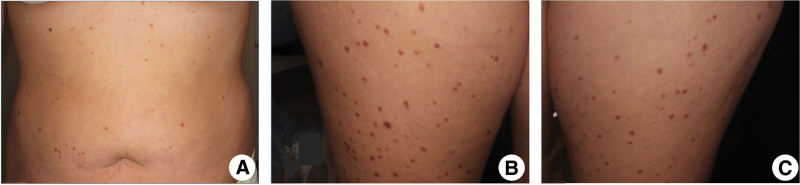
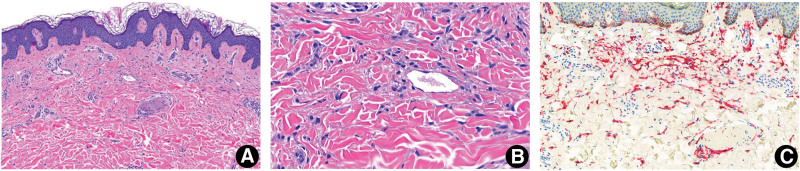
We performed a mutational analysis of dermal mast cells after enrichment by laser capture in a 23-year-old woman with recalcitrant cutaneous mastocytosis. The analysis revealed a aspartic acid to valine substitution at codon 816 (D816V) mutation in the protein c-KIT. Based on these results, we initiated treatment with the multi-kinase/KIT inhibitor midostaurin, a treatment effective against the D816V c-KIT mutation. After 3 months of treatment, the patient exhibited a reduction in the number and size of cutaneous lesions and reported resolution of pruritus and decreased severity of other mast cell-related symptoms.
The treatment of mastocytosis relies heavily on whether the disease is limited to the skin or systemic. However, there are no guidelines for cutaneous mastocytosis that does not respond to symptomatic management. In the present report describing a patient with recalcitrant cutaneous mastocytosis, we describe a strategy in which skin mutational analysis is used to guide the selection of targeted therapy.
Performing mast cell mutational analyses in the skin provides a means to select targeted therapy for symptomatic and refractory cutaneous mastocytosis.
肥大细胞增多症是肥大细胞的克隆性增殖,通常累及皮肤和骨髓,临床表现多样,从皮肤病变到全身性疾病不等。皮肤肥大细胞增多症以对症治疗为主,但系统性肥大细胞增多症则采用针对突变的受体酪氨酸激酶c-KIT的靶向治疗,c-KIT是肥大细胞增多症的致病驱动因素。然而,对于对症治疗无效的皮肤肥大细胞增多症,尚无治疗指南。我们在此报告一种为症状性和顽固性皮肤肥大细胞增多症选择基因指导治疗的方法。
我们对一名患有顽固性皮肤肥大细胞增多症的23岁女性经激光捕获富集后的真皮肥大细胞进行了突变分析。分析显示蛋白c-KIT第816密码子处存在天冬氨酸至缬氨酸替代突变(D816V)。基于这些结果,我们开始使用多激酶/KIT抑制剂米哚妥林进行治疗,该治疗对D816V c-KIT突变有效。治疗3个月后,患者皮肤病变数量和大小减少,瘙痒症状缓解,其他肥大细胞相关症状的严重程度降低。
肥大细胞增多症的治疗很大程度上取决于疾病是局限于皮肤还是全身性的。然而,对于对症治疗无效的皮肤肥大细胞增多症,尚无指南。在本报告描述一名患有顽固性皮肤肥大细胞增多症的患者时,我们描述了一种利用皮肤突变分析来指导靶向治疗选择的策略。
对皮肤肥大细胞进行突变分析为症状性和难治性皮肤肥大细胞增多症选择靶向治疗提供了一种方法。