
一种使用分泌型荧光素酶监测的KIT D816V+晚期系统性肥大细胞增多症的新型人源化体内模型。
A new humanized in vivo model of KIT D816V+ advanced systemic mastocytosis monitored using a secreted luciferase.
作者信息
Bibi Siham, Zhang Yanyan, Hugonin Caroline, Mangean Mallorie Depond, He Liang, Wedeh Ghaith, Launay Jean-Marie, Van Rijn Sjoerd, Würdinger Thomas, Louache Fawzia, Arock Michel
机构信息
Molecular and Cellular Oncology Research Group, LBPA CNRS UMR 8113, Ecole Normale Supérieure de Cachan, Cachan, France.
INSERM Unit U1170, Hématopoïèse normale et pathologique, Gustave Roussy Campus, Université Paris Sud Villejuif, France.
出版信息
Oncotarget. 2016 Dec 13;7(50):82985-83000. doi: 10.18632/oncotarget.12824.
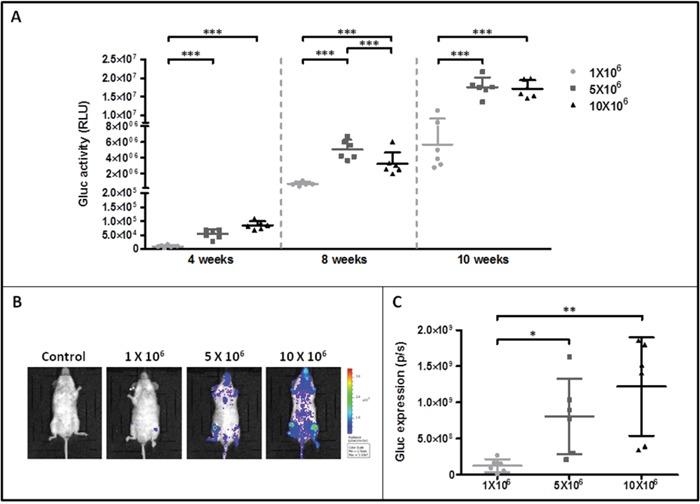
Systemic mastocytosis are rare neoplasms characterized by accumulation of mast cells in at least one internal organ. The majority of systemic mastocytosis patients carry KIT D816V mutation, which activates constitutively the KIT receptor. Patient with advanced forms of systemic mastocytosis, such as aggressive systemic mastocytosis or mast cell leukemia, are poorly treated to date. Unfortunately, the lack of in vivo models reflecting KIT D816V+ advanced disease hampers pathophysiological studies and preclinical development of new therapies for such patients. Here, we describe a new in vivo model of KIT D816V+ advanced systemic mastocytosis developed by transplantation of the human ROSAKIT D816V-Gluc mast cell line in NOD-SCID IL-2R γ-/- mice, using Gaussia princeps luciferase as a reporter. Intravenous injection of ROSAKIT D816V-Gluc cells led, in 4 weeks, to engraftment in all injected primary recipient mice. Engrafted cells were found at high levels in bone marrow, and at lower levels in spleen, liver and peripheral blood. Disease progression was easily monitored by repeated quantification of Gaussia princeps luciferase activity in peripheral blood. This quantification evidenced a linear relationship between the number of cells injected and the neoplastic mast cell burden in mice. Interestingly, the secondary transplantation of ROSAKIT D816V-Gluc cells increased their engraftment capability. To conclude, this new in vivo model mimics at the best the features of human KIT D816V+ advanced systemic mastocytosis. In addition, it is a unique and convenient tool to study the kinetics of the disease and the potential in vivo activity of new drugs targeting neoplastic mast cells.
系统性肥大细胞增多症是一种罕见的肿瘤,其特征是肥大细胞在至少一个内脏器官中积聚。大多数系统性肥大细胞增多症患者携带KIT D816V突变,该突变可组成性激活KIT受体。迄今为止,侵袭性系统性肥大细胞增多症或肥大细胞白血病等晚期系统性肥大细胞增多症患者的治疗效果不佳。不幸的是,缺乏反映KIT D816V+晚期疾病的体内模型阻碍了对此类患者的病理生理研究和新疗法的临床前开发。在此,我们描述了一种新的KIT D816V+晚期系统性肥大细胞增多症体内模型,该模型是通过将人ROSAKIT D816V-Gluc肥大细胞系移植到NOD-SCID IL-2R γ-/-小鼠中构建而成,使用海肾荧光素酶作为报告基因。静脉注射ROSAKIT D816V-Gluc细胞在4周内导致所有注射的初代受体小鼠发生植入。在骨髓中发现植入细胞的水平较高,而在脾脏、肝脏和外周血中的水平较低。通过重复定量外周血中海肾荧光素酶的活性可以轻松监测疾病进展。这种定量证明了注射细胞数量与小鼠肿瘤性肥大细胞负荷之间的线性关系。有趣的是,ROSAKIT D816V-Gluc细胞的二次移植提高了它们的植入能力。总之,这种新的体内模型最能模拟人类KIT D816V+晚期系统性肥大细胞增多症的特征。此外,它是研究疾病动力学以及靶向肿瘤性肥大细胞的新药潜在体内活性的独特且便捷的工具。




 Zotero 插件