Garcia Marcus M, Romero Aaron S, Merkley Seth D, Meyer-Hagen Jewel L, Forbes Charles, Hayek Eliane El, Sciezka David P, Templeton Rachel, Gonzalez-Estrella Jorge, Jin Yan, Gu Haiwei, Benavidez Angelica, Hunter Russell P, Lucas Selita, Herbert Guy, Kim Kyle Joohyung, Cui Julia Yue, Gullapalli Rama, In Julie G, Campen Matthew J, Castillo Eliseo F
Department of Pharmaceutical Sciences, College of Pharmacy, University of New Mexico Health Sciences, Albuquerque, NM, USA.
Division of Gastroenterology and Hepatology, Department of Internal Medicine, University of New Mexico School of Medicine, Albuquerque, NM, USA.
bioRxiv. 2023 Jun 3:2023.06.02.542598. doi: 10.1101/2023.06.02.542598.
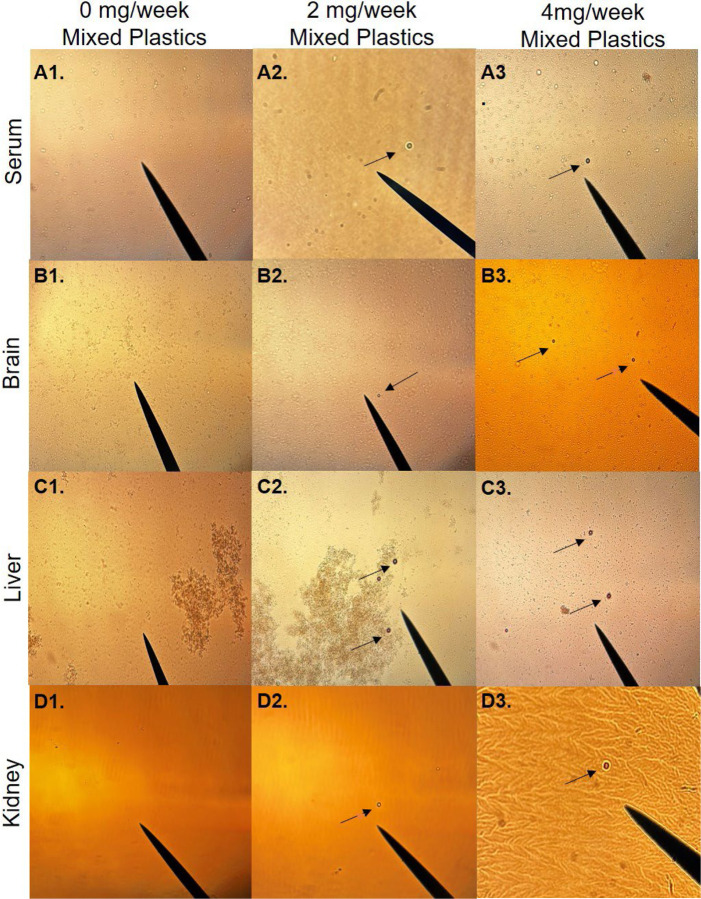
Global plastic use has consistently increased over the past century with several different types of plastics now being produced. Much of these plastics end up in oceans or landfills leading to a substantial accumulation of plastics in the environment. Plastic debris slowly degrades into microplastics (MPs) that can ultimately be inhaled or ingested by both animals and humans. A growing body of evidence indicates that MPs can cross the gut barrier and enter into the lymphatic and systemic circulation leading to accumulation in tissues such as the lungs, liver, kidney, and brain. The impacts of mixed MPs exposure on tissue function through metabolism remains largely unexplored. To investigate the impact of ingested MPs on target metabolomic pathways, mice were subjected to either polystyrene microspheres or a mixed plastics (5 µm) exposure consisting of polystyrene, polyethylene and the biodegradability and biocompatible plastic, poly-(lactic-co-glycolic acid). Exposures were performed twice a week for four weeks at a dose of either 0, 2, or 4 mg/week via oral gastric gavage. Our findings demonstrate that, in mice, ingested MPs can pass through the gut barrier, be translocated through the systemic circulation, and accumulate in distant tissues including the brain, liver, and kidney. Additionally, we report on the metabolomic changes that occur in the colon, liver and brain which show differential responses that are dependent on dose and type of MPs exposure. Lastly, our study provides proof of concept for identifying metabolomic alterations associated with MPs exposure and adds insight into the potential health risks that mixed MPs contamination may pose to humans.
在过去的一个世纪里,全球塑料使用量持续增加,目前正在生产几种不同类型的塑料。这些塑料大多最终进入海洋或垃圾填埋场,导致环境中塑料大量堆积。塑料碎片会缓慢降解为微塑料(MPs),最终可能被动物和人类吸入或摄入。越来越多的证据表明,微塑料可以穿过肠道屏障,进入淋巴和体循环,导致在肺、肝、肾和脑等组织中积累。混合微塑料暴露通过代谢对组织功能的影响在很大程度上仍未得到探索。为了研究摄入的微塑料对目标代谢组学途径的影响,对小鼠进行了聚苯乙烯微球或由聚苯乙烯、聚乙烯以及可生物降解和生物相容性塑料聚(乳酸-乙醇酸共聚物)组成的混合塑料(5微米)暴露实验。通过口服灌胃,每周两次,持续四周,剂量分别为0、2或4毫克/周。我们的研究结果表明,在小鼠中,摄入的微塑料可以穿过肠道屏障,通过体循环转移,并在包括脑、肝和肾在内的远处组织中积累。此外,我们报告了在结肠、肝脏和大脑中发生的代谢组学变化,这些变化显示出依赖于微塑料暴露剂量和类型的不同反应。最后,我们的研究为识别与微塑料暴露相关的代谢组学改变提供了概念验证,并深入了解了混合微塑料污染可能对人类造成的潜在健康风险。