Khoury Reine, Nagy Corina
Integrated Program in Neuroscience, McGill University, Montreal, QC, Canada.
McGill Group for Suicide Studies, Douglas Mental Health University Institute, Verdun, QC, Canada.
Front Mol Biosci. 2023 Jun 15;10:1154872. doi: 10.3389/fmolb.2023.1154872. eCollection 2023.
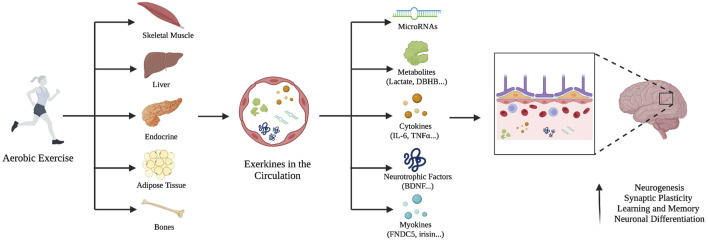
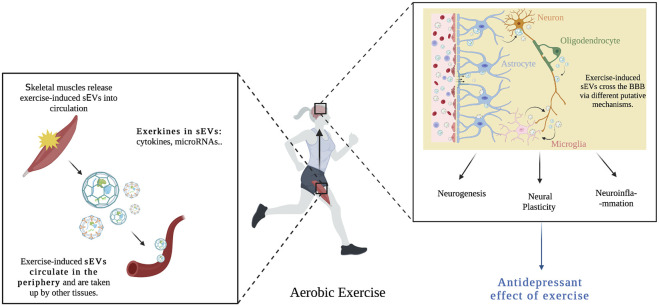
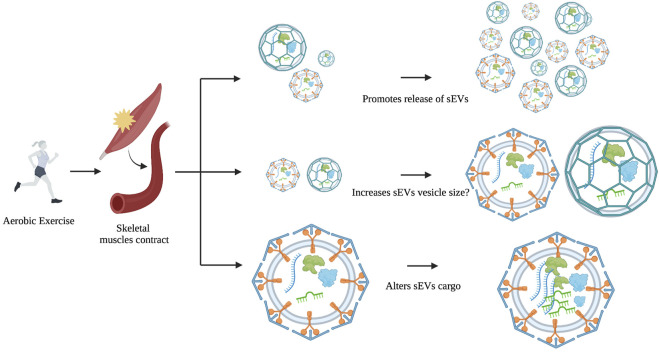
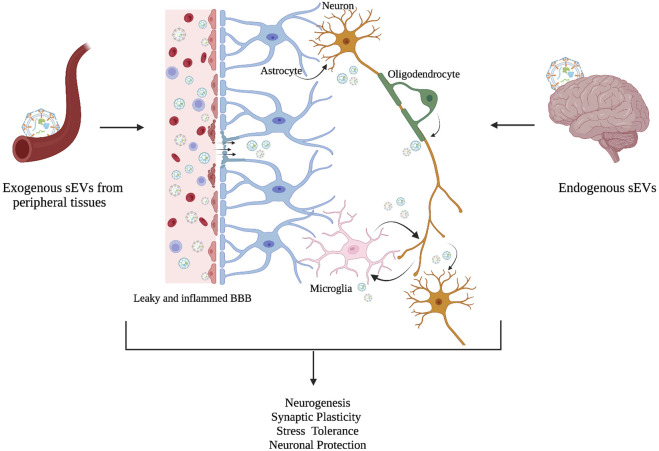
Aerobic exercise promotes beneficial effects in the brain including increased synaptic plasticity and neurogenesis and regulates neuroinflammation and stress response via the hypothalamic-pituitary-adrenal axis. Exercise can have therapeutic effects for numerous brain-related pathologies, including major depressive disorder (MDD). Beneficial effects of aerobic exercise are thought to be mediated through the release of "exerkines" including metabolites, proteins, nucleic acids, and hormones that communicate between the brain and periphery. While the specific mechanisms underlying the positive effects of aerobic exercise on MDD have not been fully elucidated, the evidence suggests that exercise may exert a direct or indirect influence on the brain via small extracellular vesicles which have been shown to transport signaling molecules including "exerkines" between cells and across the blood-brain barrier (BBB). sEVs are released by most cell types, found in numerous biofluids, and capable of crossing the BBB. sEVs have been associated with numerous brain-related functions including neuronal stress response, cell-cell communication, as well as those affected by exercise like synaptic plasticity and neurogenesis. In addition to known exerkines, they are loaded with other modulatory cargo such as microRNA (miRNA), an epigenetic regulator that regulates gene expression levels. How exercise-induced sEVs mediate exercise dependent improvements in MDD is unknown. Here, we perform a thorough survey of the current literature to elucidate the potential role of sEVs in the context of neurobiological changes seen with exercise and depression by summarizing studies on exercise and MDD, exercise and sEVs, and finally, sEVs as they relate to MDD. Moreover, we describe the links between peripheral sEV levels and their potential for infiltration into the brain. While literature suggests that aerobic exercise is protective against the development of mood disorders, there remains a scarcity of data on the therapeutic effects of exercise. Recent studies have shown that aerobic exercise does not appear to influence sEV size, but rather influence their concentration and cargo. These molecules have been independently implicated in numerous neuropsychiatric disorders. Taken together, these studies suggest that concentration of sEVs are increased post exercise, and they may contain specifically packaged protective cargo representing a novel therapeutic for MDD.
有氧运动对大脑具有有益作用,包括增强突触可塑性和神经发生,并通过下丘脑 - 垂体 - 肾上腺轴调节神经炎症和应激反应。运动对多种与大脑相关的病症具有治疗作用,包括重度抑郁症(MDD)。有氧运动的有益作用被认为是通过释放“运动因子”来介导的,这些“运动因子”包括代谢物、蛋白质、核酸和激素,它们在大脑和外周之间进行通信。虽然有氧运动对MDD产生积极影响的具体机制尚未完全阐明,但有证据表明,运动可能通过小细胞外囊泡对大脑产生直接或间接影响,小细胞外囊泡已被证明能在细胞间和穿过血脑屏障(BBB)运输包括“运动因子”在内的信号分子。小细胞外囊泡由大多数细胞类型释放,存在于多种生物流体中,并且能够穿过血脑屏障。小细胞外囊泡与许多与大脑相关的功能有关,包括神经元应激反应、细胞间通信,以及受运动影响的功能,如突触可塑性和神经发生。除了已知的运动因子外,它们还装载有其他调节性物质,如微小RNA(miRNA),一种调节基因表达水平的表观遗传调节剂。运动诱导的小细胞外囊泡如何介导运动对MDD的依赖性改善尚不清楚。在这里,我们通过总结关于运动与MDD、运动与小细胞外囊泡以及最后小细胞外囊泡与MDD相关的研究,对当前文献进行了全面的调查,以阐明小细胞外囊泡在运动和抑郁症相关神经生物学变化背景下的潜在作用。此外,我们描述了外周小细胞外囊泡水平与其渗入大脑的潜力之间的联系。虽然文献表明有氧运动对情绪障碍的发展具有保护作用,但关于运动治疗效果的数据仍然稀缺。最近的研究表明,有氧运动似乎不影响小细胞外囊泡的大小,而是影响其浓度和所载物质。这些分子已被独立证明与多种神经精神疾病有关。综上所述,这些研究表明运动后小细胞外囊泡的浓度会增加,并且它们可能包含特异性包装的保护性物质,代表了一种治疗MDD的新方法。