Department of Biological Chemistry, The Alexander Silberman Institute of Life Sciences, The Hebrew University of Jerusalem, Jerusalem, Israel.
Faculty of Biology, Technion-Israel Institute of Technology, Haifa, Israel.
Biochem J. 2023 Jul 26;480(14):1097-1107. doi: 10.1042/BCJ20230139.
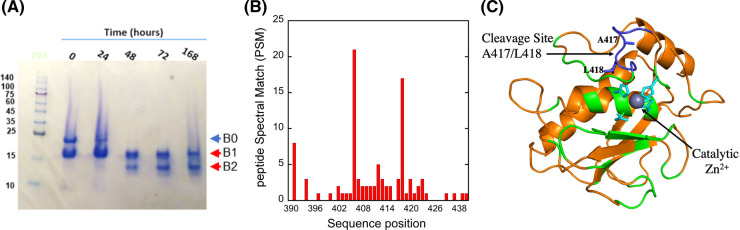
Matrix metalloproteinase-9 (MMP-9) is an endopeptidase that remodels the extracellular matrix. MMP-9 has been implicated in several diseases including neurodegeneration, arthritis, cardiovascular diseases, fibrosis and several types of cancer, resulting in a high demand for MMP-9 inhibitors for therapeutic purposes. For such drug design efforts, large amounts of MMP-9 are required. Yet, the catalytic domain of MMP-9 (MMP-9Cat) is an intrinsically unstable enzyme that tends to auto-cleave within minutes, making it difficult to use in drug design experiments and other biophysical studies. We set our goal to design MMP-9Cat variant that is active but stable to auto-cleavage. For this purpose, we first identified potential auto-cleavage sites on MMP-9Cat using mass spectroscopy and then eliminated the auto-cleavage site by predicting mutations that minimize auto-cleavage potential without reducing enzyme stability. Four computationally designed MMP-9Cat variants were experimentally constructed and evaluated for auto-cleavage and enzyme activity. Our best variant, Des2, with 2 mutations, was as active as the wild-type enzyme but did not exhibit auto-cleavage after 7 days of incubation at 37°C. This MMP-9Cat variant, with an identical with MMP-9Cat WT active site, is an ideal candidate for drug design experiments targeting MMP-9 and enzyme crystallization experiments. The developed strategy for MMP-9CAT stabilization could be applied to redesign other proteases to improve their stability for various biotechnological applications.
基质金属蛋白酶-9(MMP-9)是一种内切酶,可重塑细胞外基质。MMP-9 与多种疾病有关,包括神经退行性疾病、关节炎、心血管疾病、纤维化和几种类型的癌症,因此需要大量 MMP-9 抑制剂用于治疗目的。然而,MMP-9 的催化结构域(MMP-9Cat)是一种内在不稳定的酶,容易在数分钟内自动切割,使其难以用于药物设计实验和其他生物物理研究。我们的目标是设计具有活性但稳定的 MMP-9Cat 变体。为此,我们首先使用质谱法确定 MMP-9Cat 上的潜在自动切割位点,然后通过预测突变来消除自动切割位点,这些突变在不降低酶稳定性的情况下最小化自动切割潜力。实验构建了四个计算设计的 MMP-9Cat 变体,并评估了它们的自动切割和酶活性。我们的最佳变体 Des2 有 2 个突变,与野生型酶一样具有活性,但在 37°C 孵育 7 天后没有发生自动切割。这种 MMP-9Cat 变体与 MMP-9Cat WT 活性位点相同,是针对 MMP-9 的药物设计实验和酶结晶实验的理想候选物。MMP-9CAT 稳定化的开发策略可应用于重新设计其他蛋白酶,以提高它们在各种生物技术应用中的稳定性。