Department of Medicine, Division of Endocrinology, U.C. San Diego School of Medicine, La Jolla, CA 92093, USA.
Department of Bioengineering, Graduate Program in Bioinformatics & Systems Biology, U.C. San Diego, La Jolla, CA 92093, USA.
Nucleic Acids Res. 2023 Aug 25;51(15):e80. doi: 10.1093/nar/gkad562.
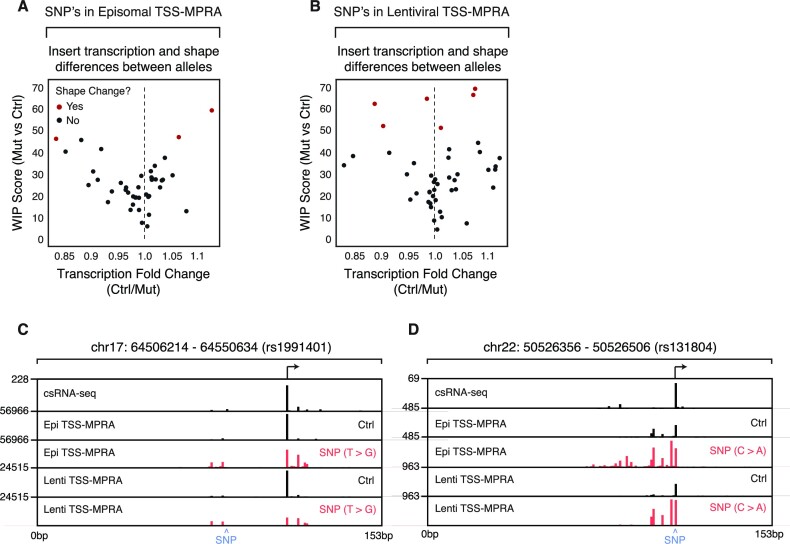
Cis-regulatory elements (CREs) can be classified by the shapes of their transcription start site (TSS) profiles, which are indicative of distinct regulatory mechanisms. Massively parallel reporter assays (MPRAs) are increasingly being used to study CRE regulatory mechanisms, yet the degree to which MPRAs replicate individual endogenous TSS profiles has not been determined. Here, we present a new low-input MPRA protocol (TSS-MPRA) that enables measuring TSS profiles of episomal reporters as well as after lentiviral reporter chromatinization. To sensitively compare MPRA and endogenous TSS profiles, we developed a novel dissimilarity scoring algorithm (WIP score) that outperforms the frequently used earth mover's distance on experimental data. Using TSS-MPRA and WIP scoring on 500 unique reporter inserts, we found that short (153 bp) MPRA promoter inserts replicate the endogenous TSS patterns of ∼60% of promoters. Lentiviral reporter chromatinization did not improve fidelity of TSS-MPRA initiation patterns, and increasing insert size frequently led to activation of extraneous TSS in the MPRA that are not active in vivo. We discuss the implications of our findings, which highlight important caveats when using MPRAs to study transcription mechanisms. Finally, we illustrate how TSS-MPRA and WIP scoring can provide novel insights into the impact of transcription factor motif mutations and genetic variants on TSS patterns and transcription levels.
顺式调控元件 (CREs) 可以根据其转录起始位点 (TSS) 谱的形状进行分类,这些形状表明了不同的调控机制。大规模平行报告基因分析 (MPRA) 越来越多地被用于研究 CRE 调控机制,但尚未确定 MPRAs 在多大程度上复制单个内源性 TSS 谱。在这里,我们提出了一种新的低输入 MPRA 方案 (TSS-MPRA),该方案能够测量外源性报告基因以及慢病毒报告基因染色质化后的 TSS 谱。为了灵敏地比较 MPRA 和内源性 TSS 谱,我们开发了一种新的不相似性评分算法 (WIP 评分),该算法在实验数据上优于常用的大地移动距离。使用 TSS-MPRA 和 WIP 评分对 500 个独特的报告基因插入物进行分析,我们发现,短 (153bp) MPRA 启动子插入物可复制约 60%启动子的内源性 TSS 模式。慢病毒报告基因染色质化并没有提高 TSS-MPRA 起始模式的保真度,并且增加插入物大小通常会导致 MPRA 中激活非内源性 TSS,而这些 TSS 在体内是不活跃的。我们讨论了我们的发现的意义,这些发现强调了在使用 MPRAs 研究转录机制时应注意的重要事项。最后,我们说明了 TSS-MPRA 和 WIP 评分如何为研究转录因子基序突变和遗传变异对 TSS 模式和转录水平的影响提供新的见解。