Kreimer Anat, Ashuach Tal, Inoue Fumitaka, Khodaverdian Alex, Deng Chengyu, Yosef Nir, Ahituv Nadav
Department of Bioengineering and Therapeutic Sciences, University of California, San Francisco, San Francisco, CA, 94158, USA.
Institute for Human Genetics, University of California, San Francisco, San Francisco, CA, 94158, USA.
Nat Commun. 2022 Mar 21;13(1):1504. doi: 10.1038/s41467-022-28659-0.
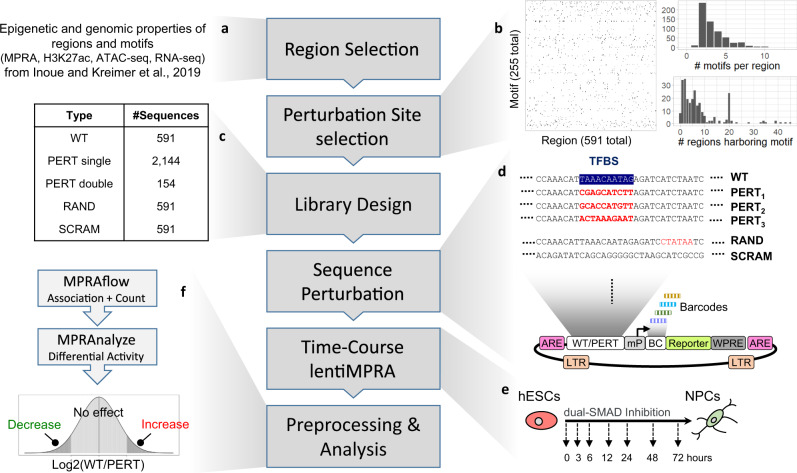
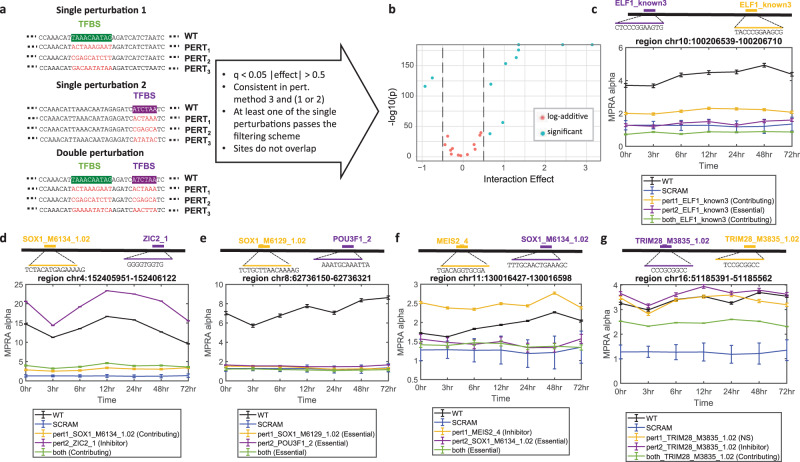
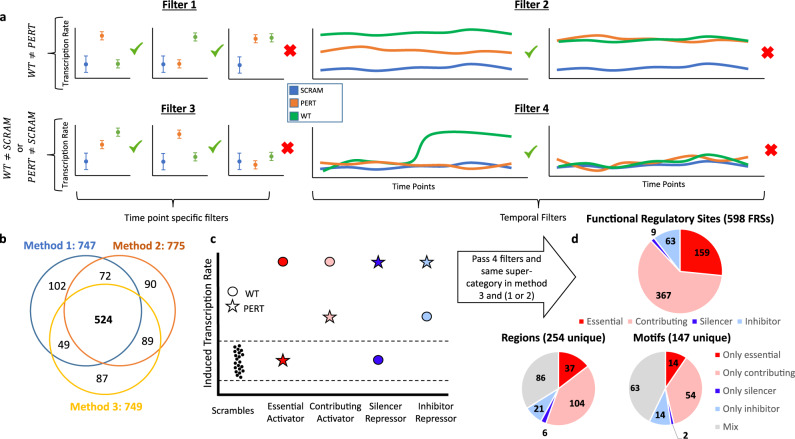
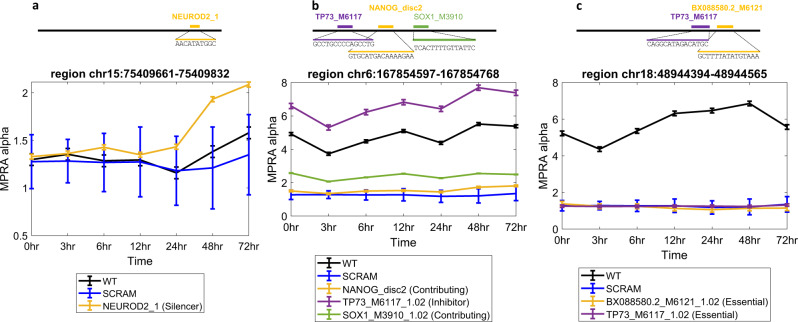
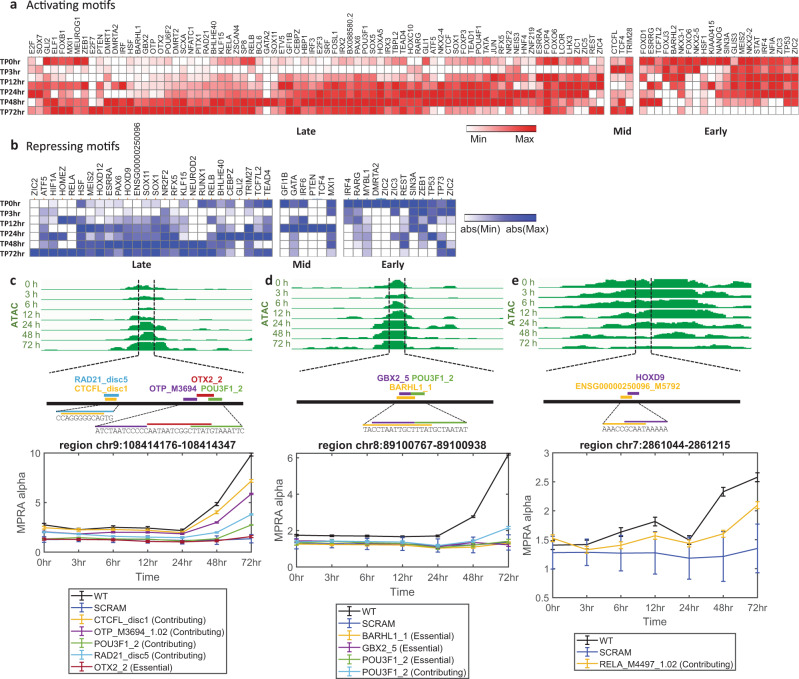
Gene regulatory elements play a key role in orchestrating gene expression during cellular differentiation, but what determines their function over time remains largely unknown. Here, we perform perturbation-based massively parallel reporter assays at seven early time points of neural differentiation to systematically characterize how regulatory elements and motifs within them guide cellular differentiation. By perturbing over 2,000 putative DNA binding motifs in active regulatory regions, we delineate four categories of functional elements, and observe that activity direction is mostly determined by the sequence itself, while the magnitude of effect depends on the cellular environment. We also find that fine-tuning transcription rates is often achieved by a combined activity of adjacent activating and repressing elements. Our work provides a blueprint for the sequence components needed to induce different transcriptional patterns in general and specifically during neural differentiation.
基因调控元件在细胞分化过程中协调基因表达方面发挥着关键作用,但随着时间的推移是什么决定了它们的功能在很大程度上仍然未知。在这里,我们在神经分化的七个早期时间点进行基于扰动的大规模平行报告基因检测,以系统地表征调控元件及其内部的基序如何指导细胞分化。通过扰动活跃调控区域中超过2000个假定的DNA结合基序,我们划分出四类功能元件,并观察到活性方向主要由序列本身决定,而效应的大小取决于细胞环境。我们还发现,微调转录速率通常是通过相邻激活元件和抑制元件的联合活性来实现的。我们的工作为一般情况下,特别是在神经分化过程中诱导不同转录模式所需的序列成分提供了一个蓝图。