
脂肪性病变能否解释炎症对放射学轴性脊柱关节炎患者新骨桥形成的影响?来自 SIAS 队列和 ASSERT 试验的结果。
Do fatty lesions explain the effect of inflammation on new syndesmophytes in patients with radiographic axial spondyloarthritis? Results from the SIAS cohort and ASSERT trial.
机构信息
Department of Rheumatology, Leiden University Medical Center, Leiden, The Netherlands
Department of Rheumatology, Leiden University Medical Center, Leiden, The Netherlands.
出版信息
RMD Open. 2023 Jul;9(3). doi: 10.1136/rmdopen-2023-003118.
OBJECTIVES
To determine how much of the effect of vertebral corner inflammation on development of syndesmophytes is explained by vertebral corner fat deposition.
METHODS
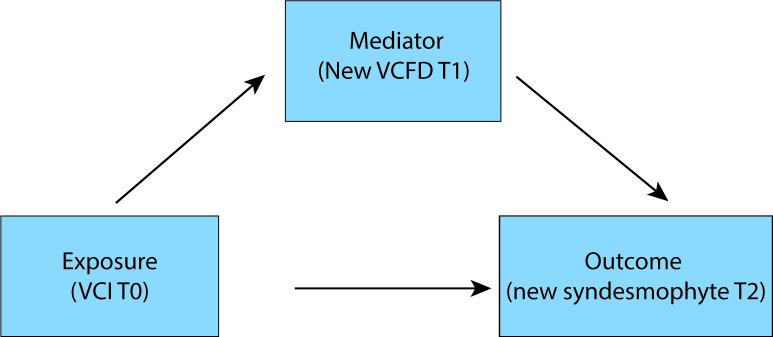
Patients with radiographic axial spondyloarthritis (r-axSpA) from the SIAS (Sensitive Imaging in Ankylosing Spondylitis) cohort and ASSERT (Ankylosing Spondylitis Study for the Evaluation of Recombinant Infliximab Therapy) trial were assessed at T0, T1 (SIAS: 1 year; ASSERT: 24 weeks) and T2 (2 years). Syndesmophytes assessed in each vertebral corner by whole spine low-dose CT (SIAS) or spinal radiographs (ASSERT) at T0 and T2 were considered present if seen by two of two readers. Inflammation (T0) and fat deposition (T0 and T1) on MRI were present if seen by ≥2 of 3 readers (SIAS) or 2 of 2 readers (ASSERT). Vertebral corners showing fat deposition or a syndesmophyte at baseline were ignored. Mediation analysis was applied to determine what proportion of the total effect of inflammation on syndesmophyte formation could be explained via the path of intermediate fat deposition.
RESULTS
Forty-nine SIAS patients (with 2667 vertebral corners) and 168 ASSERT patients (with 2918 vertebral corners) were analysed. The presence of inflammation at T0 increased the probability of a new syndesmophyte in the same vertebral corner at T2 by 9.3%. Of this total effect, 0.2% (2% (0.2 of 9.3) of the total effect) went via intermediate new fat deposition. In ASSERT, the total effect was 7.3%, of which 0.8% (10% of the total effect) went via new fat deposition.
CONCLUSION
In r-axSpA, vertebral corner inflammation may lead to syndesmophyte formation but in a minority of cases via visible fat deposition.
目的
确定脊柱角炎症对骨桥形成的影响有多少可以通过脊柱角脂肪沉积来解释。
方法
来自 SIAS(敏感影像学在强直性脊柱炎中的应用)队列和 ASSERT(评估重组英夫利昔单抗治疗强直性脊柱炎的研究)试验的影像学轴性强直性脊柱炎(r-axSpA)患者在 T0、T1(SIAS:1 年;ASSERT:24 周)和 T2(2 年)时进行评估。如果两位读者中的两位在每个脊柱角的全脊柱低剂量 CT(SIAS)或脊柱 X 线片(ASSERT)上看到了骨桥,则认为在 T0 和 T2 时存在骨桥。如果≥3 位读者中的两位(SIAS)或 2 位读者中的两位(ASSERT)看到了炎症(T0)和脂肪沉积(T0 和 T1),则认为存在炎症和脂肪沉积。基线时出现脂肪沉积或骨桥的脊柱角被忽略。中介分析用于确定炎症对骨桥形成的总影响中,通过中间脂肪沉积路径可以解释多少比例。
结果
共分析了 49 名 SIAS 患者(2667 个脊柱角)和 168 名 ASSERT 患者(2918 个脊柱角)。T0 时存在炎症会使同一脊柱角在 T2 时出现新骨桥的可能性增加 9.3%。在总效应中,有 0.2%(2%(9.3 的 0.2)的总效应)是通过中间的新脂肪沉积传递的。在 ASSERT 中,总效应为 7.3%,其中 0.8%(总效应的 10%)是通过新脂肪沉积传递的。
结论
在 r-axSpA 中,脊柱角炎症可能导致骨桥形成,但在少数情况下是通过可见的脂肪沉积。
 Zotero 插件