Department of General and Trauma Surgery, Ruhr University Bochum, Bürkle-de-La-Camp-Platz 1, 44789, Bochum, Germany.
Department of General and Trauma Surgery, BG University Hospital Bergmannsheil, Bürkle- de- La- Camp Platz 1, 44789, Bochum, Germany.
BMC Musculoskelet Disord. 2023 Jul 5;24(1):554. doi: 10.1186/s12891-023-06675-5.
Distal femur nonunions are well-recognized contributors to persistent functional disability, with limited data regarding their treatment options. In the current study, we asked whether additional medial augmentation plating is a feasible treatment option for patients with aseptic distal femoral nonunion and intact lateral implants.
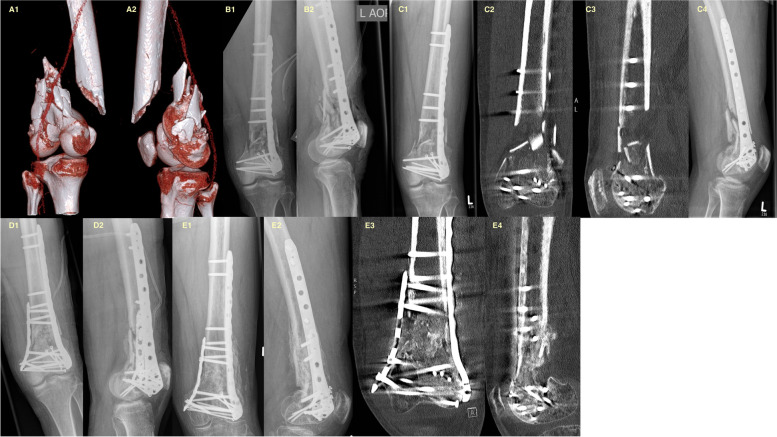
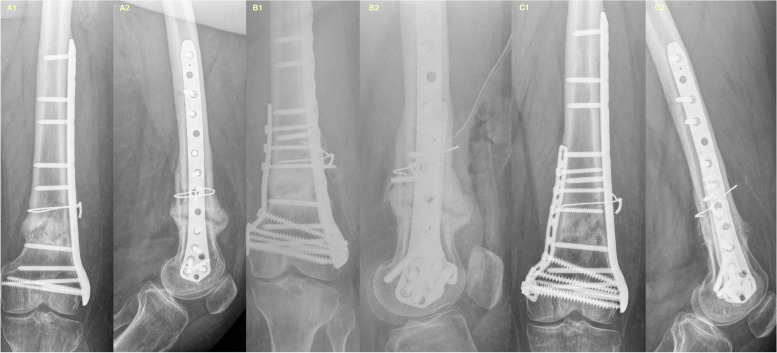
We conducted a single-center, retrospective study including 20 patients treated for aseptic distal femoral nonunion between 2002 and 2017. The treatment procedure included a medial approach to the distal femur, debridement of the nonunion site, bone grafting and medial augmentation plating utilizing a large-fragment titanium plate. Outcome measures were bone-related and functional results, measured by the Hospital for Special Surgery Knee Rating Scale (HSS) and the German Short Musculoskeletal Function Assessment questionnaire (SMFA-D).
Eighteen of 20 nonunions showed osseous healing at 8.16 ± 5.23 (range: 3-21) months after augmentation plating. Regarding functional results, the mean HSS score was 74.17 ± 11.12 (range: 57-87). The mean SMFA-D functional index was 47.38 ± 16.78 (range 25.74-71.32) at the last follow-up. Index procedure-associated complications included two cases of persistent nonunion and one case of infection.
According to the assessed outcome measures, augmentation plating is a feasible treatment option, with a high proportion of patients achieving bony union and good functional outcomes and a few patients experiencing complications.
股骨远端骨不连是导致持续功能障碍的公认原因,其治疗选择的数据有限。在本研究中,我们询问了对于无菌性股骨远端骨不连且外侧植入物完整的患者,是否可以采用额外的内侧增强板固定作为一种可行的治疗选择。
我们进行了一项单中心回顾性研究,纳入了 2002 年至 2017 年期间治疗的 20 例无菌性股骨远端骨不连患者。治疗过程包括采用内侧入路显露股骨远端,清除骨不连部位,植骨并用大钛板进行内侧增强板固定。评估的指标包括骨相关和功能结果,采用美国特种外科医院膝关节评分量表(HSS)和德国短肢肌肉骨骼功能评估问卷(SMFA-D)进行评估。
在增强板固定后 8.16±5.23(范围:3-21)个月,20 例骨不连中有 18 例显示骨愈合。关于功能结果,HSS 评分平均为 74.17±11.12(范围:57-87)。末次随访时,SMFA-D 功能指数的平均为 47.38±16.78(范围 25.74-71.32)。与指数相关的手术并发症包括 2 例持续性骨不连和 1 例感染。
根据评估的结果,增强板固定是一种可行的治疗选择,有很大比例的患者实现了骨愈合和良好的功能结果,少数患者出现了并发症。