Institute of Virology, Medical Center - University of Freiburg, Freiburg, Germany.
Faculty of Medicine, University of Freiburg, Freiburg, Germany.
PLoS Biol. 2023 Jul 6;21(7):e3002182. doi: 10.1371/journal.pbio.3002182. eCollection 2023 Jul.
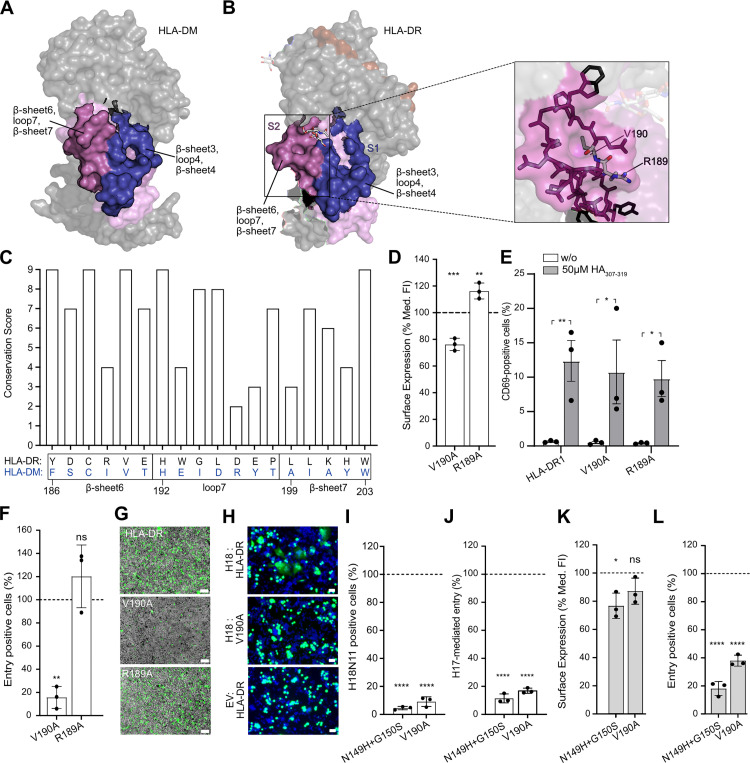
The viral hemagglutinins of conventional influenza A viruses (IAVs) bind to sialylated glycans on host cell surfaces for attachment and subsequent infection. In contrast, hemagglutinins of bat-derived IAVs target major histocompatibility complex class II (MHC-II) for cell entry. MHC-II proteins from various vertebrate species can facilitate infection with the bat IAV H18N11. Yet, it has been difficult to biochemically determine the H18:MHC-II binding. Here, we followed a different approach and generated MHC-II chimeras from the human leukocyte antigen DR (HLA-DR), which supports H18-mediated entry, and the nonclassical MHC-II molecule HLA-DM, which does not. In this context, viral entry was supported only by a chimera containing the HLA-DR α1, α2, and β1 domains. Subsequent modeling of the H18:HLA-DR interaction identified the α2 domain as central for this interaction. Further mutational analyses revealed highly conserved amino acids within loop 4 (N149) and β-sheet 6 (V190) of the α2 domain as critical for virus entry. This suggests that conserved residues in the α1, α2, and β1 domains of MHC-II mediate H18-binding and virus propagation. The conservation of MHC-II amino acids, which are critical for H18N11 binding, may explain the broad species specificity of this virus.
传统甲型流感病毒 (IAV) 的病毒血凝素与宿主细胞表面的唾液酸化聚糖结合,用于附着和随后的感染。相比之下,蝙蝠衍生的 IAV 的血凝素针对主要组织相容性复合体 II (MHC-II) 以进行细胞进入。来自各种脊椎动物物种的 MHC-II 蛋白可以促进蝙蝠 IAV H18N11 的感染。然而,很难通过生化方法确定 H18:MHC-II 的结合。在这里,我们采用了不同的方法,从支持 H18 介导进入的人类白细胞抗原 DR(HLA-DR)和不支持非经典 MHC-II 分子 HLA-DM 生成 MHC-II 嵌合体。在这种情况下,只有包含 HLA-DR α1、α2 和 β1 结构域的嵌合体才能支持病毒进入。随后对 H18:HLA-DR 相互作用进行建模,确定 α2 结构域是这种相互作用的核心。进一步的突变分析显示,α2 结构域环 4(N149)和β-折叠 6(V190)内的高度保守氨基酸对于病毒进入至关重要。这表明 MHC-II 的 α1、α2 和 β1 结构域中的保守残基介导 H18 结合和病毒传播。对于 H18N11 结合至关重要的 MHC-II 氨基酸的保守性可能解释了这种病毒广泛的物种特异性。