Department of Physical Medicine and Rehabilitation, Pamukkale University Faculty of Medicine, Denizli, Turkiye.
Department of Physical Medicine and Rehabilitation, Ministry of Health, Şırnak State Hospital, Denizli, Turkiye.
Investig Clin Urol. 2023 Jul;64(4):395-403. doi: 10.4111/icu.20230009.
To define transcutaneous medial plantar nerve stimulation (T-MPNS) as a new neuromodulation method and assess the efficacy of T-MPNS on quality of life (QoL) and clinical parameters associated with incontinence in women with idiopathic overactive bladder (OAB).
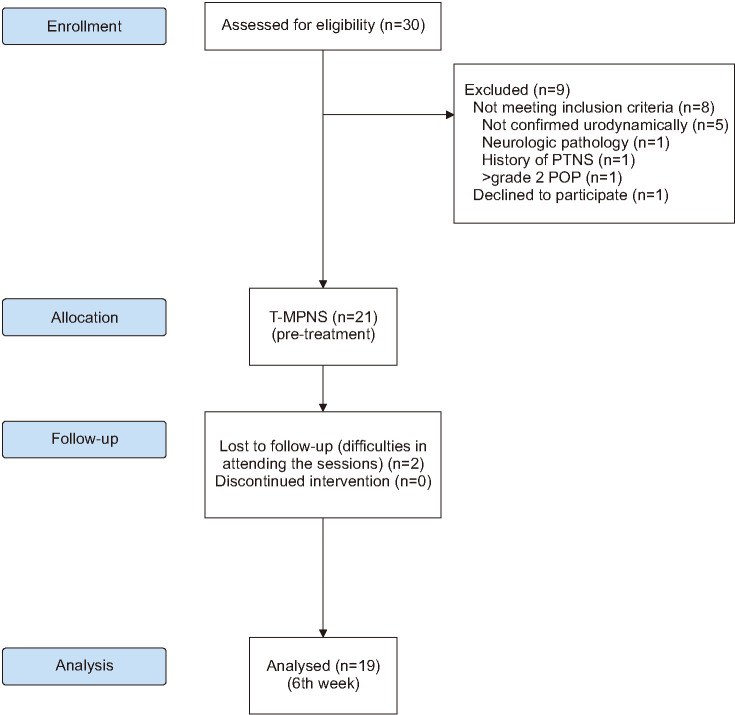
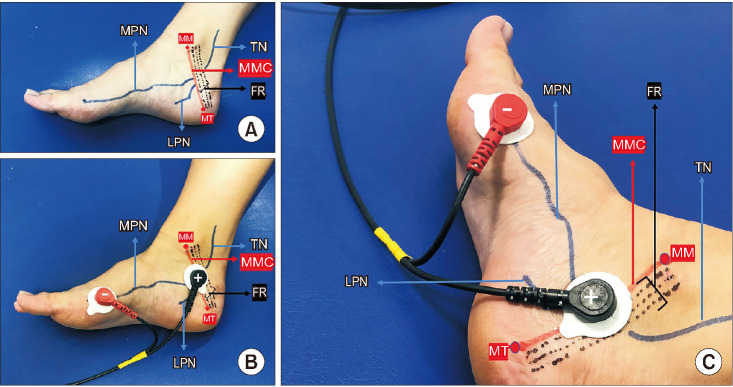
Twenty-one women were included in this study. All women received T-MPNS. Two self-adhesive surface electrodes were positioned with the negative electrode near the metatarsal-phalangeal joint of the great toe on the medial aspect of the foot and the positive electrode 2 cm inferior-posterior of the medial malleolus (in front of the medio-malleolar-calcaneal axis). T-MPNS was performed 2 days a week, 30 minutes a day, for a total of 12 sessions for 6 weeks. Women were evaluated for incontinence severity (24-h pad test), 3-day voiding diary, symptom severity (Overactive Bladder Questionnaire [OAB-V8]), QoL (Quality of Life-Incontinence Impact Questionnaire [IIQ-7]), positive response and cure-improvement rates, and treatment satisfaction at baseline and at the 6th week.
Statistically significant improvement was found in the severity of incontinence, frequency of voiding, incontinence episodes, nocturia, number of pads, symptom severity, and QoL parameters at the 6th week compared with baseline. Treatment satisfaction, treatment success, and cure or improvement rates were found to be high at the 6th week.
T-MPNS was first described in the literature as a new neuromodulation method. We conclude that T-MPNS is effective on both clinical parameters and QoL associated with incontinence in women with idiopathic OAB. Randomized controlled multicenter studies are needed to validate the effectiveness of T-MPNS.
将经皮内侧足底神经刺激(T-MPNS)定义为一种新的神经调节方法,并评估 T-MPNS 对特发性过度活跃膀胱(OAB)女性的生活质量(QoL)和与失禁相关的临床参数的疗效。
本研究纳入了 21 名女性。所有女性均接受 T-MPNS 治疗。将两个自粘表面电极放置在足部内侧,大脚趾的跖趾关节附近放置负电极,内踝后下方 2 厘米处放置正电极(在中踝跟距轴前方)。T-MPNS 每周进行 2 天,每天 30 分钟,共 12 次,持续 6 周。在基线和第 6 周评估女性的失禁严重程度(24 小时垫试验)、3 天排尿日记、症状严重程度(过度活动膀胱问卷 [OAB-V8])、QoL(生活质量-失禁影响问卷 [IIQ-7])、阳性反应和治愈改善率以及治疗满意度。
与基线相比,第 6 周时失禁严重程度、排尿频率、失禁发作次数、夜尿、尿垫数量、症状严重程度和 QoL 参数均有显著改善。第 6 周时,治疗满意度、治疗成功率和治愈或改善率均较高。
T-MPNS 首次在文献中被描述为一种新的神经调节方法。我们得出结论,T-MPNS 对特发性 OAB 女性的失禁相关临床参数和 QoL 均有效。需要进行随机对照多中心研究来验证 T-MPNS 的有效性。