Molecular and Cellular Biology Graduate Program, University of Washington, Seattle, United States.
Division of Immunology and Pathogenesis, University of California, Berkeley, Berkeley, United States.
Elife. 2023 Jul 7;12:e84108. doi: 10.7554/eLife.84108.
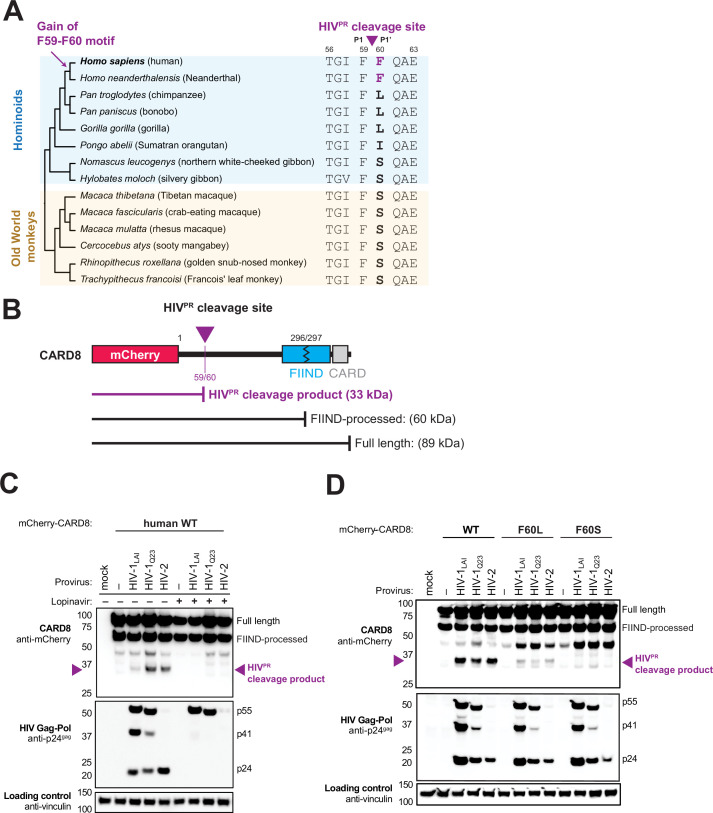
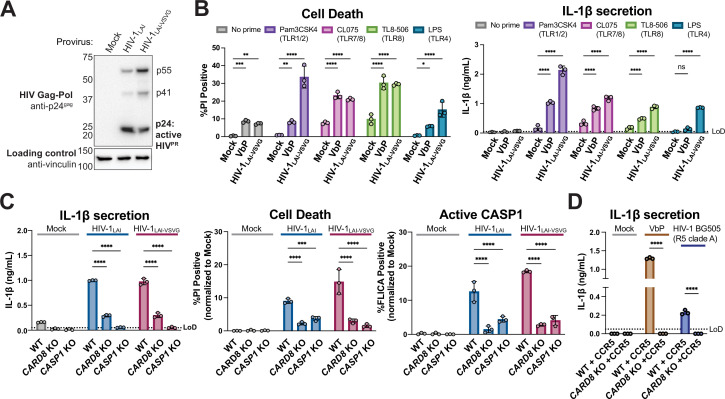
Inflammasomes are cytosolic innate immune complexes that assemble upon detection of diverse pathogen-associated cues and play a critical role in host defense and inflammatory pathogenesis. Here, we find that the human inflammasome-forming sensor CARD8 senses HIV-1 infection via site-specific cleavage of the CARD8 N-terminus by the HIV protease (HIV-1). HIV-1 cleavage of CARD8 induces pyroptotic cell death and the release of pro-inflammatory cytokines from infected cells, processes regulated by Toll-like receptor stimulation prior to viral infection. In acutely infected cells, CARD8 senses the activity of both de novo translated HIV-1 and packaged HIV-1 that is released from the incoming virion. Moreover, our evolutionary analyses reveal that the HIV-1 cleavage site in human CARD8 arose after the divergence of chimpanzees and humans. Although chimpanzee CARD8 does not recognize proteases from HIV or simian immunodeficiency viruses from chimpanzees (SIVcpz), SIVcpz does cleave human CARD8, suggesting that SIVcpz was poised to activate the human CARD8 inflammasome prior to its cross-species transmission into humans. Our findings suggest a unique role for CARD8 inflammasome activation in response to lentiviral infection of humans.
炎症小体是细胞溶质固有免疫复合物,在检测到各种病原体相关线索时组装,并在宿主防御和炎症发病机制中发挥关键作用。在这里,我们发现人类炎症小体形成传感器 CARD8 通过 HIV-1 蛋白酶(HIV-1)对 CARD8 N 末端的特异性切割来感知 HIV-1 感染。HIV-1 对 CARD8 的切割诱导感染细胞发生细胞焦亡和促炎细胞因子的释放,这些过程受病毒感染前 Toll 样受体刺激的调节。在急性感染的细胞中,CARD8 感知新翻译的 HIV-1 和从传入病毒体中释放的包装 HIV-1 的活性。此外,我们的进化分析表明,人类 CARD8 中的 HIV-1 切割位点是在黑猩猩和人类分化之后出现的。尽管黑猩猩 CARD8 不能识别 HIV 或黑猩猩来源的猴免疫缺陷病毒(SIVcpz)的蛋白酶,但 SIVcpz 确实能切割人 CARD8,这表明 SIVcpz 在跨物种传播到人类之前,就已经准备好激活人 CARD8 炎症小体。我们的研究结果表明,CARD8 炎症小体激活在人类慢病毒感染中的反应中具有独特的作用。