Cognitive and Experimental Psychology, Institute of Psychology, RWTH Aachen University, Jägerstrasse 17/19, 52066, Aachen, Germany.
Department of Psychology, Durham University, Durham, UK.
Psychol Res. 2024 Feb;88(1):197-206. doi: 10.1007/s00426-023-01855-3. Epub 2023 Jul 9.
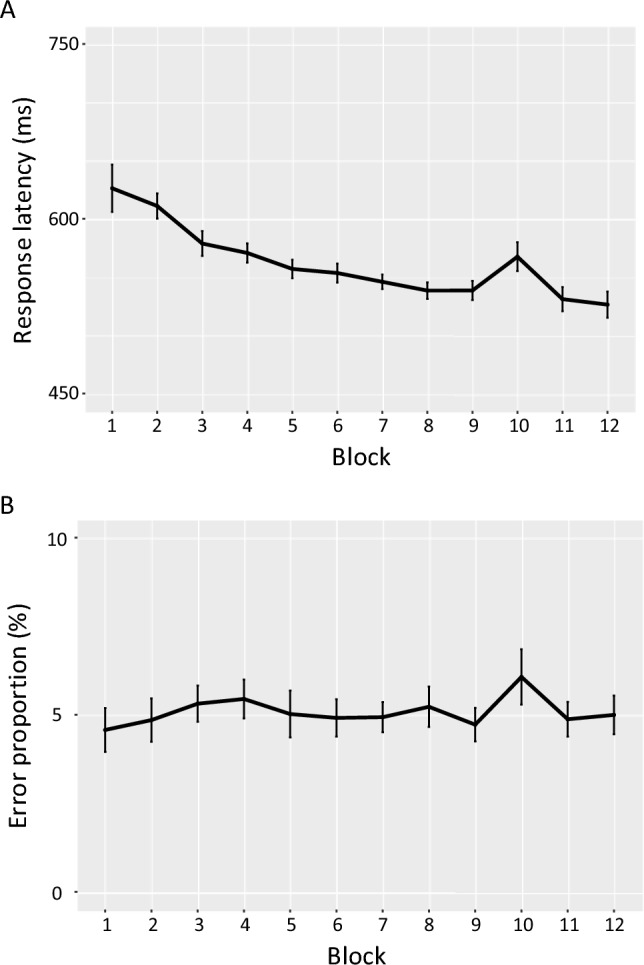
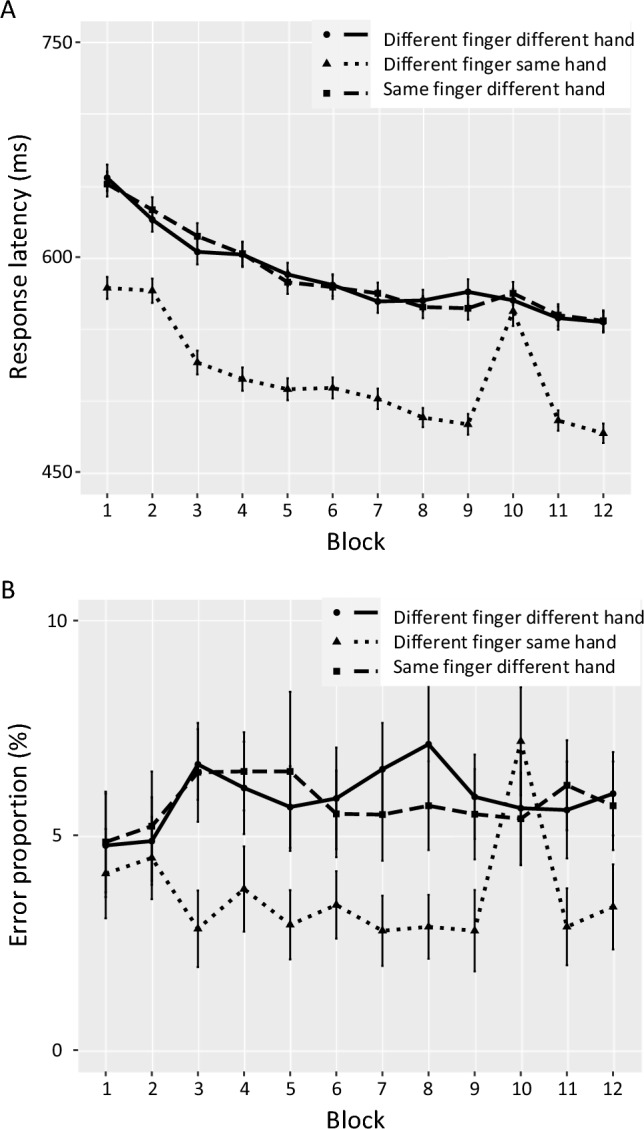
Sequence learning in serial reaction time (SRT) tasks is an established, lab-based experimental paradigm to study acquisition and transfer of skills based on the detection of predictable regularities in stimulus and motor response sequences. Participants learn a sequence of targets and responses to these targets by associating the responses with subsequently presented targets. In the traditional paradigm, however, actions and response targets are directly related. In contrast, the present study asked whether participants would demonstrate acquisition of a sequence of effector movements of the left vs. right hand (e.g., hand sequence learning), whilst the actual targets and associated finger responses are unpredictable. Twenty-seven young adults performed a SRT task to visually presented characters with the index or middle fingers of both hands. While the specific fingers to respond with were randomly selected for each target presentation, both hands followed a covert sequence. We asked whether participants would learn the underlying hand sequence as demonstrated by shortened response latencies and increased accuracy compared to a fully randomized hand sequence. The results show sequence-specific learning effects. However, categorization of hand responses depending on the previous response suggested that learning occurred predominantly for subsequent finger responses of the same hand, which added to general hand-based priming. Nevertheless, a marginally significant effect was observed even for predictable shifts between hands when homologous fingers were involved. Our results thus suggest that humans are able to benefit from predictable within-hand finger shifts but less so for predicted shifts between hands.
序列学习在连续反应时间(SRT)任务中是一种已建立的、基于实验室的实验范式,用于研究基于刺激和运动反应序列中可预测规则的技能获取和转移。参与者通过将反应与随后呈现的目标相关联,学习目标和对这些目标的反应的序列。然而,在传统范式中,动作和反应目标是直接相关的。相比之下,本研究探讨了参与者是否会表现出对手的左/右手运动序列的习得(例如,手序列学习),而实际的目标和相关的手指反应是不可预测的。27 名年轻成年人使用双手的食指或中指完成了一项 SRT 任务,以视觉呈现的字符。虽然每个目标呈现时随机选择要响应的特定手指,但双手都遵循一个隐蔽的序列。我们询问参与者是否会像通过与完全随机的手序列相比缩短反应时和提高准确性来证明的那样学习潜在的手序列。结果显示出特定于序列的学习效应。然而,根据先前的反应对手的反应进行分类表明,学习主要发生在同一手的后续手指反应中,这增加了基于手的一般启动。尽管如此,即使涉及同源手指,当涉及到可预测的手之间的转移时,也观察到了一个边际显著的效应。因此,我们的研究结果表明,人类能够从可预测的手内手指转移中受益,但对可预测的手之间的转移则受益较少。