Miller Mary Beth, Freeman Lindsey K, Helle Ashley C, Hall Nicole A, DiBello Angelo M, McCrae Christina S
Department of Psychiatry, University of Missouri, Columbia, Missouri, USA.
Department of Psychological Sciences, University of Missouri, Columbia, Missouri, USA.
J Sleep Res. 2024 Apr;33(2):e13969. doi: 10.1111/jsr.13969. Epub 2023 Jul 9.
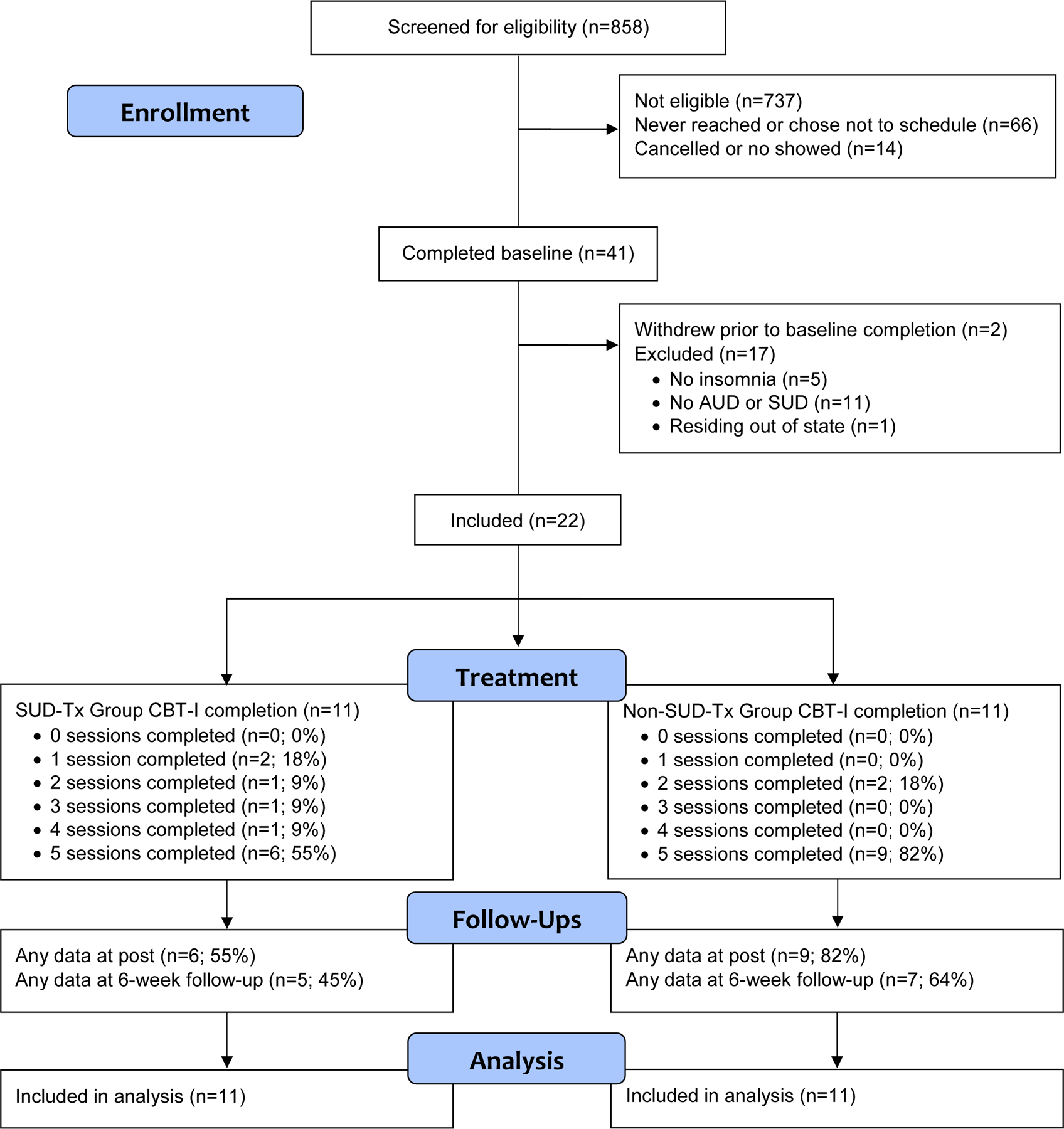
Two out of three adults seeking treatment for alcohol or other substance use disorders report co-occurring symptoms of insomnia. This study compared the feasibility, acceptability, and preliminary efficacy of cognitive behavioural therapy for insomnia (CBT-I) among adults seeking and not seeking treatment for substance use. Adults with alcohol or other substance use disorders (n = 22, 32% female, 82% White; M = 39.5) completed assessments at baseline, post-treatment, and at 6 week follow-up. Of those, 11 were and 11 were not enrolled in substance use treatment. All received CBT-I. Multiple imputation was used for missing data. Data were analysed using repeated measures analyses of variance. In the substance use treatment group, 6/11 completed post and 5/11 completed follow-up. In the non-treatment group, 9/11 completed post and 7/11 completed follow-up. Participants in both groups reported improvements in insomnia severity, sleep onset latency, and dysfunctional beliefs about sleep, with most effects evident at post and follow-up. There was a marginal group-by-time interaction in the change in frequency of substance use, with only participants not in substance use treatment reporting decreases at follow-up. Participants in substance use treatment reported significant reductions in substance-related problems and symptoms of post-traumatic stress disorder over time; however, they also reported more symptoms at baseline. CBT-I produces similar reductions in insomnia but is relatively less feasible among individuals in (versus not in) treatment for substance use disorder. This may be due to the more complex logistics of accessing CBT-I among those in treatment. We speculate that integrating CBT-I into treatment for addictions may improve feasibility in this population. clinicaltrials.gov NCT04198311.
在寻求酒精或其他物质使用障碍治疗的成年人中,三分之二报告同时存在失眠症状。本研究比较了认知行为疗法治疗失眠(CBT-I)在寻求和未寻求物质使用治疗的成年人中的可行性、可接受性和初步疗效。患有酒精或其他物质使用障碍的成年人(n = 22,32%为女性,82%为白人;平均年龄39.5岁)在基线、治疗后和6周随访时完成评估。其中,11人参加了物质使用治疗,11人未参加。所有人都接受了CBT-I。对缺失数据采用多重填补法。使用重复测量方差分析对数据进行分析。在物质使用治疗组中,11人中有6人完成了治疗后评估,11人中有5人完成了随访。在未治疗组中,11人中有9人完成了治疗后评估,11人中有7人完成了随访。两组参与者均报告失眠严重程度、入睡潜伏期和对睡眠的功能失调信念有所改善,大多数效果在治疗后和随访时明显。在物质使用频率的变化方面存在边缘性的组×时间交互作用,只有未接受物质使用治疗的参与者在随访时报告有所减少。随着时间的推移,接受物质使用治疗的参与者报告与物质相关的问题和创伤后应激障碍症状显著减少;然而,他们在基线时也报告有更多症状。CBT-I在减轻失眠方面产生了类似的效果,但在接受(与未接受)物质使用障碍治疗的个体中相对不太可行。这可能是由于接受治疗的人获取CBT-I的后勤工作更为复杂。我们推测将CBT-I纳入成瘾治疗可能会提高该人群的可行性。clinicaltrials.gov NCT04198311。