Taheri Mahbobeh, Eshrati Babak, Bahadorimonfared Ayad, Sohrabi Mohammad-Reza
Department of Community Medicine, School of Medicine, Shahid Beheshti University of Medical Sciences, Tehran, Iran.
Preventive Medicine and Public Health Research Center, Iran University of Medical Sciences, Tehran, Iran.
Med J Islam Repub Iran. 2023 May 15;37:52. doi: 10.47176/mjiri.37.52. eCollection 2023.
Despite the advances in the control of infectious diseases like cholera, they can potentially cause epidemics, especially in mass gathering events. One of the most important countries on the walking way of the religious event is Iran, which requires health system preparedness. The aim of this study was to predict the cholera epidemic in Iran by using the syndromic surveillance system of Iranian pilgrims in Iraq.
The data of the Iranian pilgrims with acute watery diarrhea in Iraq during the religious event and the confirmed cholera cases of pilgrims after returning to Iran were analyzed. We used the Poisson regression model of the relationship between the numbers of cases to evaluate acute watery diarrhea and cholera. Spatial statistics and hot spot analysis were used to identify the provinces with the highest incidence. SPSS software Version 24 was used for statistical analysis.
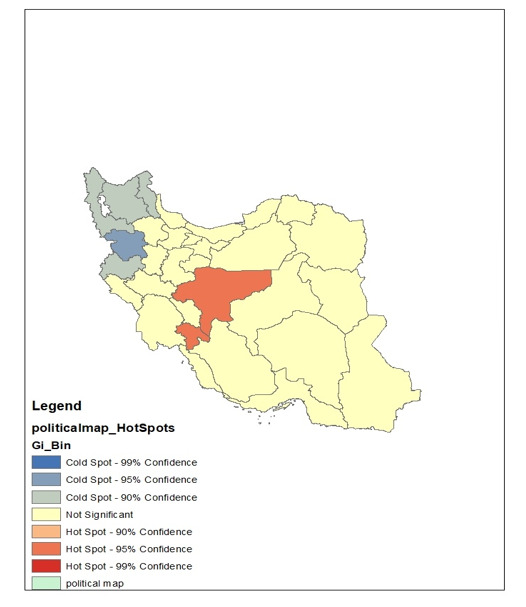
The frequency of acute watery diarrhea cases was 2232 and the frequency of cholera in pilgrims after returning to Iran was 641. The results of spatial analysis for acute watery diarrhea cases showed a high number of acute watery diarrhea cases in the Khuzestan and Isfahan provinces, located in hot spots. Using Poisson regression, the relationship between the number of acute watery diarrhea reported in the syndromic surveillance system and the number of cholera cases was confirmed.
The syndromic surveillance system is useful to predict the outbreak of infectious diseases in large religious mass gatherings.
尽管在霍乱等传染病防控方面取得了进展,但它们仍有可能引发疫情,尤其是在大规模聚集活动中。伊朗是该宗教活动行程中的重要国家之一,需要卫生系统做好准备。本研究的目的是利用在伊拉克的伊朗朝圣者的症状监测系统预测伊朗的霍乱疫情。
分析了宗教活动期间在伊拉克的患有急性水样腹泻的伊朗朝圣者的数据以及返回伊朗后朝圣者的霍乱确诊病例。我们使用病例数之间关系的泊松回归模型来评估急性水样腹泻和霍乱。采用空间统计和热点分析来确定发病率最高的省份。使用SPSS 24版软件进行统计分析。
急性水样腹泻病例数为2232例,返回伊朗后朝圣者中的霍乱病例数为641例。急性水样腹泻病例的空间分析结果显示,位于热点地区的胡齐斯坦省和伊斯法罕省急性水样腹泻病例数较多。通过泊松回归,证实了症状监测系统中报告的急性水样腹泻病例数与霍乱病例数之间的关系。
症状监测系统有助于预测大型宗教聚集活动中传染病的爆发。