Farre Albert, Fang Mei, Hannah Beth, Makita Meiko, McFadden Alison, Menezes Deborah, Rodriguez Andrea, Sixsmith Judith, M Gray Nicola
School of Health Sciences, University of Dundee, Dundee, UK.
School of Humanities, Social Sciences and Law, University of Dundee, Dundee, UK.
Digit Health. 2023 Jun 29;9:20552076231185442. doi: 10.1177/20552076231185442. eCollection 2023 Jan-Dec.
To map and explore existing evidence on the use of digital technology to deliver healthcare services with explicit consideration of health inequalities in UK settings.
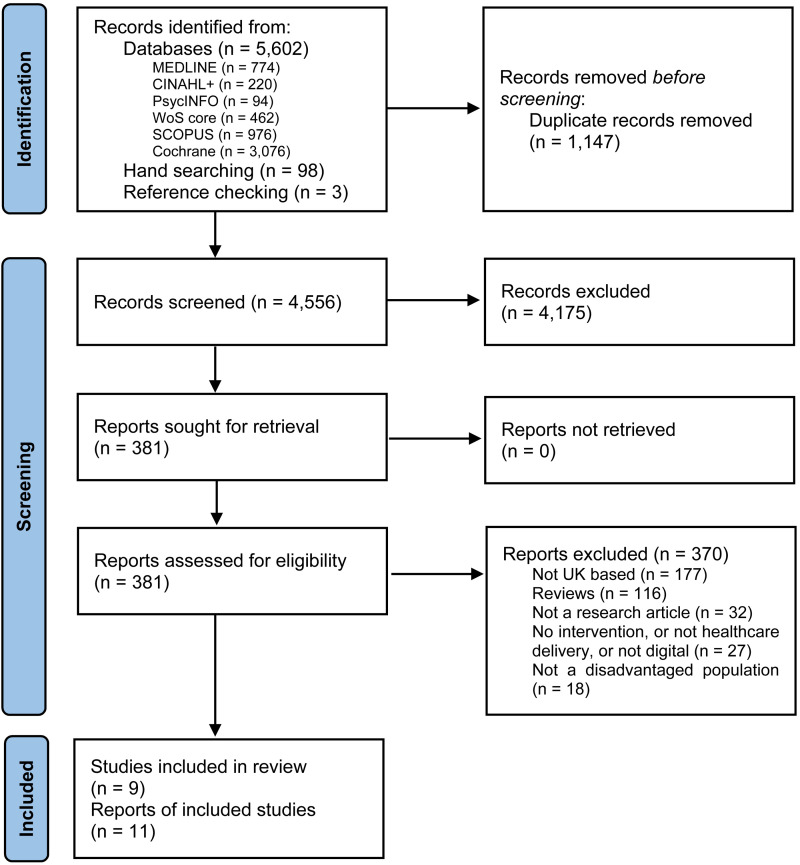
We searched six bibliographic databases, and the National Health Service (NHS) websites of each UK nation (England, Scotland, Wales, Northern Ireland). Restrictions were applied on publication date (2013-2021) and publication language (English). Records were independently screened against eligibility criteria by pairs of reviewers from the team. Articles reporting relevant qualitative and/or quantitative research were included. Data were synthesised narratively.
Eleven articles, reporting data from nine interventions, were included. Articles reported findings from quantitative (n = 5), qualitative (n = 5), and mixed-methods (n = 1) studies. Study settings were mainly community based, with only one hospital based. Two interventions targeted service users, and seven interventions targeted healthcare providers. Two studies were explicitly and directly aimed at (and designed for) addressing health inequalities, with the remaining studies addressing them indirectly (e.g. study population can be classed as disadvantaged). Seven articles reported data on implementation outcomes (acceptability, appropriateness, and feasibility) and four articles reported data on effectiveness outcomes, with only one intervention demonstrating cost-effectiveness.
It is not yet clear if digital health interventions/services in the UK work for those most at risk of health inequalities. The current evidence base is significantly underdeveloped, and research/intervention efforts have been largely driven by healthcare provider/system needs, rather than those of service users. Digital health interventions can help address health inequalities, but a range of barriers persist, alongside a potential for exacerbation of health inequalities.
在明确考虑英国背景下健康不平等问题的基础上,梳理并探究有关利用数字技术提供医疗服务的现有证据。
我们检索了六个文献数据库以及英国每个地区(英格兰、苏格兰、威尔士、北爱尔兰)的国民医疗服务体系(NHS)网站。对出版日期(2013 - 2021年)和出版语言(英语)进行了限制。研究团队的评审人员对记录进行独立筛选,以符合纳入标准。纳入报告相关定性和/或定量研究的文章。对数据进行叙述性综合分析。
纳入了11篇文章,报告了来自9项干预措施的数据。文章报告了定量研究(n = 5)、定性研究(n = 5)和混合方法研究(n = 1)的结果。研究环境主要基于社区,只有一项基于医院。两项干预措施针对服务使用者,七项干预措施针对医疗服务提供者。两项研究明确且直接旨在(并设计用于)解决健康不平等问题,其余研究则间接解决这些问题(例如研究人群可归类为弱势群体)。七篇文章报告了实施结果(可接受性、适宜性和可行性)的数据,四篇文章报告了有效性结果的数据,只有一项干预措施显示出成本效益。
在英国,数字健康干预措施/服务是否对那些健康不平等风险最高的人群有效尚不清楚。目前的证据基础明显不发达,研究/干预工作在很大程度上是由医疗服务提供者/系统的需求驱动的,而不是服务使用者的需求。数字健康干预措施有助于解决健康不平等问题,但一系列障碍仍然存在,同时还有加剧健康不平等的可能性。