
剩余的小圆肌和肩胛下肌可能有助于防止肱骨头向上移位以及肩袖撕裂中骨关节炎变化的进展。
The remaining teres minor and subscapularis may contribute to preventing superior migration of the humeral head and progression of osteoarthritic change in rotator cuff tears.
作者信息
Tamura Toshifumi, Tokunaga Takuya, Karasugi Tatsuki, Miyamoto Takeshi, Kikukawa Kenshi
机构信息
Department of Orthopaedic Surgery, Kumamoto General Hospital, Japan Community Healthcare Organization, Yatsushiro, Kumamoto, Japan.
Department of Orthopaedic Surgery, Faculty of Life Sciences, Kumamoto University, Kumamoto, Japan.
出版信息
JSES Int. 2023 Apr 7;7(4):561-567. doi: 10.1016/j.jseint.2023.03.005. eCollection 2023 Jul.
BACKGROUND
Superior migration of the humeral head is common in large and massive rotator cuff tears (RCTs). Humeral heads migrate superiorly according to an increase in the RCT size; however, the relevance of the remaining cuff has not been elucidated. This study investigated the relation between superior migration of the humeral head and the remaining rotator cuff, especially the teres minor (TM) and subscapularis (SSC), in RCTs involving tears and atrophy of the infraspinatus (ISP).
METHODS
Plain anteroposterior radiographic and magnetic resonance imaging examinations were performed on 1345 patients between January 2013 and March 2018. A total of 188 shoulders with tears of the supraspinatus and ISP with atrophic ISP were evaluated. Gradings of superior migration of the humeral head and osteoarthritic change were evaluated using the acromiohumeral interval, Oizumi classification, and Hamada classification on plain anteroposterior radiographs. The cross-sectional area of the remaining rotator cuff muscles was evaluated using oblique sagittal magnetic resonance imaging. The TM was classified as hypertrophic (H) and normal and atrophic (NA). The SSC was classified as nonatrophic (N) and atrophic (A). All shoulders were classified as groups A (H-N), B (NA-N), C (H-A), and D (NA-A). Age- and sex-matched patients with no cuff tears were also enrolled (control).
RESULTS
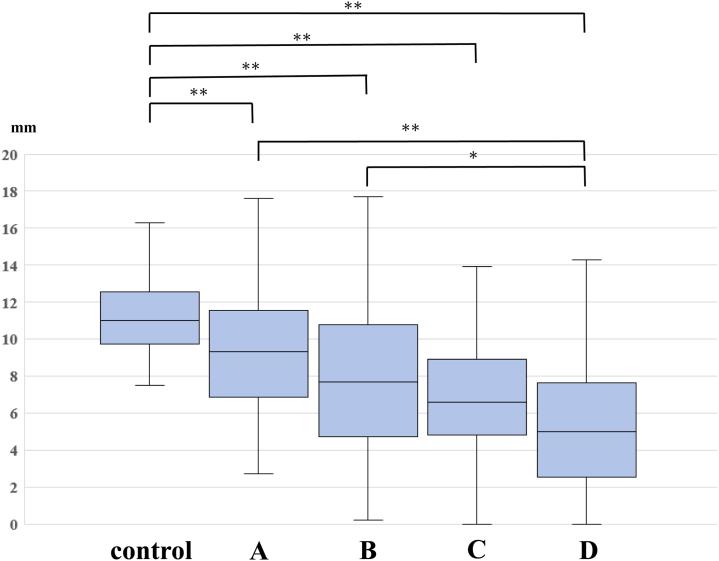
The acromiohumeral intervals of the control group and groups A-D were 11.4 ± 2.4, 9.5 ± 3.8, 7.8 ± 4.1, 7.2 ± 4.0, and 5.4 ± 3.5 mm (84, 74, 64, 21, and 29 shoulders, respectively), with significant differences between groups A and D ( < .001) and groups B and D ( = .016). Grade 3 of the Oizumi classification and grades 3, 4, and 5 of the Hamada classification were significantly higher in group D than in others ( < .001).
CONCLUSION
The group showing hypertrophic TM and nonatrophic SSC prevented significantly migration of the humeral head and cuff tear osteoarthritis compared to the group showing atrophic TM and SSC in posterosuperior RCTs. The findings indicate that the remaining TM and SSC may prevent superior migration of the humeral head and progression of osteoarthritic change in RCTs. In treating patients with large and massive posterosuperior RCTs, the status of the remaining TM and SSC muscles should be assessed.
背景
肱骨头向上移位在大型和巨大肩袖撕裂(RCT)中很常见。肱骨头会随着RCT尺寸的增加而向上移位;然而,剩余肩袖的相关性尚未阐明。本研究调查了在涉及冈下肌(ISP)撕裂和萎缩的RCT中,肱骨头向上移位与剩余肩袖,尤其是小圆肌(TM)和肩胛下肌(SSC)之间的关系。
方法
对2013年1月至2018年3月期间的1345例患者进行了前后位X线平片和磁共振成像检查。共评估了188例患有冈上肌和ISP撕裂且ISP萎缩的肩部。使用前后位X线平片上的肩峰肱骨头间距、大泉分类和滨田分类评估肱骨头向上移位和骨关节炎变化的分级。使用斜矢状面磁共振成像评估剩余肩袖肌肉的横截面积。TM分为肥厚型(H)、正常型和萎缩型(NA)。SSC分为非萎缩型(N)和萎缩型(A)。所有肩部分为A组(H-N)、B组(NA-N)、C组(H-A)和D组(NA-A)。还纳入了无肩袖撕裂的年龄和性别匹配患者作为对照组。
结果
对照组以及A-D组的肩峰肱骨头间距分别为11.4±2.4、9.5±3.8、7.8±4.1、7.2±4.0和5.4±3.5mm(分别为84、74,、64、21和29个肩部),A组和D组之间(<0.001)以及B组和D组之间(=0.016)存在显著差异。大泉分类的3级以及滨田分类的3、4和5级在D组中显著高于其他组(<0.001)。
结论
与后上象限RCT中显示萎缩性TM和SSC的组相比,显示肥厚性TM和非萎缩性SSC的组可显著防止肱骨头移位和肩袖撕裂性骨关节炎。研究结果表明,剩余的TM和SSC可能会防止RCT中肱骨头向上移位和骨关节炎变化的进展。在治疗大型和巨大后上象限RCT患者时,应评估剩余TM和SSC肌肉的状态。



 Zotero 插件