The First Central Clinical School, Tianjin Medical University, No 22 Qixiangtai Road, Tianjin, 300070, Heping District, China.
Department of Cardiology, Tianjin First Central Hospital, No 24 Fukang Road, Tianjin, 300192, Nankai District, China.
BMC Cardiovasc Disord. 2023 Jul 10;23(1):344. doi: 10.1186/s12872-023-03341-5.
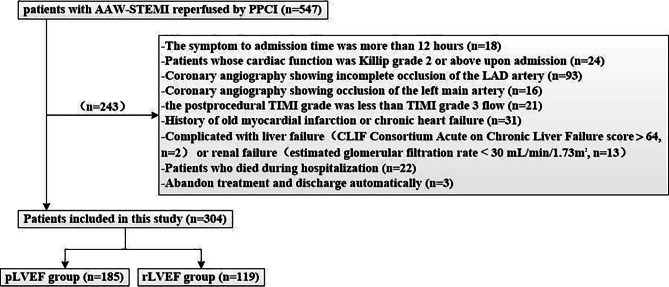
The aim of this study was to perform a retrospective analysis of patients with acute anterior wall ST-segment elevation myocardial infarction (AAW-STEMI) whose left anterior descending (LAD) artery was completely occluded and reperfused by primary percutaneous coronary intervention (PPCI) and to determine the influencing factors and prognostic value of left ventricular systolic dysfunction (LVSD) in the acute phase of acute myocardial infarction (AMI).
A total of 304 patients with AAW-STEMI were selected. The selected patients were divided into two groups: the preserved left ventricular ejection fraction (pLVEF) group (LVEF ≥ 50%, n = 185) and the reduced left ventricular ejection fraction (rLVEF) group (LVEF < 50%, n = 119). The influencing factors of LVSD and their predictive value for LVSD were analyzed. Patients were followed up by examining outpatient records and via telephone. The predictive value of LVSD for the cardiovascular mortality of patients with AAW-STEMI was analyzed.
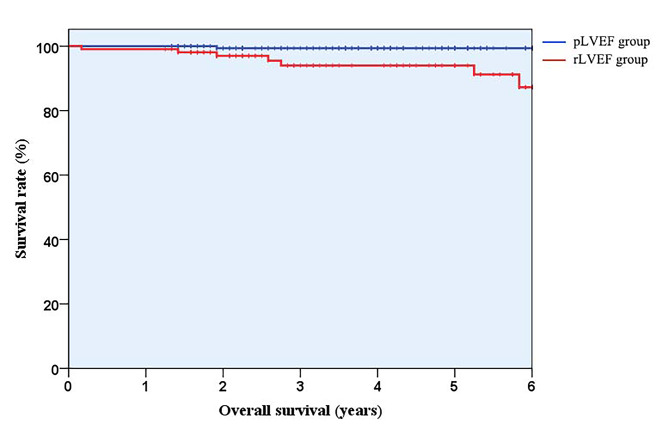
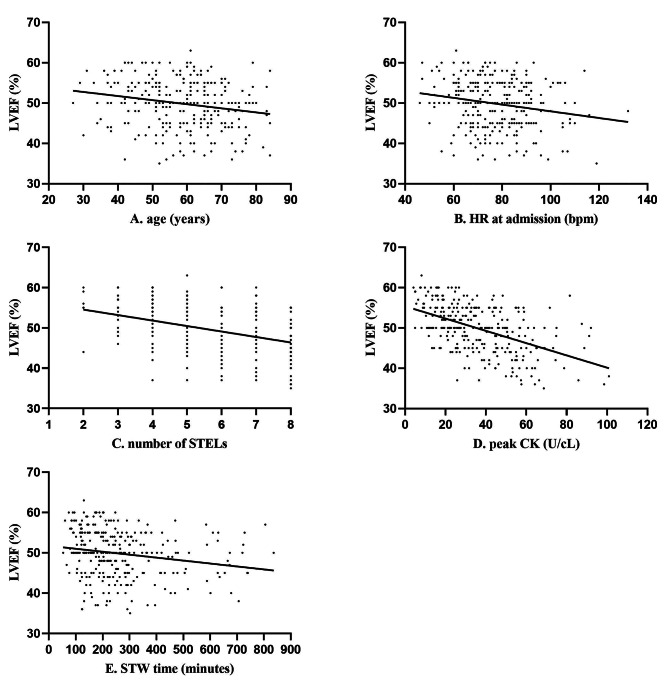
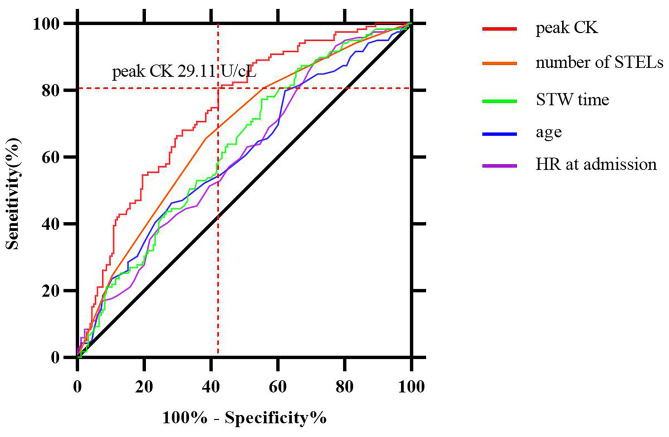
Age, heart rate (HR) at admission, number of ST-segment elevation leads (STELs), peak creatine kinase (CK) and symptom to wire-crossing (STW) time were independent risk factors for LVSD (P < 0.05). The receiver operating characteristic (ROC) analysis showed that the peak CK had the strongest predictive value for LVSD, with an area under the curve (AUC) of 0.742 (CI, 0.687 to 0.797) as the outcome. At a median follow-up of 47 months (interquartile range, 27 to 64 months), the Kaplan‒Meier survival curves up to 6-year follow-up revealed a total of 8 patients succumbed to cardiovascular disease, with 7 (6.54%) in the rLVEF group and 1 (0.56%) in the pLVEF group, respectively (hazard ratio: 12.11, [P = 0.02]). Univariate and multivariate Cox proportional hazards regression analysis demonstrated that rLVEF was an independent risk predictor of cardiovascular death in patients with AAW-STEMI discharged after PPCI (P < 0.01).
Age, HR at admission, number of STELs, peak CK, and STW time may be used to identify patients with a high risk of heart failure (HF) in a timely manner and initiate early standard therapy for incident LVSD in the acute phase of AAW-STEMI reperfused by PPCI. A trend toward increased cardiovascular mortality at follow-up was significantly linked to LVSD.
本研究旨在对行直接经皮冠状动脉介入治疗(PPCI)的急性前壁 ST 段抬高型心肌梗死(AAW-STEMI)患者中左前降支(LAD)完全闭塞并再通的患者进行回顾性分析,确定急性心肌梗死(AMI)急性期左心室收缩功能障碍(LVSD)的影响因素及预测价值。
选取 304 例 AAW-STEMI 患者,将入选患者分为射血分数保留组(LVEF≥50%,n=185)和射血分数降低组(LVEF<50%,n=119)。分析 LVSD 的影响因素及其对 LVSD 的预测价值。通过检查门诊记录和电话随访对患者进行随访。分析 LVSD 对 AAW-STEMI 患者心血管死亡率的预测价值。
年龄、入院时心率(HR)、ST 段抬高导联数(STELs)、肌酸激酶(CK)峰值、症状至导丝通过时间(STW)是 LVSD 的独立危险因素(P<0.05)。受试者工作特征(ROC)分析显示,CK 峰值对 LVSD 的预测价值最强,曲线下面积(AUC)为 0.742(CI:0.687 至 0.797)。中位随访 47 个月(IQR:27 至 64 个月),Kaplan-Meier 生存曲线至 6 年随访共 8 例患者死于心血管疾病,射血分数降低组 7 例(6.54%),射血分数保留组 1 例(0.56%)(危险比:12.11,P=0.02)。单因素和多因素 Cox 比例风险回归分析表明,射血分数降低是 PPCI 后出院的 AAW-STEMI 患者心血管死亡的独立危险因素(P<0.01)。
年龄、入院时 HR、STELs 数、CK 峰值和 STW 时间可用于及时识别行 PPCI 再通的 AAW-STEMI 患者发生心力衰竭(HF)的高危人群,并对急性阶段出现的 LVSD 进行早期标准治疗。随访中观察到心血管死亡率呈上升趋势与 LVSD 显著相关。