School of Biological Sciences, University of East Anglia, Norwich Research Park, Norwich, NR4 7TJ, UK.
BMC Biol. 2023 Jul 10;21(1):153. doi: 10.1186/s12915-023-01648-5.
The standard evolutionary theory of ageing proposes that ageing occurs because of a trade-off between reproduction and longevity. Eusocial insect queens exhibit positive fecundity-longevity associations and so have been suggested to be counter-examples through not expressing costs of reproduction and through remodelling conserved genetic and endocrine networks regulating ageing and reproduction. If so, eusocial evolution from solitary ancestors with negative fecundity-longevity associations must have involved a stage at which costs of reproduction were suppressed and fecundity and longevity became positively associated. Using the bumblebee (Bombus terrestris), we experimentally tested whether queens in annual eusocial insects at an intermediate level of eusocial complexity experience costs of reproduction, and, using mRNA-seq, the extent to which they exhibit a remodelling of relevant genetic and endocrine networks. Specifically, we tested whether costs of reproduction are present but latent, or whether a remodelling of relevant genetic and endocrine networks has already occurred allowing queens to reproduce without costs.
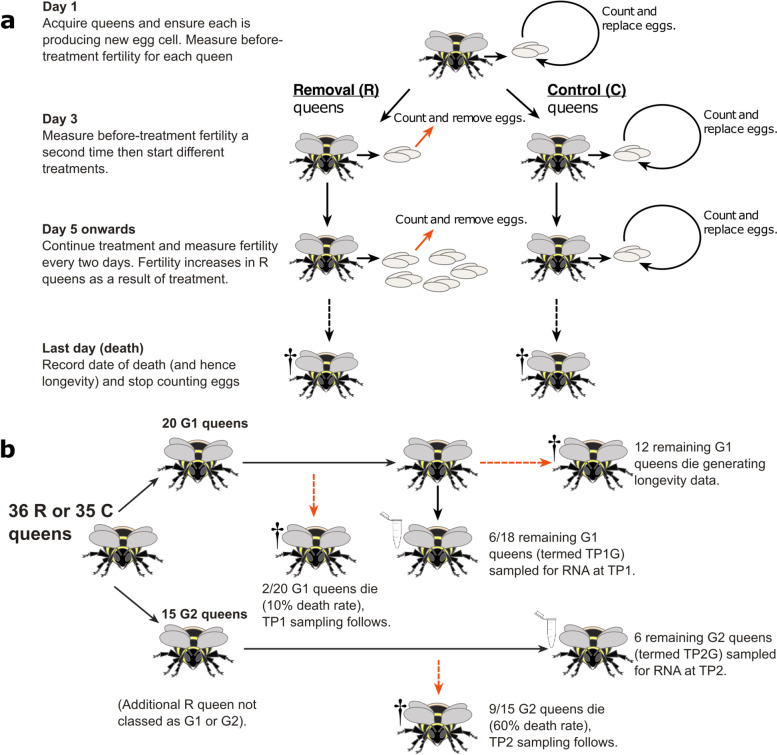
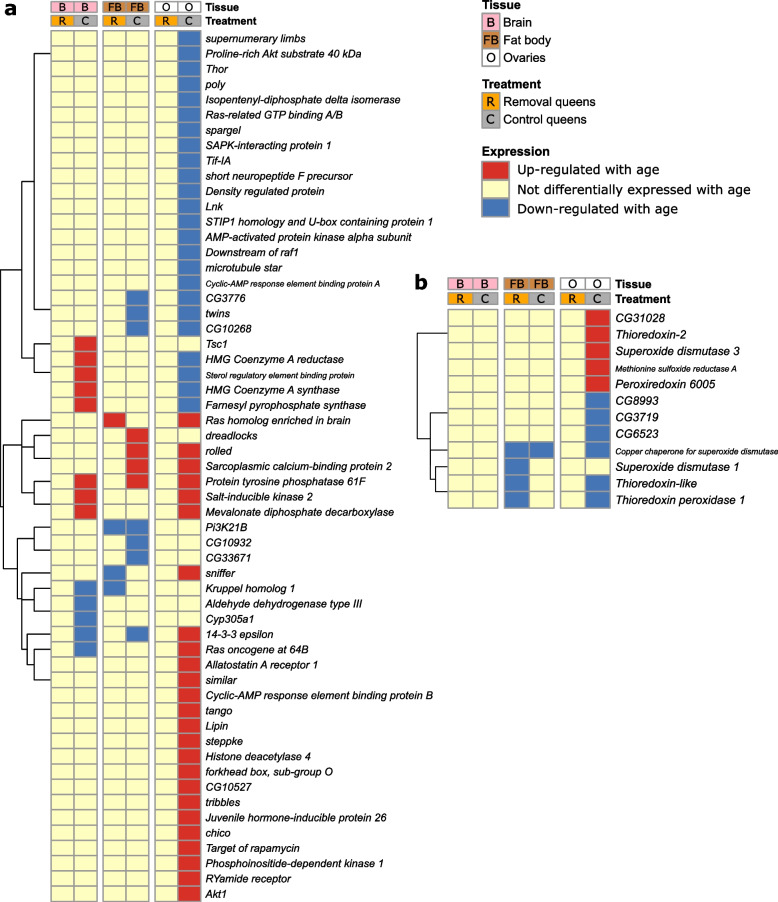
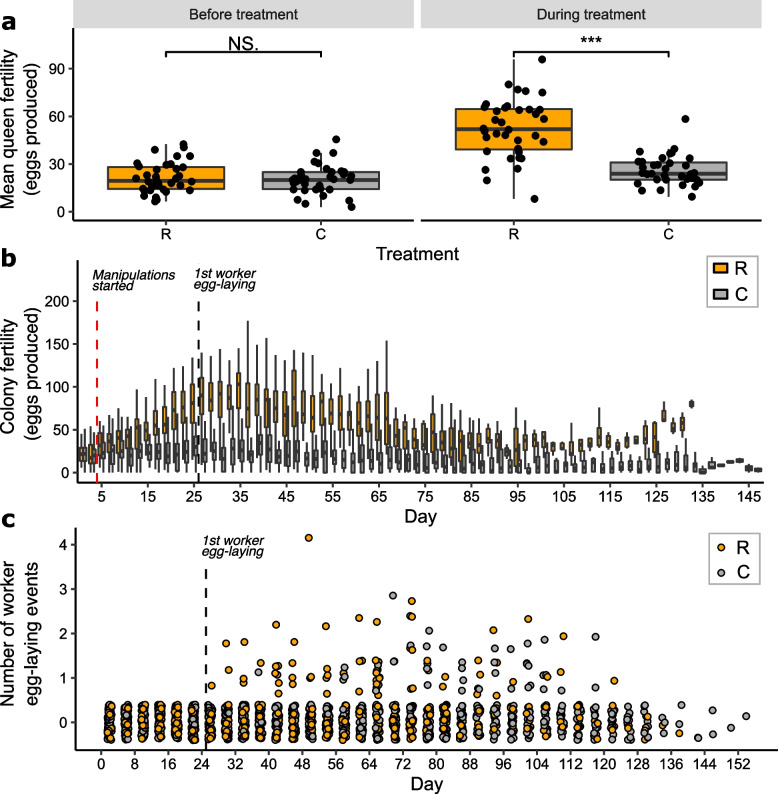
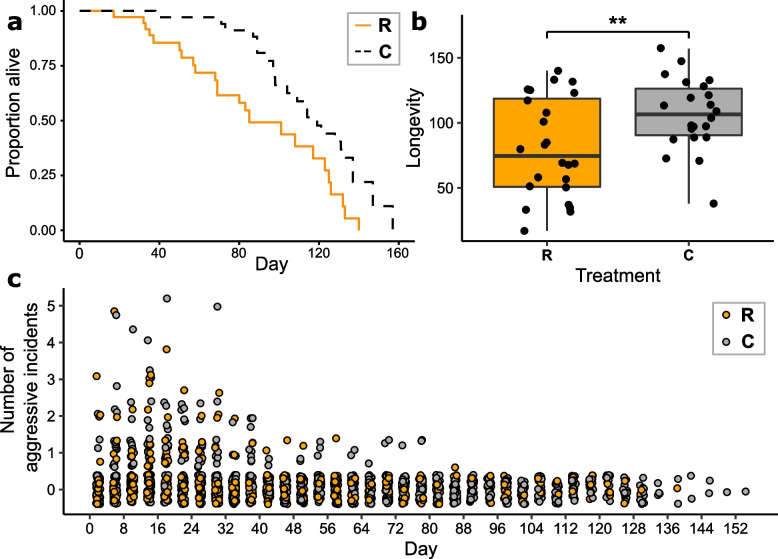
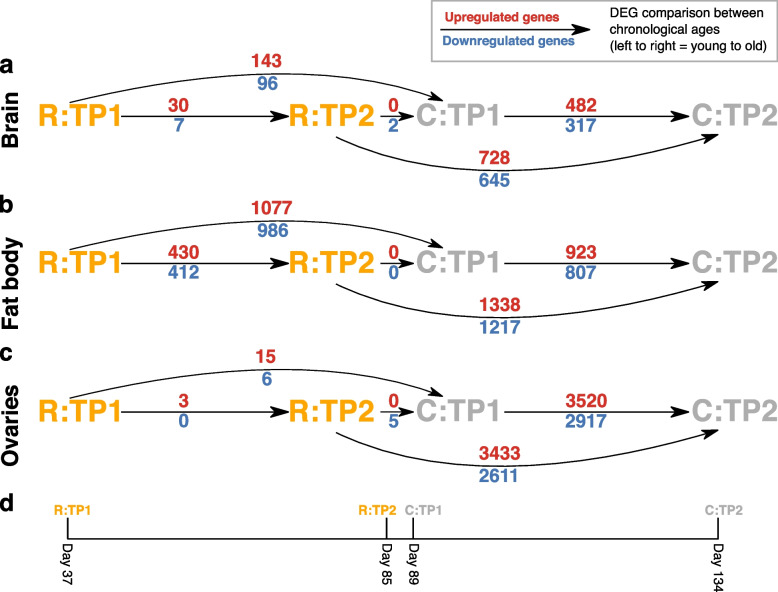
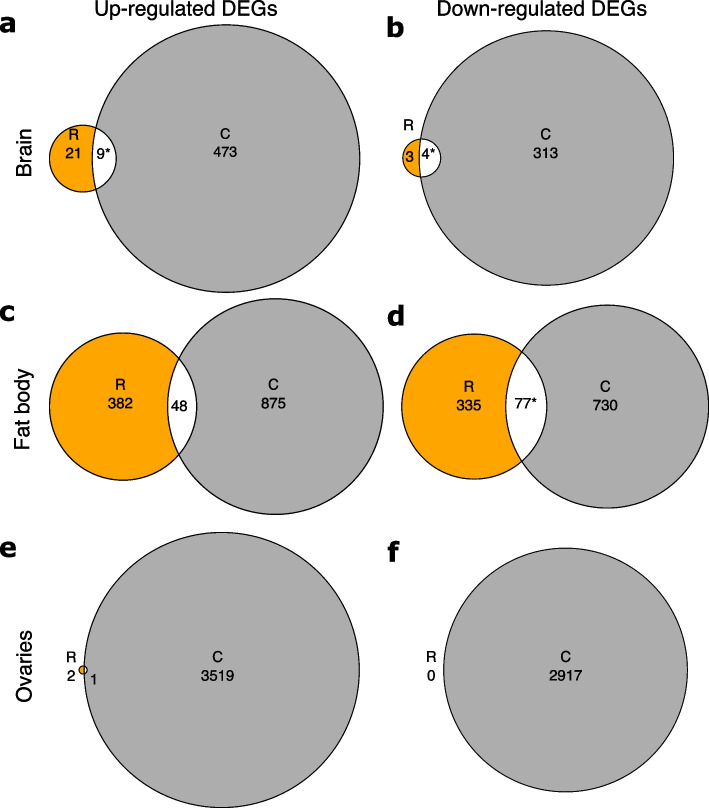
We experimentally increased queens' costs of reproduction by removing their eggs, which caused queens to increase their egg-laying rate. Treatment queens had significantly reduced longevity relative to control queens whose egg-laying rate was not increased. Reduced longevity in treatment queens was not caused by increased worker-to-queen aggression or by increased overall activity in queens. In addition, treatment and control queens differed in age-related gene expression based on mRNA-seq in both their overall expression profiles and the expression of ageing-related genes. Remarkably, these differences appeared to occur principally with respect to relative age, not chronological age.
This study represents the first simultaneously phenotypic and transcriptomic experimental test for a longevity cost of reproduction in eusocial insect queens. The results support the occurrence of costs of reproduction in annual eusocial insects of intermediate social complexity and suggest that reproductive costs are present but latent in queens of such species, i.e. that these queens exhibit condition-dependent positive fecundity-longevity associations. They also raise the possibility that a partial remodelling of genetic and endocrine networks underpinning ageing may have occurred in intermediately eusocial species such that, in unmanipulated conditions, age-related gene expression depends more on chronological than relative age.
标准的衰老进化论认为,衰老是由于繁殖和寿命之间的权衡造成的。社会性昆虫的女王表现出积极的繁殖-寿命关联,因此被认为是例外,因为它们不表现出繁殖的成本,并且通过重塑调节衰老和繁殖的保守遗传和内分泌网络来实现。如果是这样,那么从具有消极繁殖-寿命关联的独居祖先进化而来的社会性,一定经历了一个繁殖成本被抑制、繁殖力和寿命呈正相关的阶段。利用熊蜂(Bombus terrestris),我们通过实验测试了在社会性复杂性处于中等水平的一年生社会性昆虫的女王是否会经历繁殖成本,并且通过 mRNA 测序,测试了它们在多大程度上表现出相关遗传和内分泌网络的重塑。具体来说,我们测试了繁殖成本是存在但潜伏的,还是相关遗传和内分泌网络的重塑已经发生,从而使女王能够在没有成本的情况下进行繁殖。
我们通过去除女王的卵来实验性地增加了女王的繁殖成本,这导致女王增加了产卵率。处理组的女王与产卵率没有增加的对照组女王相比,寿命明显缩短。处理组女王的寿命缩短并不是因为工蜂对女王的攻击性增加,也不是因为女王的整体活动增加。此外,处理组和对照组女王在基于 mRNA 测序的年龄相关基因表达方面存在差异,无论是在整体表达谱还是在与衰老相关的基因表达方面。值得注意的是,这些差异似乎主要与相对年龄有关,而不是与实际年龄有关。
这项研究是首次对一年生社会性昆虫女王的繁殖对寿命的成本进行同时表型和转录组学的实验测试。结果支持在中等社会性复杂性的一年生社会性昆虫中存在繁殖成本,并且表明在这些物种的女王中存在但潜伏的繁殖成本,即这些女王表现出条件依赖性的积极繁殖-寿命关联。它们还提出了这样一种可能性,即衰老的遗传和内分泌网络的部分重塑可能已经发生在中等社会性物种中,以至于在未受干扰的情况下,年龄相关的基因表达更多地取决于实际年龄,而不是相对年龄。