Department of Cardiovascular Ultrasound, The First Hospital of China Medical University, No. 155 Nanjing Bei Street, Shenyang, 110001, Liaoning, China.
Clinical Medical Research Center of Imaging in Liaoning Province, Shenyang, Liaoning, China.
BMC Pulm Med. 2023 Jul 10;23(1):253. doi: 10.1186/s12890-023-02552-y.
The role of echocardiography in the diagnostic and prognostic assessment of pulmonary hypertension (PH) has been widely studied recently. However, these findings have not undergone normative evaluation and may provide confusing evidence for clinicians. To evaluate and summarize existing evidence, we performed an umbrella review.
Systematic reviews and meta-analyses were searched in PubMed, Embase, Web of Science, and Cochrane Library from inception to September 4, 2022. The methodological quality of the included studies was assessed using Assessment of Multiple Systematic Reviews (AMSTAR), and the Grading of Recommendations Assessment, Development and Evaluation (GRADE) system was used to evaluate the quality of evidence.
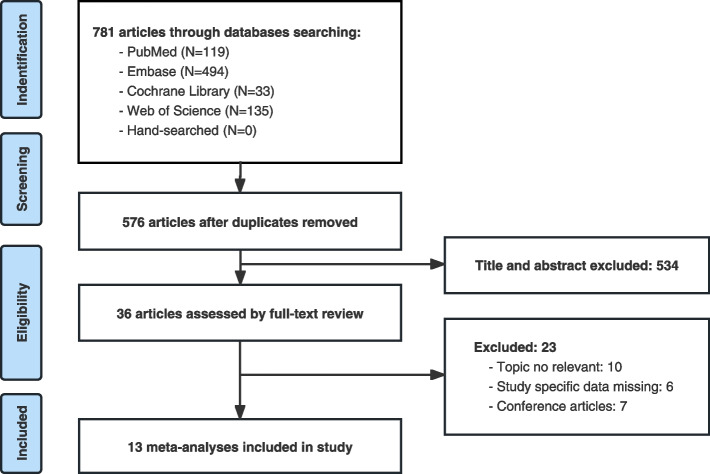
Thirteen meta-analyses (nine diagnostic and four prognostic studies) were included after searching four databases. The methodological quality of the included studies was rated as high (62%) or moderate (38%) by AMSTAR. The thirteen included meta-analyses involved a total of 28 outcome measures. The quality of evidence for these outcomes were high (7%), moderate (29%), low (39%), and very low (25%) using GRADE methodology. In the detection of PH, the sensitivity of systolic pulmonary arterial pressure is 0.85-0.88, and the sensitivity and specificity of right ventricular outflow tract acceleration time are 0.84. Pericardial effusion, right atrial area, and tricuspid annulus systolic displacement provide prognostic value in patients with pulmonary arterial hypertension with hazard ratios between 1.45 and 1.70. Meanwhile, right ventricular longitudinal strain has independent prognostic value in patients with PH, with a hazard ratio of 2.96-3.67.
The umbrella review recommends echocardiography for PH detection and prognosis. Systolic pulmonary arterial pressure and right ventricular outflow tract acceleration time can be utilized for detection, while several factors including pericardial effusion, right atrial area, tricuspid annular systolic displacement, and right ventricular longitudinal strain have demonstrated prognostic significance.
PROSPERO (CRD42022356091), https://www.crd.york.ac.uk/prospero/ .
超声心动图在肺动脉高压(PH)的诊断和预后评估中的作用最近得到了广泛研究。然而,这些发现尚未经过规范评估,可能会为临床医生提供令人困惑的证据。为了评估和总结现有证据,我们进行了伞式综述。
从建库到 2022 年 9 月 4 日,在 PubMed、Embase、Web of Science 和 Cochrane Library 中系统地检索了综述和荟萃分析。使用评估多项系统评价(AMSTAR)评估纳入研究的方法学质量,并使用推荐评估、制定与评价(GRADE)系统评估证据质量。
在搜索了四个数据库后,共纳入了 13 项荟萃分析(9 项诊断研究和 4 项预后研究)。纳入研究的方法学质量由 AMSTAR 评定为高(62%)或中(38%)。这 13 项纳入的荟萃分析共涉及 28 项结局指标。使用 GRADE 方法,这些结局的证据质量为高(7%)、中(29%)、低(39%)和极低(25%)。在 PH 的检测中,收缩期肺动脉压力的敏感性为 0.85-0.88,右心室流出道加速度时间的敏感性和特异性为 0.84。心包积液、右心房面积和三尖瓣环收缩期位移在肺动脉高压患者中具有预测价值,风险比在 1.45 到 1.70 之间。同时,右心室纵向应变在 PH 患者中有独立的预后价值,风险比为 2.96-3.67。
伞式综述推荐超声心动图用于 PH 的检测和预后。收缩期肺动脉压力和右心室流出道加速度时间可用于检测,而心包积液、右心房面积、三尖瓣环收缩期位移和右心室纵向应变等几个因素均具有预后意义。
PROSPERO(CRD42022356091),https://www.crd.york.ac.uk/prospero/ 。