Ma Hongmei, Li Xin, Wang Zhe, Qiao Qiao, Gao Yanfeng, Yuan Hui, Guan Bin, Guan Zheng
Department of Anesthesiology, the First Affiliated Hospital of Xi'an Jiaotong University, Xi'an, Shaanxi, China.
Department of Anesthesiology, Qinghai Provincial People's Hospital, Xining, Qinghai, China.
Perioper Med (Lond). 2023 Jul 10;12(1):33. doi: 10.1186/s13741-023-00327-x.
To investigate the effect of intraoperative goal-directed fluid therapy (GDFT) combined with enhanced recovery after surgery (ERAS) program on postoperative complications in elderly patients undergoing thoracoscopic pulmonary resection.
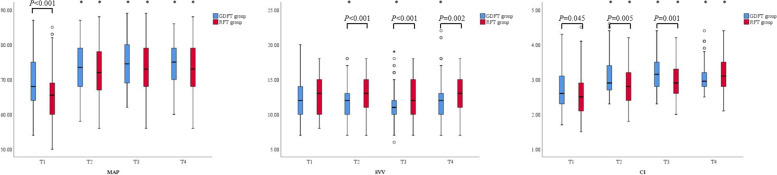
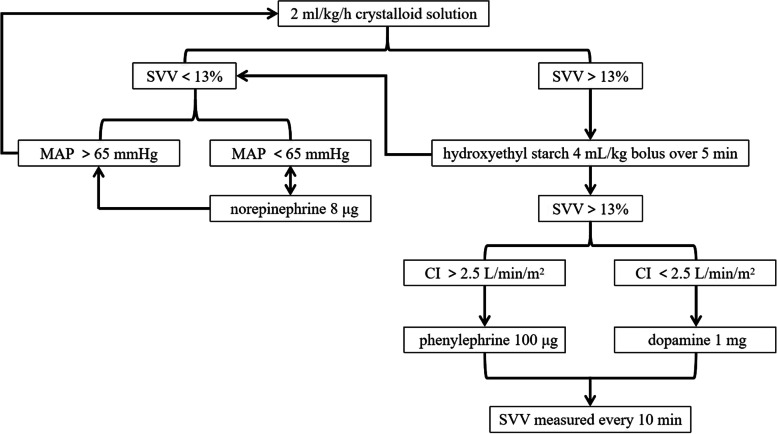
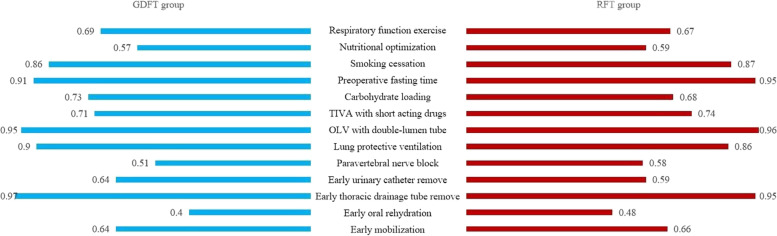
Patients, more than 60 years old, undergoing thoracoscopic pulmonary resection for non-small cell lung cancer were randomly divided into GDFT group and restrictive fluid therapy (RFT) group. ERAS program was implemented in all patients. In GDFT group, the intraoperative fluid management was guided by stroke volume variation (SVV), cardiac index (CI), and mean arterial pressure (MAP) and maintained the SVV < 13%, CI > 2.5 L/min/m, and MAP > 65 mmHg. In RFT group, fluid maintenance with 2 ml/kg/h of balanced crystalloid solution, norepinephrine was used to maintain MAP > 65 mmHg. The incidence of postoperative acute kidney injury (AKI) and pulmonary and cardiac complications was compared.
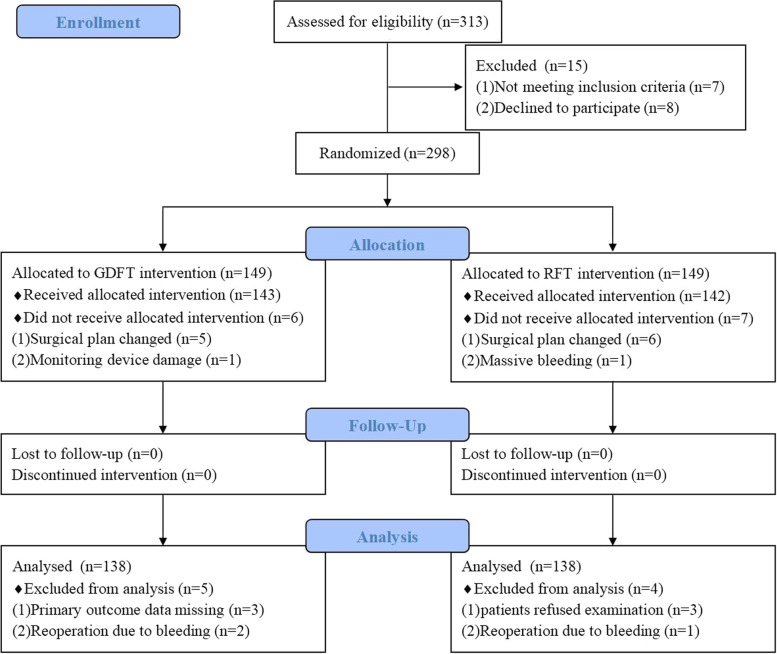
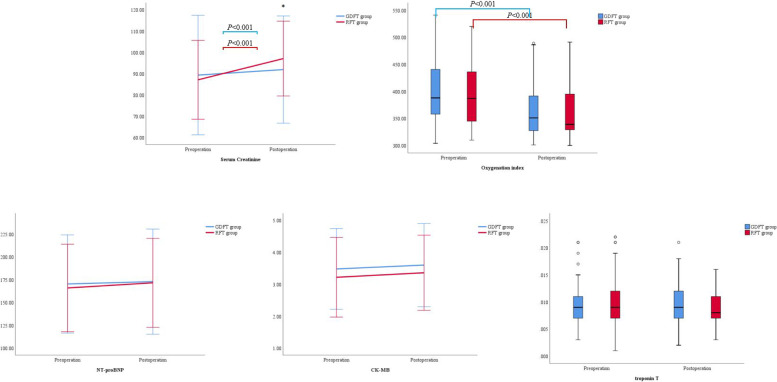
Two-hundred seventy-six patients were enrolled and randomly divided into two groups (138 in each group). Compared to RFT group, the total intraoperative infusion volume, colloids infusion volume, and urine output were more; the dosage of norepinephrine was lower in GDFT group. Although there were no significant differences of postoperative AKI (GDFT vs RFT; 4.3% vs 8%; P = 0.317) and composite postoperative complications (GDFT vs RFT; 66 vs 70) between groups, but the postoperative increase degree of serum creatinine was lower in GDFT group than that in RFT group (GDFT vs RFT; 91.9 ± 25.2 μmol/L vs 97.1 ± 17.6 μmol/L; P = 0.048).
Under ERAS program, there was no significant difference of AKI incidence between GDFT and RFT in elderly patients undergoing thoracoscopic pulmonary resection. But postoperative increase degree of serum creatinine was lower in GDFT group.
Registered at ClinicalTrials.gov, NCT04302467 on 26 February 2020.
探讨术中目标导向液体治疗(GDFT)联合术后加速康复(ERAS)方案对老年患者行胸腔镜肺切除术后并发症的影响。
将60岁以上行胸腔镜非小细胞肺癌肺切除术的患者随机分为GDFT组和限制性液体治疗(RFT)组。所有患者均实施ERAS方案。GDFT组术中液体管理以每搏量变异度(SVV)、心脏指数(CI)和平均动脉压(MAP)为指导,维持SVV<13%,CI>2.5L/(min·m²),MAP>65mmHg。RFT组以2ml/(kg·h)的平衡晶体液维持补液,使用去甲肾上腺素维持MAP>65mmHg。比较术后急性肾损伤(AKI)及肺部和心脏并发症的发生率。
共纳入276例患者并随机分为两组(每组138例)。与RFT组相比,GDFT组术中总输液量、胶体液输液量及尿量更多;GDFT组去甲肾上腺素用量更低。虽然两组术后AKI发生率(GDFT组 vs RFT组;4.3% vs 8%;P = 0.317)及术后综合并发症(GDFT组 vs RFT组;66例 vs 70例)无显著差异,但GDFT组术后血清肌酐升高程度低于RFT组(GDFT组 vs RFT组;91.9±25.2μmol/L vs 97.1±17.6μmol/L;P = 0.048)。
在ERAS方案下,老年胸腔镜肺切除患者GDFT组与RFT组的AKI发生率无显著差异。但GDFT组术后血清肌酐升高程度更低。
于2020年2月26日在ClinicalTrials.gov注册,注册号为NCT04302467。