
在采采蝇中开发家畜病原体锥虫(Nannomonas)simiae,并描述来自喙的可能有性阶段。
Development of the livestock pathogen Trypanosoma (Nannomonas) simiae in the tsetse fly with description of putative sexual stages from the proboscis.
机构信息
School of Biological Sciences, University of Bristol, Bristol, BS8 1TQ, UK.
Bristol Veterinary School, University of Bristol, Langford, Bristol, BS40 7DU, UK.
出版信息
Parasit Vectors. 2023 Jul 11;16(1):231. doi: 10.1186/s13071-023-05847-5.
BACKGROUND
Tsetse-transmitted African animal trypanosomiasis is recognised as an important disease of ruminant livestock in sub-Saharan Africa, but also affects domestic pigs, with Trypanosoma simiae notable as a virulent suid pathogen that can rapidly cause death. Trypanosoma simiae is widespread in tsetse-infested regions, but its biology has been little studied compared to T. brucei and T. congolense.
METHODS
Trypanosoma simiae procyclics were cultured in vitro and transfected using protocols developed for T. brucei. Genetically modified lines, as well as wild-type trypanosomes, were transmitted through tsetse flies, Glossina pallidipes, to study T. simiae development in the tsetse midgut, proventriculus and proboscis. The development of proventricular trypanosomes was also studied in vitro. Image and mensural data were collected and analysed.
RESULTS
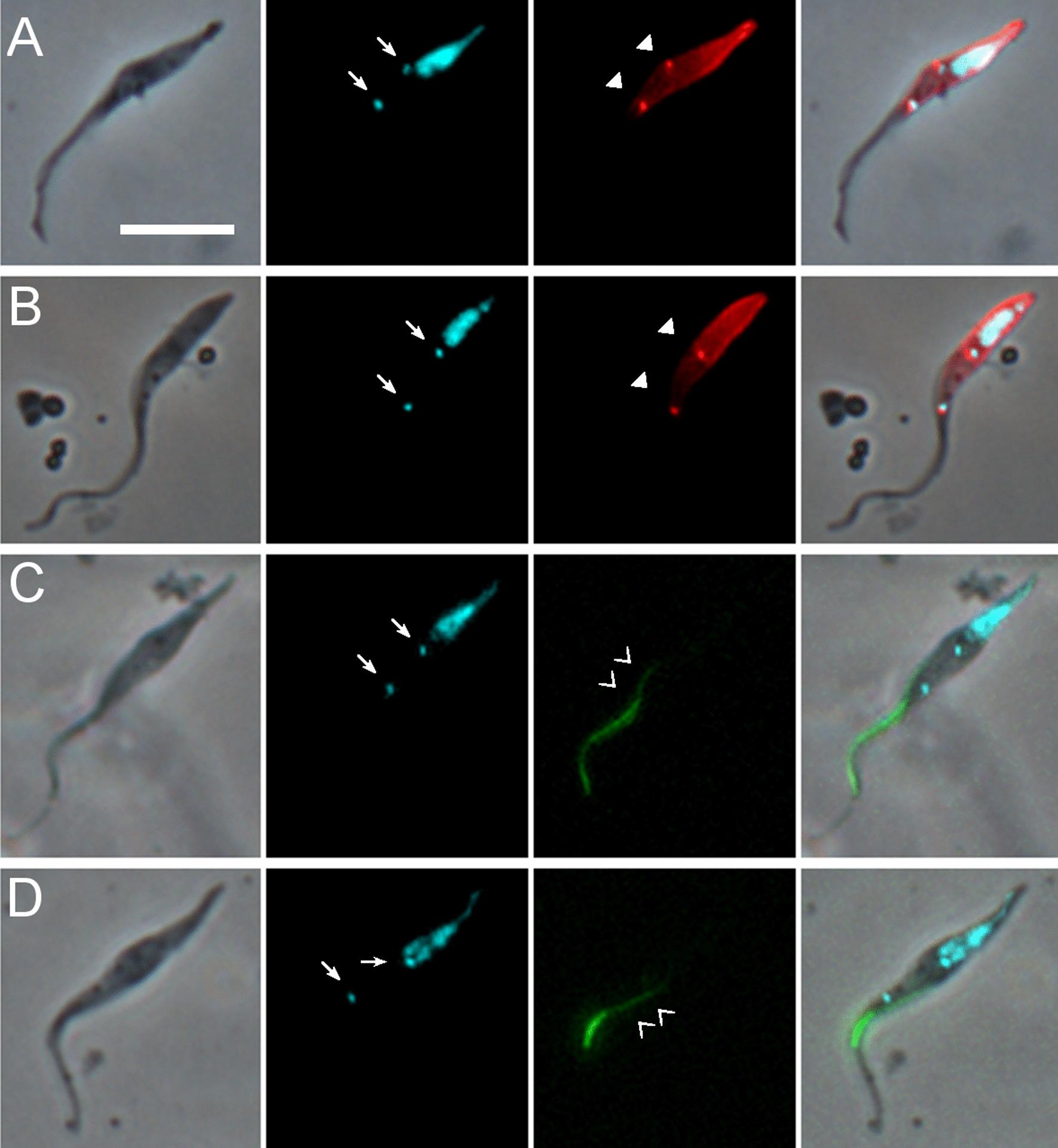
A PFR1::YFP line successfully completed development in tsetse, but a YFP::HOP1 line failed to progress beyond midgut infection. Analysis of image and mensural data confirmed that the vector developmental cycles of T. simiae and T. congolense are closely similar, but we also found putative sexual stages in T. simiae, as judged by morphological similarity to these stages in T. brucei. Putative meiotic dividers were abundant among T. simiae trypanosomes in the proboscis, characterised by a large posterior nucleus and two anterior kinetoplasts. Putative gametes and other meiotic intermediates were also identified by characteristic morphology. In vitro development of proventricular forms of T. simiae followed the pattern previously observed for T. congolense: long proventricular trypanosomes rapidly attached to the substrate and shortened markedly before commencing cell division.
CONCLUSIONS
To date, T. brucei is the only tsetse-transmitted trypanosome with experimentally proven capability to undergo sexual reproduction, which occurs in the fly salivary glands. By analogy, sexual stages of T. simiae or T. congolense are predicted to occur in the proboscis, where the corresponding portion of the developmental cycle takes place. While no such stages have been observed in T. congolense, for T. simiae putative sexual stages were abundant in the tsetse proboscis. Although our initial attempt to demonstrate expression of a YFP-tagged, meiosis-specific protein was unsuccessful, the future application of transgenic approaches will facilitate the identification of meiotic stages and hybrids in T. simiae.
背景
采采蝇传播的非洲动物锥虫病被认为是撒哈拉以南非洲反刍动物家畜的重要疾病,但也会影响家猪,其中食蟹猴锥虫是一种毒力很强的猪病原体,可迅速导致死亡。食蟹猴锥虫广泛存在于采采蝇滋生的地区,但与布氏锥虫和冈比亚锥虫相比,其生物学特性研究甚少。
方法
采用针对布氏锥虫开发的方案,对食蟹猴前鞭毛体进行体外培养和转染。通过冈比亚采采蝇( Glossina pallidipes )将遗传修饰株和野生型锥虫传播给动物,以研究食蟹猴在采采蝇中肠、前胃和喙部的发育情况。还在体外研究了前胃锥虫的发育情况。收集和分析图像和计量数据。
结果
成功构建了一个 PFR1::YFP 株,该株在采采蝇中完成了发育,但 YFP::HOP1 株未能在中肠感染后进一步发育。图像和计量数据分析证实,食蟹猴和冈比亚锥虫的媒介发育周期非常相似,但我们也发现了食蟹猴中可能存在的有性阶段,这些阶段与布氏锥虫中的这些阶段形态相似。在喙中,大量的有丝分裂分隔器存在于食蟹猴锥虫中,其特征是一个大的后核和两个前动基体。通过特征形态也鉴定了可能的配子和其他有丝分裂中间体。食蟹猴前胃型的体外发育遵循以前观察到的冈比亚锥虫的模式:长前胃锥虫迅速附着在基质上,并在开始细胞分裂前显著缩短。
结论
迄今为止,布氏锥虫是唯一一种经实验证明具有有性生殖能力的采采蝇传播锥虫,这种有性生殖发生在蝇类的唾液腺中。类比来看,食蟹猴或冈比亚锥虫的有性阶段预计发生在喙中,这是发育周期的相应部分。虽然在冈比亚锥虫中没有观察到这样的阶段,但在食蟹猴中,有性阶段在采采蝇的喙中大量存在。虽然我们最初尝试证明一个 YFP 标记的、减数分裂特异性蛋白的表达是不成功的,但未来应用转基因方法将有助于鉴定食蟹猴减数分裂阶段和杂种。



 Zotero 插件