Contreras Angulo Macarena, García Izquierdo Belén, Armengod Grao Laura, Palacios García Nuria
Department of Endocrinology and Nutrition, Puerta de Hierro University Hospital, Majadahonda, Madrid, Spain.
Endocr Oncol. 2023 Feb 13;3(1):e220078. doi: 10.1530/EO-22-0078. eCollection 2023 Jan 1.
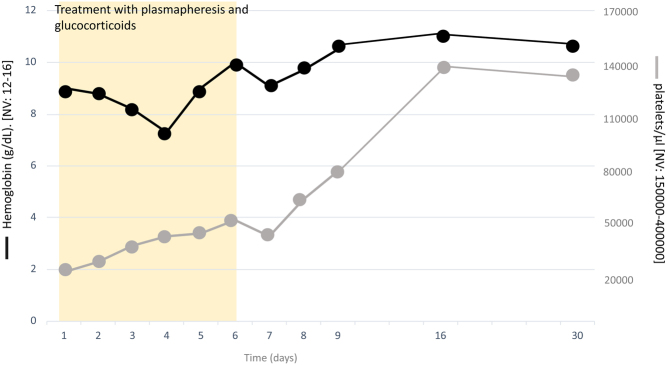
Systemic thrombotic microangiopathy (TMA) is a serious condition whose early treatment is essential to reduce morbidity and mortality. TMA with only renal involvement has been associated with tyrosine kinase inhibitors, including lenvatinib, a drug used for certain advanced neoplasms. To date, TMA with systemic involvement associated with this drug has not been described. We present the case of a patient with progressive metastatic thyroid cancer who developed this complication after starting treatment with lenvatinib. We describe the signs and symptoms that led to the diagnosis and the treatment required for her recovery.
Thrombotic microangiopathy (TMA) is a group of disorders characterized by thrombosis in capillaries and arterioles due to an endothelial injury. Both, localized and systemic forms have been described.TMA with systemic involvement is characterized by hemolytic anemia, low platelets, and organ damage.Vascular endothelial growth factor signaling inhibitors have been associated with TMA, either restricted to the kidney or with systemic involvement.Lenvatinib has been rarely associated with TMA. Although only forms with isolated or predominantly renal involvement had been described so far, a predominantly systemic form can occur.Lenvatinib-induced systemic TMA must be distinguished from primary forms by measuring ADAMTS-13. Treatment includes discontinuation of the drug and supportive measures.When anemia and thrombocytopenia coexist in a patient receiving treatment with lenvatinib, a peripheral blood smear to exclude TMA is recommended.
系统性血栓性微血管病(TMA)是一种严重疾病,早期治疗对于降低发病率和死亡率至关重要。仅累及肾脏的TMA与酪氨酸激酶抑制剂有关,包括用于某些晚期肿瘤的药物乐伐替尼。迄今为止,尚未描述与该药物相关的全身性累及的TMA。我们报告一例进展性转移性甲状腺癌患者,在开始使用乐伐替尼治疗后发生了这种并发症。我们描述了导致诊断的体征和症状以及她康复所需的治疗。
血栓性微血管病(TMA)是一组以内皮损伤导致毛细血管和小动脉血栓形成的疾病。已描述了局限性和全身性两种形式。全身性累及的TMA的特征为溶血性贫血、血小板减少和器官损伤。血管内皮生长因子信号抑制剂与TMA有关,可局限于肾脏或全身性累及。乐伐替尼很少与TMA相关。尽管迄今为止仅描述了孤立性或主要累及肾脏的形式,但也可出现主要累及全身的形式。必须通过检测ADAMTS-13将乐伐替尼诱导的全身性TMA与原发性形式区分开来。治疗包括停用药物和支持性措施。当接受乐伐替尼治疗的患者同时存在贫血和血小板减少时,建议进行外周血涂片检查以排除TMA。