Schmidt Daniel, Kollan Christian, Schewe Knud, Hanhoff Nikola, Rüsenberg Robin, Friebe Martin, Schikowski Tim, Schink Susanne Barbara, Marcus Ulrich, Koppe Uwe, Jansen Klaus, Streeck Hendrik, Ottensmeyer Patrick, An der Heiden Matthias, Bannert Norbert, M'Bayo Rosaline, Ceres Maia, Weber Lukas, Sweers Holger, Schmidt Axel Jeremias, Tietz Helge, Danan Emmanuel, Bendig Jörg, Kloep Stephan, Neumann Anja, Valbert Frederik, Wasem Jürgen, Bartmeyer Barbara, Bremer Viviane
Fachgebiet HIV/AIDS und andere sexuell oder durch Blut übertragbare Infektionen, Abteilung für Infektionsepidemiologie, Robert Koch-Institut Berlin, Berlin, Deutschland.
Deutsche Arbeitsgemeinschaft ambulant tätiger Ärztinnen und Ärzte für Infektionskrankheiten und HIV-Medizin e. V. (dagnä), Berlin, Deutschland.
Bundesgesundheitsblatt Gesundheitsforschung Gesundheitsschutz. 2023 Sep;66(9):1008-1018. doi: 10.1007/s00103-023-03733-0. Epub 2023 Jul 12.
We investigated the impact of HIV pre-exposure prophylaxis (PrEP) as a new service of the statutory health insurance (SHI) on the incidence of HIV and other sexually transmitted infections (STIs) in Germany. In addition, PrEP needs and access barriers were analyzed.
The following data were evaluated as part of the evaluation project: HIV and syphilis notification data and extended surveillance by the Robert Koch Institute (RKI), pharmacy prescription data, SHI routine data, PrEP use in HIV-specialty care centers, Checkpoint, the BRAHMS and PrApp studies, as well as a community board.
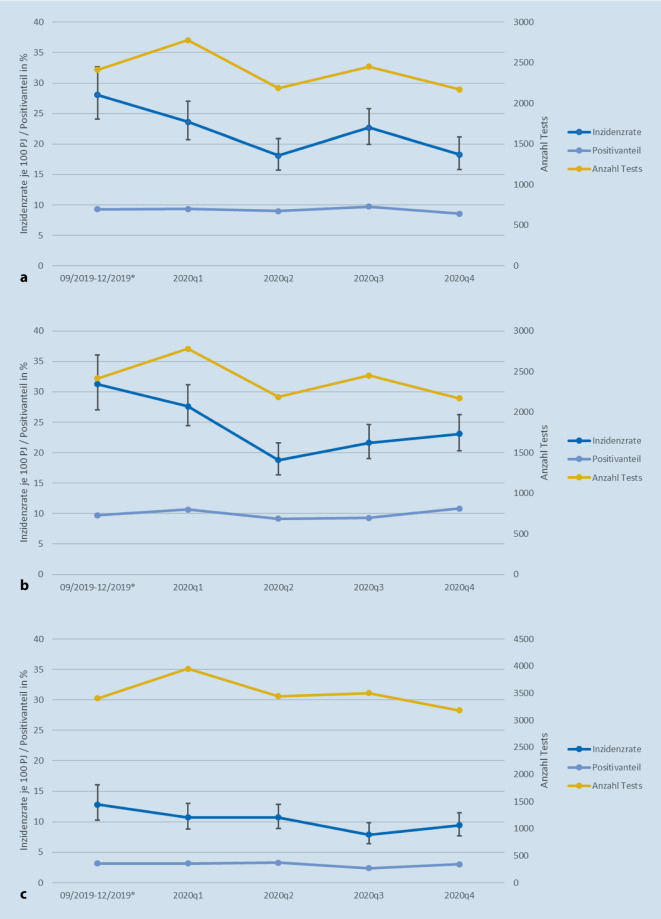
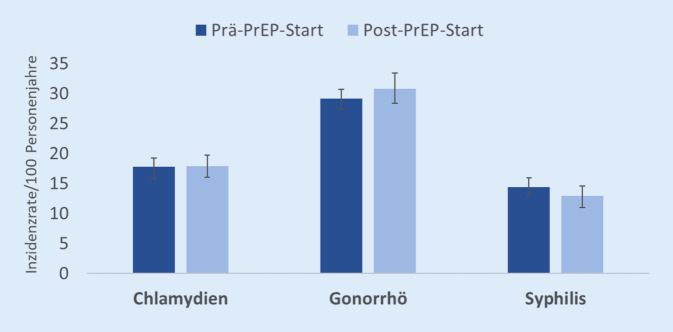
The majority of PrEP users were male (98-99%), primarily aged between 25-45 years, and predominantly of German nationality or origin (67-82%). The majority were men who have sex with men (99%). With regard to HIV infections, PrEP proved to be highly effective. There were only isolated cases of HIV infections (HIV incidence rate 0.08/100 person years); in most cases the suspected reason was low adherence. The incidences of chlamydia, gonorrhea, and syphilis did not increase but remained almost the same or even decreased. A need for information on PrEP for people in trans*/non-binary communities, sex workers, migrants, and drug users emerged. Needs-based services for target groups at increased risk of HIV are necessary.
PrEP proved to be a very effective HIV prevention method. The partly feared indirect negative influences on STI rates were not confirmed in this study. Due to the temporal overlap with the containment measures during the COVID-19 pandemic, a longer observation period would be desirable for a conclusive assessment.
我们调查了作为法定健康保险(SHI)一项新服务的HIV暴露前预防(PrEP)对德国HIV及其他性传播感染(STIs)发病率的影响。此外,还分析了PrEP的需求及获取障碍。
作为评估项目的一部分,对以下数据进行了评估:HIV和梅毒通报数据以及罗伯特·科赫研究所(RKI)的扩展监测数据、药房处方数据、SHI常规数据、HIV专科护理中心的PrEP使用情况、Checkpoint、BRAHMS和PrApp研究以及一个社区委员会。
大多数PrEP使用者为男性(98 - 99%),主要年龄在25 - 45岁之间,且大多具有德国国籍或德国血统(67 - 82%)。大多数是男男性行为者(99%)。就HIV感染而言,PrEP被证明非常有效。仅有个别HIV感染病例(HIV发病率为0.08/100人年);在大多数情况下,疑似原因是依从性低。衣原体、淋病和梅毒的发病率没有增加,而是几乎保持不变甚至有所下降。出现了为跨性别/非二元性别群体、性工作者、移民和吸毒者提供PrEP信息的需求。有必要为HIV感染风险增加的目标群体提供基于需求的服务。
PrEP被证明是一种非常有效的HIV预防方法。本研究未证实部分人担心的对性传播感染率的间接负面影响。由于与COVID - 19大流行期间的防控措施存在时间重叠,为得出结论性评估,需要更长的观察期。