Homma Kanji, Kaneko Satoshi, Tsukagoshi Kazuhito, Nishino Tomoaki
Department of Chemistry, School of Science, Tokyo Institute of Technology, 2-12-1 W4-10 Ookayama, Meguro-ku, Tokyo 152-8551, Japan.
International Center for Materials Nanoarchitectonics (WPI-MANA), National Institute for Materials Science (NIMS), 1-1 Namiki, Tsukuba, Ibaraki 305-0044, Japan.
J Am Chem Soc. 2023 Jul 26;145(29):15788-15795. doi: 10.1021/jacs.3c02050. Epub 2023 Jul 12.
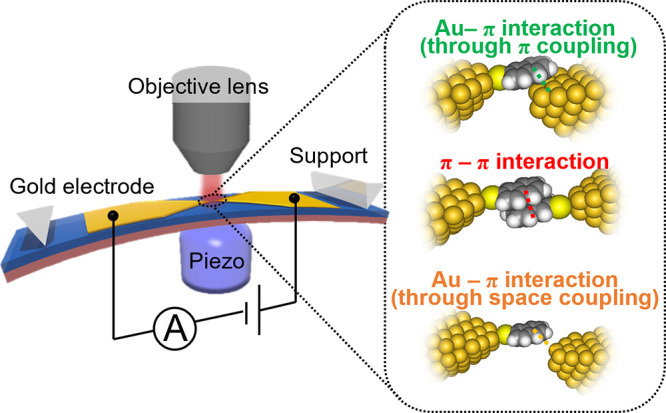
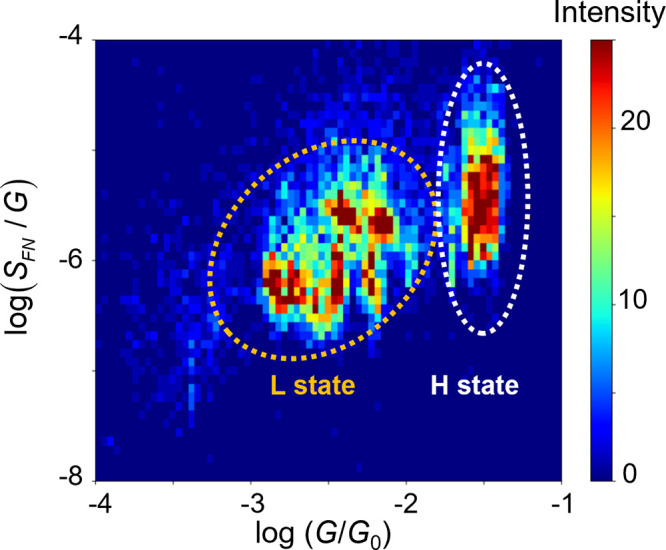
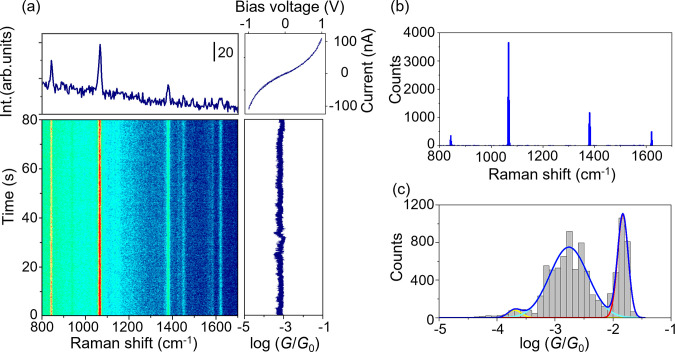
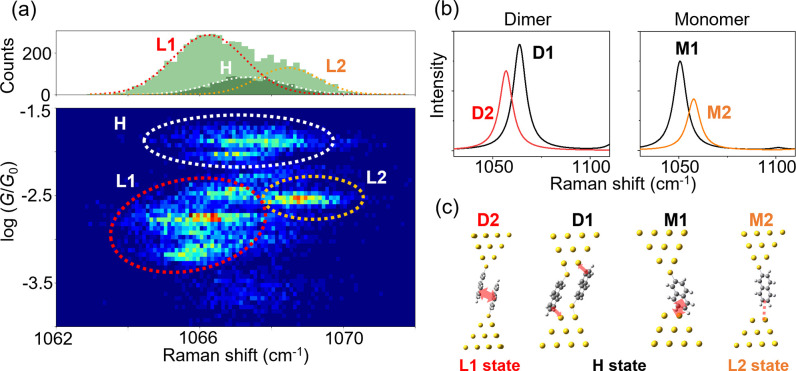
Electron transport through noncovalent interaction is of fundamental and practical importance in nanomaterials and nanodevices. Recent single-molecule studies employing single-molecule junctions have revealed unique electron transport properties through noncovalent interactions, especially those through a π-π interaction. However, the relationship between the junction structure and electron transport remains elusive due to the insufficient knowledge of geometric structures. In this article, we employ surface-enhanced Raman scattering (SERS) synchronized with current-voltage (-) measurements to characterize the junction structure, together with the transport properties, of a single dimer and monomer junction of naphthalenethiol, the former of which was formed by the intermolecular π-π interaction. The correlation analysis of the vibrational energy and electrical conductance enables identifying the intermolecular and molecule-electrode interactions in these molecular junctions and, consequently, addressing the transport properties exclusively associated with the π-π interaction. In addition, the analysis achieved discrimination of the interaction between the NT molecule and the Au electrode of the junction, i.e., Au-π interactions through-π coupling and though-space coupling. The power density spectra support the noncovalent character at the interfaces in the molecular junctions. These results demonstrate that the simultaneous SERS and - technique provides a unique means for the structural and electrical investigation of noncovalent interactions.
通过非共价相互作用进行的电子传输在纳米材料和纳米器件中具有重要的基础和实际意义。最近利用单分子结进行的单分子研究揭示了通过非共价相互作用(特别是通过π-π相互作用)的独特电子传输特性。然而,由于对几何结构的了解不足,结结构与电子传输之间的关系仍然难以捉摸。在本文中,我们采用与电流-电压(I-V)测量同步的表面增强拉曼散射(SERS)来表征萘硫醇单二聚体和单分子结的结结构以及传输特性,其中前者是通过分子间π-π相互作用形成的。对振动能量和电导的相关分析能够识别这些分子结中的分子间和分子-电极相互作用,从而确定仅与π-π相互作用相关的传输特性。此外,该分析实现了对NT分子与结的金电极之间相互作用的区分,即通过π耦合和空间耦合的Au-π相互作用。功率密度谱支持分子结界面处的非共价特性。这些结果表明,同步SERS和I-V技术为非共价相互作用的结构和电学研究提供了一种独特的方法。