Australian Institute of Health Innovation, Macquarie University, 75 Talavera Rd, Macquarie Park, New South Wales 2109, Australia.
IIMPACT in Health, Allied Health and Human Performance, University of South Australia, GPO Box 2471, Adelaide, South Australia 5001, Australia.
Int J Qual Health Care. 2023 Jul 25;35(3). doi: 10.1093/intqhc/mzad056.
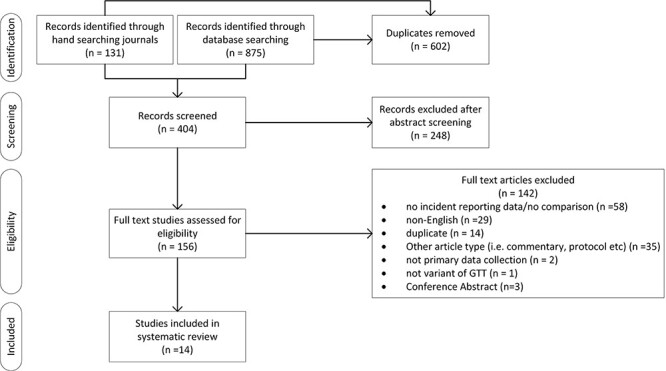
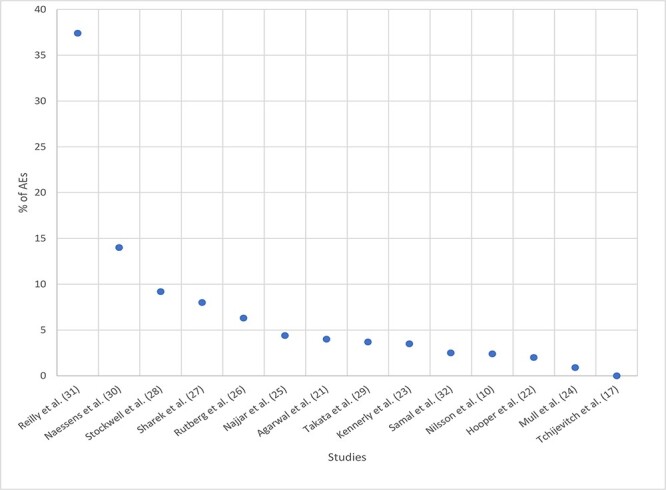
Many hospitals continue to use incident reporting systems (IRSs) as their primary patient safety data source. The information IRSs collect on the frequency of harm to patients [adverse events (AEs)] is generally of poor quality, and some incident types (e.g. diagnostic errors) are under-reported. Other methods of collecting patient safety information using medical record review, such as the Global Trigger Tool (GTT), have been developed. The aim of this study was to undertake a systematic review to empirically quantify the gap between the percentage of AEs detected using the GTT to those that are also detected via IRSs. The review was conducted in adherence to the Preferred Reporting Items for Systematic Reviews and Meta-Analyses (PRISMA) statement. Studies published in English, which collected AE data using the GTT and IRSs, were included. In total, 14 studies met the inclusion criteria. All studies were undertaken in hospitals and were published between 2006 and 2022. The studies were conducted in six countries, mainly in the USA (nine studies). Studies reviewed 22 589 medical records using the GTT across 107 institutions finding 7166 AEs. The percentage of AEs detected using the GTT that were also detected in corresponding IRSs ranged from 0% to 37.4% with an average of 7.0% (SD 9.1; median 3.9 and IQR 5.2). Twelve of the fourteen studies found <10% of the AEs detected using the GTT were also found in corresponding IRSs. The >10-fold gap between the detection rates of the GTT and IRSs is strong evidence that the rate of AEs collected in IRSs in hospitals should not be used to measure or as a proxy for the level of safety of a hospital. IRSs should be recognized for their strengths which are to detect rare, serious, and new incident types and to enable analysis of contributing and contextual factors to develop preventive and corrective strategies. Health systems should use multiple patient safety data sources to prioritize interventions and promote a cycle of action and improvement based on data rather than merely just collecting and analysing information.
许多医院继续使用事件报告系统(IRS)作为其主要的患者安全数据来源。IRS 收集的关于患者伤害频率(不良事件[AE])的信息质量通常较差,并且一些事件类型(例如诊断错误)报告不足。已经开发了其他使用病历审查收集患者安全信息的方法,例如全球触发工具(GTT)。本研究的目的是进行系统评价,从实证上量化使用 GTT 检测到的 AE 百分比与 IRS 检测到的 AE 百分比之间的差距。该审查是按照系统评价和荟萃分析的首选报告项目(PRISMA)声明进行的。纳入了使用 GTT 和 IRS 收集 AE 数据的以英语发表的研究。共有 14 项研究符合纳入标准。所有研究均在医院进行,发表于 2006 年至 2022 年期间。这些研究在六个国家进行,主要在美国(九项研究)。研究人员使用 GTT 审查了 22589 份病历,在 107 家机构中发现了 7166 例 AE。使用 GTT 检测到的 AE 中,在相应 IRS 中也检测到的 AE 百分比范围为 0%至 37.4%,平均为 7.0%(SD 9.1;中位数 3.9 和 IQR 5.2)。14 项研究中有 12 项发现使用 GTT 检测到的 AE 中<10%也在相应 IRS 中发现。GTT 和 IRS 检测率之间超过 10 倍的差距有力地证明,医院 IRS 中收集的 AE 率不应用于衡量或作为医院安全性水平的替代指标。IRS 应因其优势而得到认可,这些优势包括检测罕见、严重和新的事件类型,并能够分析促成因素和背景因素,以制定预防和纠正策略。卫生系统应使用多种患者安全数据源来优先干预措施,并根据数据而不仅仅是收集和分析信息来促进行动和改进周期。