Zhu Xiao, Fan Chenyang, Xiong Zhuolong, Chen Mingwei, Li Zesong, Tao Tao, Liu Xiuqing
Zhejiang Provincial People's Hospital Affiliated to Hangzhou Medical College, Hangzhou Medical College, Hangzhou, China.
The Marine Biomedical Research Institute, Guangdong Medical University, Zhanjiang, China.
Front Microbiol. 2023 Jun 12;14:1188526. doi: 10.3389/fmicb.2023.1188526. eCollection 2023.
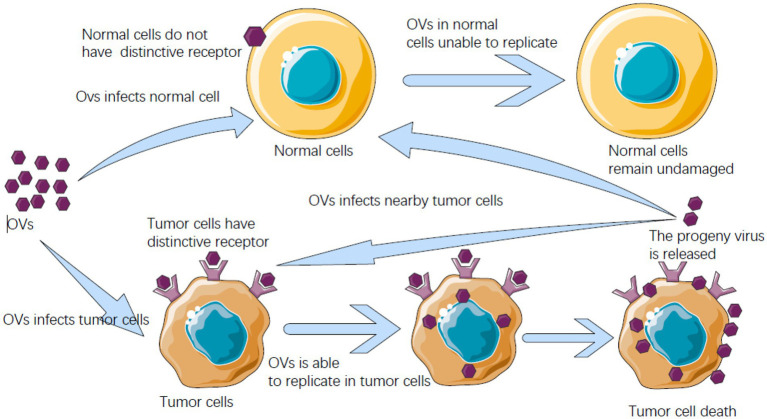
Viruses and tumors are two pathologies that negatively impact human health, but what occurs when a virus encounters a tumor? A global consensus among cancer patients suggests that surgical resection, chemotherapy, radiotherapy, and other methods are the primary means to combat cancer. However, with the innovation and development of biomedical technology, tumor biotherapy (immunotherapy, molecular targeted therapy, gene therapy, oncolytic virus therapy, etc.) has emerged as an alternative treatment for malignant tumors. Oncolytic viruses possess numerous anti-tumor properties, such as directly lysing tumor cells, activating anti-tumor immune responses, and improving the tumor microenvironment. Compared to traditional immunotherapy, oncolytic virus therapy offers advantages including high killing efficiency, precise targeting, and minimal side effects. Although oncolytic virus (OV) therapy was introduced as a novel approach to tumor treatment in the 19th century, its efficacy was suboptimal, limiting its widespread application. However, since the U.S. Food and Drug Administration (FDA) approved the first OV therapy drug, T-VEC, in 2015, interest in OV has grown significantly. In recent years, oncolytic virus therapy has shown increasingly promising application prospects and has become a major research focus in the field of cancer treatment. This article reviews the development, classification, and research progress of oncolytic viruses, as well as their mechanisms of action, therapeutic methods, and routes of administration.
病毒和肿瘤是对人类健康产生负面影响的两种病理状况,但是当病毒遇到肿瘤时会发生什么呢?癌症患者的普遍共识是,手术切除、化疗、放疗和其他方法是对抗癌症的主要手段。然而,随着生物医学技术的创新和发展,肿瘤生物疗法(免疫疗法、分子靶向疗法、基因疗法、溶瘤病毒疗法等)已成为恶性肿瘤的一种替代治疗方法。溶瘤病毒具有多种抗肿瘤特性,例如直接裂解肿瘤细胞、激活抗肿瘤免疫反应以及改善肿瘤微环境。与传统免疫疗法相比,溶瘤病毒疗法具有杀伤效率高、靶向精准和副作用小等优点。尽管溶瘤病毒(OV)疗法在19世纪就作为一种新型肿瘤治疗方法被提出,但其疗效并不理想,限制了其广泛应用。然而,自美国食品药品监督管理局(FDA)在2015年批准首款OV疗法药物T-VEC以来,人们对OV的兴趣显著增长。近年来,溶瘤病毒疗法展现出越来越广阔的应用前景,并已成为癌症治疗领域的一个主要研究重点。本文综述了溶瘤病毒的发展、分类和研究进展,以及它们的作用机制、治疗方法和给药途径。