Jang Ji-Hun, Jeong Seung-Hyun, Lee Yong-Bok
Department of Pharmacy, College of Pharmacy, Chonnam National University, Gwangju, 61186, Republic of Korea.
Department of Pharmacy, College of Pharmacy, Sunchon National University, Suncheon-si, 57922, Republic of Korea.
J Pharm Anal. 2023 Jun;13(6):660-672. doi: 10.1016/j.jpha.2023.04.001. Epub 2023 Apr 6.
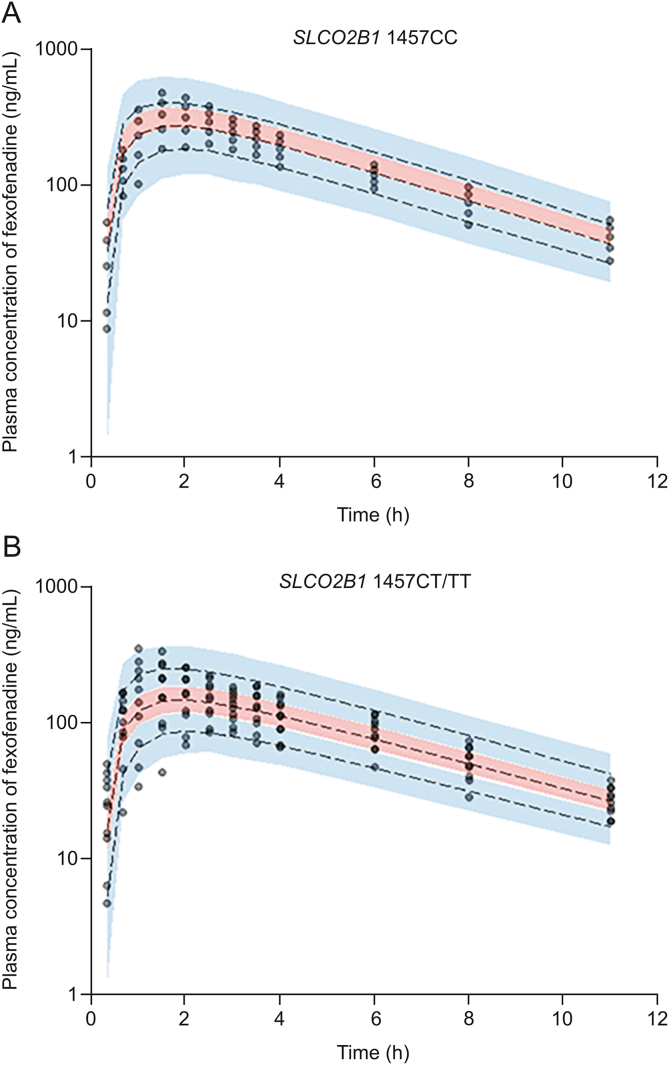
Fexofenadine is useful in various allergic disease treatment. However, the pharmacokinetic variability information and quantitative factor identification of fexofenadine are very lacking. This study aimed to verify the validity of previously proposed genetic factors through fexofenadine population pharmacokinetic modeling and to explore the quantitative correlations affecting the pharmacokinetic variability. Polymorphisms of the organic-anion-transporting-polypeptide (OATP) 1B1 and 2B1 have been proposed to be closely related to fexofenadine pharmacokinetic diversity. Therefore, modeling was performed using fexofenadine oral exposure data according to the OATP1B1- and 2B1-polymorphisms. OATP1B1 and 2B1 were identified as effective covariates of clearance (CL/F) and distribution volume (V/F)-CL/F, respectively, in fexofenadine pharmacokinetic variability. CL/F and average steady-state plasma concentration of fexofenadine differed by up to 2.17- and 2.20-folds, respectively, depending on the OATP1B1 polymorphism. Among the individuals with different OATP2B1 polymorphisms, the CL/F and V/F differed by up to 1.73- and 2.00-folds, respectively. Ratio of the areas under the curves following single- and multiple-administrations, and the cumulative ratio were significantly different between OATP1B1- and 2B1-polymorphism groups. Based on quantitative prediction comparison through a model-based approach, OATP1B1 was confirmed to be relatively more important than 2B1 regarding the degree of effect on fexofenadine pharmacokinetic variability. Based on the established pharmacokinetic-pharmacodynamic relationship, the difference in fexofenadine efficacy according to genetic polymorphisms of OATP1B1 and 2B1 was 1.25- and 0.87-times, respectively, and genetic consideration of OATP1B1 was expected to be important in the pharmacodynamics area as well. This population pharmacometrics study will be a very useful starting point for fexofenadine precision medicine.
非索非那定在各种过敏性疾病治疗中很有用。然而,非索非那定的药代动力学变异性信息以及定量因素识别非常缺乏。本研究旨在通过非索非那定群体药代动力学建模验证先前提出的遗传因素的有效性,并探索影响药代动力学变异性的定量相关性。有机阴离子转运多肽(OATP)1B1和2B1的多态性已被认为与非索非那定药代动力学多样性密切相关。因此,根据OATP1B1和2B1多态性,使用非索非那定口服暴露数据进行建模。在非索非那定药代动力学变异性方面,OATP1B1和2B1分别被确定为清除率(CL/F)和分布容积(V/F)-CL/F的有效协变量。根据OATP1B1多态性,非索非那定的CL/F和平均稳态血浆浓度分别相差高达2.17倍和2.20倍。在具有不同OATP2B1多态性的个体中,CL/F和V/F分别相差高达1.73倍和2.00倍。单剂量和多剂量给药后的曲线下面积比值以及累积比值在OATP1B1和2B1多态性组之间有显著差异。基于通过基于模型的方法进行的定量预测比较,就对非索非那定药代动力学变异性的影响程度而言,OATP1B1被证实比2B1相对更重要。基于已建立的药代动力学-药效学关系,根据OATP1B1和2B1基因多态性,非索非那定疗效的差异分别为1.25倍和0.87倍,预计OATP1B1的基因考量在药效学领域也很重要。这项群体药代动力学研究将是开展非索非那定制剂精准医学的一个非常有用的起点。