Wong Chi Ho, Lortz Rolf
Department of Physics, Hong Kong University of Science and Technology, Hong Kong, China.
Department of Industrial and Systems Engineering, The Hong Kong Polytechnic University, Hong Kong, China.
Materials (Basel). 2023 Jun 28;16(13):4674. doi: 10.3390/ma16134674.
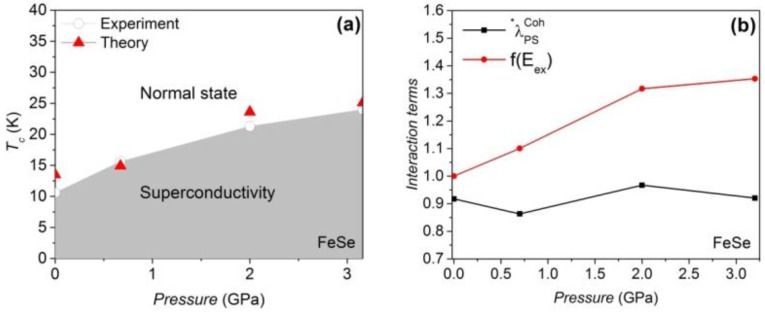
Many theoretical models of iron-based superconductors (IBSC) have been proposed, but the superconducting transition temperature () calculations based on these models are usually missing. We have chosen two models of iron-based superconductors from the literature and computed the values accordingly; recently two models have been announced which suggest that the superconducting electron concentration involved in the pairing mechanism of iron-based superconductors may have been underestimated and that the antiferromagnetism and the induced potential may even have a dramatic amplification effect on electron-phonon coupling. We use bulk FeSe, LiFeAs and NaFeAs data to calculate the based on these models and test if the combined model can predict the superconducting transition temperature () of the nanostructured FeSe monolayer well. To substantiate the recently announced potential in the literature, we create a two-channel model to separately superimpose the dynamics of the electron in the upper and lower tetrahedral plane. The results of our two-channel model support the literature data. While scientists are still searching for a universal DFT functional that can describe the pairing mechanism of all iron-based superconductors, we base our model on the ARPES data to propose an empirical combination of a DFT functional for revising the electron-phonon scattering matrix in the superconducting state, which ensures that all electrons involved in iron-based superconductivity are included in the computation. Our computational model takes into account this amplifying effect of antiferromagnetism and the correction of the electron-phonon scattering matrix, together with the abnormal soft out-of-plane lattice vibration of the layered structure. This allows us to calculate theoretical values of LiFeAs, NaFeAs and FeSe as a function of pressure that correspond reasonably well to the experimental values. More importantly, by taking into account the interfacial effect between an FeSe monolayer and its SrTiO substrate as an additional gain factor, our calculated value is up to 91 K and provides evidence that the strong enhancement recently observed in such monolayers with reaching 100 K may be contributed from the electrons within the ARPES range.
人们已经提出了许多铁基超导体(IBSC)的理论模型,但基于这些模型的超导转变温度( )计算通常缺失。我们从文献中选取了两种铁基超导体模型,并据此计算了 值;最近公布的两种模型表明,铁基超导体配对机制中涉及的超导电子浓度可能被低估了,并且反铁磁性和感应 势甚至可能对电子 - 声子耦合产生显著的放大效应。我们使用块状FeSe、LiFeAs和NaFeAs数据,基于这些模型计算 ,并测试组合模型是否能很好地预测纳米结构FeSe单层的超导转变温度( )。为了证实文献中最近公布的 势,我们创建了一个双通道模型,以分别叠加上下四面体平面中电子的动力学。我们的双通道模型结果支持了文献数据。虽然科学家们仍在寻找一种能描述所有铁基超导体配对机制的通用密度泛函理论(DFT)泛函,但我们基于角分辨光电子能谱(ARPES)数据建立模型,提出一种DFT泛函的经验组合,用于修正超导态下的电子 - 声子散射矩阵,这确保了铁基超导中涉及的所有电子都包含在计算中。我们的计算模型考虑了反铁磁性的这种放大效应以及电子 - 声子散射矩阵的修正,同时考虑了层状结构异常软的面外晶格振动。这使我们能够计算出LiFeAs、NaFeAs和FeSe的理论 值作为压力的函数,与实验值相当吻合。更重要的是,通过将FeSe单层与其SrTiO衬底之间的界面效应作为一个额外的增益因子考虑在内,我们计算出的 值高达91 K,并提供了证据表明最近在这种单层中观察到的高达100 K的强 增强可能来自ARPES范围内的电子。