Pan Minghui, Li Yuchao, Sun Siyuan, Liao Wenhe, Xing Yan, Tang Wencheng
School of Mechanical Engineering, Nanjing University of Science and Technology, Nanjing 210094, China.
Digital Forming Technology and Equipment National-Local United Engineering Laboratory, Nanjing University of Science and Technology, Nanjing 210094, China.
Materials (Basel). 2023 Jul 6;16(13):4864. doi: 10.3390/ma16134864.
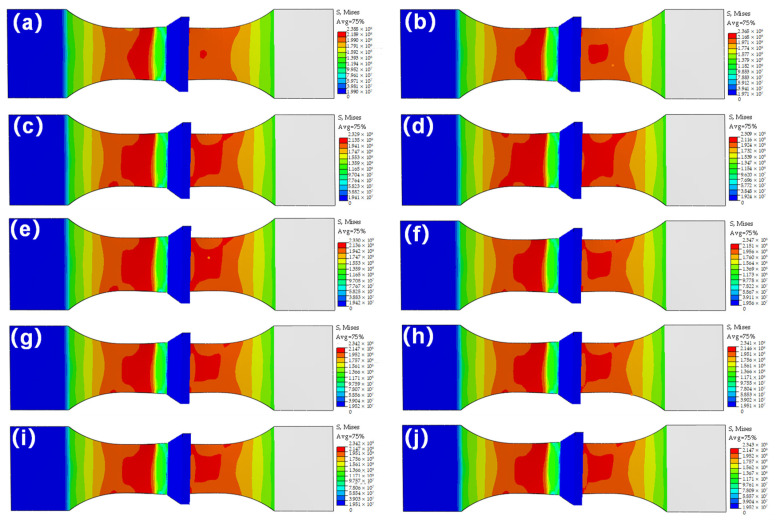
In order to deeply investigate the tensile properties and fracture behaviors that are obtained by tensile tests of welded joints, constitutive and damage models are imperative for analyzing the tensile behaviors. In this work, the tensile tests are conducted on the T-welded joint specimens of aluminum alloy 6061-T6, which were cut from the T-welded joints of thin-walled parts under different welding currents of Tungsten Inert Gas Welding (TIGW). A modified Johnson-Cook (J-C) model based on the original J-C equation, Swift model, Voce model, and Hockett-Sherby (H-S) model, their linear combination model, and fracture failure model are constructed and applied to simulate tensile behaviors, combined with tensile test data. What is more, the finite element (FE) simulation of tension tests is executed with the VUMAT and VUSDFLD subroutines. Compared to those results simulated with different fracture criteria and tensile experiments, the tensile strength and yield strength of T-welded joint thin-walled parts under different welding currents were achieved, and their best mean errors were only about 1%. Furthermore, the accuracy of different fracture criteria is also evaluated by the correlation coefficient and mean squared error. The results show that the combination model can accurately predict the tensile properties and fracture behaviors of T-welded joints better than the single model, especially the results simulated with the Swift-H-S model and H-S-Voce model, which are in good agreement with tensile test results, which will provide an analysis foundation for enhancing the welding assembly quality and preventing fracture failure for complex thin-walled antenna structures.
为了深入研究焊接接头拉伸试验所获得的拉伸性能和断裂行为,本构模型和损伤模型对于分析拉伸行为至关重要。在这项工作中,对6061-T6铝合金T形焊接接头试样进行了拉伸试验,这些试样取自不同钨极惰性气体保护焊(TIGW)焊接电流下薄壁零件的T形焊接接头。基于原始的约翰逊-库克(J-C)方程、斯威夫特模型、沃斯模型和霍克特-谢尔比(H-S)模型构建了改进的J-C模型、它们的线性组合模型以及断裂失效模型,并结合拉伸试验数据应用于模拟拉伸行为。此外,使用VUMAT和VUSDFLD子程序对拉伸试验进行了有限元(FE)模拟。与用不同断裂准则模拟的结果和拉伸试验相比,获得了不同焊接电流下T形焊接接头薄壁零件的抗拉强度和屈服强度,其最佳平均误差仅约为1%。此外,还通过相关系数和均方误差评估了不同断裂准则的准确性。结果表明,组合模型比单一模型能更准确地预测T形焊接接头的拉伸性能和断裂行为,特别是用斯威夫特-H-S模型和H-S-沃斯模型模拟的结果与拉伸试验结果吻合良好,这将为提高复杂薄壁天线结构的焊接装配质量和防止断裂失效提供分析基础。