Toepfer Andreas, Strässle Michael, Lenze Ulrich, Lenze Florian, Harrasser Norbert
Orthopaedics and Traumatology, Kantonsspital St.Gallen, Rorschacher Strasse 95, CH-9007 St.Gallen, Switzerland.
Department of Orthopaedics and Sportorthopaedics, Klinikum rechts der Isar, Technical University Munich, Ismaninger Straße 22, 81675 München, Germany.
J Clin Med. 2023 Jun 26;12(13):4272. doi: 10.3390/jcm12134272.
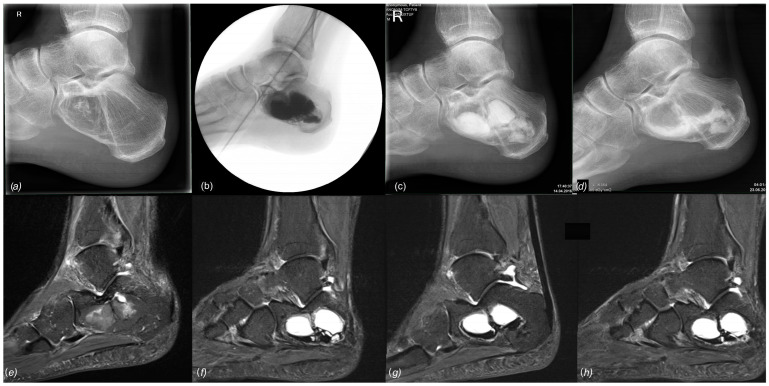
Simple bone cysts (SBCs) and intraosseous lipoma (IOL) of the calcaneus are rare tumor entities that are primarily diagnosed due to unspecific heel pain, incidental findings, or rarely due to pathological fractures. Compared to traditional open tumor resections, endoscopic resection of these benign tumors aims to minimize surgical morbidity and maximize surgical efficiency without compromising safety. Grafting is regularly performed to reduce the risk of recurrence and stimulate osseous consolidation of the lytic lesion. As the incidence is low and treatment strategies are heterogeneous, there is no clear consensus for the treatment of simple cysts or intraosseous lipomas of the calcaneus. The objectives of this study are (a) to present medium to long-term results after endoscopic resection and grafting with allogenic cancellous bone or bioresorbable hydroxyapatite and calcium sulfate cement, and (b) to add further evidence to the discussion of whether calcaneal SBC and IOL are the same entity at different developmental stages. Between 2012 and 2019, a total of 25 benign bone tumors consisting of 17 SBCs and 8 IOLs were treated by A.T. with endoscopic resection and grafting, comprising the largest cohort to date. For grafting, 12 patients received allogenic cancellous bone (group A) and 13 patients received injectable bone substitute (group B). Pre- and postoperative imaging using plain X-rays and MRI was retrospectively analyzed with a mean follow-up time of 24.5 months to assess tumor size, osseous consolidation (modified Neer classification), and tumor recurrence. A retrospective chart analysis focusing on adverse intra- and perioperative events and other complications associated with the surgical procedure was performed using the modified Clavien-Dindo classification (CD1-3). A total of 12/13 cases with allogenic bone grafting showed a Neer Type 1 osseous healing of the tumorous lesion after endoscopic resection, whereas only 5/11 cases with injectable bone substitute showed sufficient healing (types 1 and 2). There were three recurrent cysts (Neer 4) and two persistent cysts (Neer 3) after using injectable bone substitute. Two CD1 complications were observed in group A (prolonged wound drainage, sural neuritis) and eight complications were observed in group B (6× CD1, 2× CD3). At least two IOLs diagnosed preoperatively using MRI were ultimately identified as SBCs upon histopathologic examination. Allogenic cancellous bone grafting after endoscopic resection of calcaneal SBC or IOL showed a very low rate of complications and no tumor recurrence in our series. On the other hand, depending on the material used, injectable bone substitute showed a high rate of "white-out" (excessive drainage), resulting in multiple complications such as prolonged wound healing, insufficient permanent defect filling, recurrence, and revision surgery. Over time, calcaneal SBC may transform into IOL, exhibiting distinct features of both entities simultaneously during ossoscopy and histopathological analysis.
跟骨的单纯性骨囊肿(SBCs)和骨内脂肪瘤(IOL)是罕见的肿瘤类型,主要因非特异性足跟疼痛、偶然发现而被诊断,极少数情况下是由于病理性骨折。与传统的开放性肿瘤切除术相比,这些良性肿瘤的内镜切除术旨在将手术发病率降至最低,并在不影响安全性的前提下最大限度地提高手术效率。通常会进行植骨以降低复发风险,并促进溶骨性病变的骨愈合。由于发病率低且治疗策略各异,对于跟骨单纯性囊肿或骨内脂肪瘤的治疗尚无明确的共识。本研究的目的是:(a)呈现内镜切除并用同种异体松质骨或可生物吸收的羟基磷灰石和硫酸钙骨水泥植骨后的中长期结果;(b)为跟骨SBC和IOL是否为不同发育阶段的同一实体的讨论增加更多证据。在2012年至2019年期间,A.T.共对25例良性骨肿瘤进行了内镜切除和植骨治疗,其中包括17例SBC和8例IOL,这是迄今为止最大的队列研究。对于植骨,12例患者接受了同种异体松质骨(A组),13例患者接受了可注射骨替代物(B组)。回顾性分析术前和术后使用X线平片和MRI的影像学资料,平均随访时间为24.5个月,以评估肿瘤大小、骨愈合情况(改良Neer分类)和肿瘤复发情况。使用改良的Clavien-Dindo分类(CD1-3)对专注于手术中和围手术期不良事件以及与手术相关的其他并发症的回顾性病历分析。12/13例接受同种异体骨移植的病例在内镜切除后肿瘤病变显示Neer 1型骨愈合,而使用可注射骨替代物的病例中只有5/11例显示充分愈合(1型和2型)。使用可注射骨替代物后有3例囊肿复发(Neer 4)和2例囊肿持续存在(Neer 3)。A组观察到2例CD1并发症(伤口引流延长、腓肠神经损伤),B组观察到8例并发症(6×CD1,2×CD3)。至少2例术前使用MRI诊断为IOL的病例在组织病理学检查后最终被确定为SBC。在我们的系列研究中,跟骨SBC或IOL内镜切除后同种异体松质骨移植的并发症发生率非常低,且无肿瘤复发。另一方面,根据所用材料不同,可注射骨替代物显示出较高的“白色消失”率(引流过多),导致多种并发症,如伤口愈合延长、永久性缺损填充不足、复发和翻修手术。随着时间的推移,跟骨SBC可能转变为IOL,在骨镜检查和组织病理学分析中同时表现出两种实体的不同特征。