You Sung-Min, Cho Baek-Hwan, Bae Hyo-Eun, Kim Young-Kyun, Kim Jae-Rim, Park Soo-Ryun, Shon Young-Min, Seo Dae-Won, Kim In-Young
Department of Biomedical Engineering, Hanyang University, Seoul 04763, Republic of Korea.
Fetal Neonatal Neuroimaging and Developmental Science Center, Boston Children's Hospital, Harvard Medical School, Boston, MA 02115, USA.
J Clin Med. 2023 Jun 26;12(13):4284. doi: 10.3390/jcm12134284.
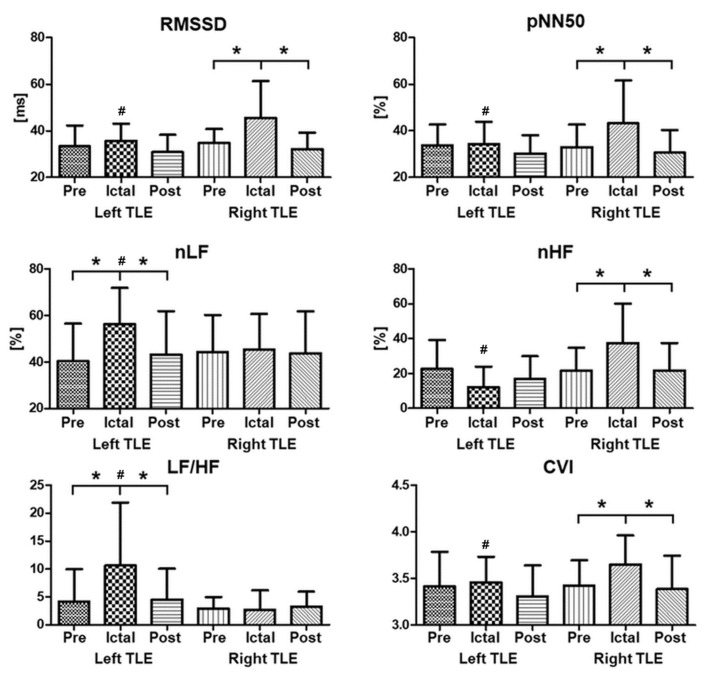
Epilepsy's impact on cardiovascular function and autonomic regulation, including heart-rate variability, is complex and may contribute to sudden unexpected death in epilepsy (SUDEP). Lateralization of autonomic control in the brain remains the subject of debate; nevertheless, ultra-short-term heart-rate variability (HRV) analysis is a useful tool for understanding the pathophysiology of autonomic dysfunction in epilepsy patients. A retrospective study reviewed medical records of patients with temporal lobe epilepsy who underwent presurgical evaluations. Data from 75 patients were analyzed and HRV indices were extracted from electrocardiogram recordings of preictal, ictal, and postictal intervals. Various HRV indices were calculated, including time domain, frequency domain, and nonlinear indices, to assess autonomic function during different seizure intervals. The study found significant differences in HRV indices based on hemispheric laterality, language dominancy, hippocampal atrophy, amygdala enlargement, sustained theta activity, and seizure frequency. HRV indices such as the root mean square of successive differences between heartbeats, pNN50, normalized low-frequency, normalized high-frequency, and the low-frequency/high-frequency ratio exhibited significant differences during the ictal period. Language dominancy, hippocampal atrophy, amygdala enlargement, and sustained theta activity were also found to affect HRV. Seizure frequency was correlated with HRV indices, suggesting a potential relationship with the risk of SUDEP.
癫痫对心血管功能和自主神经调节(包括心率变异性)的影响是复杂的,可能导致癫痫性猝死(SUDEP)。大脑中自主神经控制的侧化仍是一个有争议的话题;然而,超短期心率变异性(HRV)分析是了解癫痫患者自主神经功能障碍病理生理学的有用工具。一项回顾性研究回顾了接受术前评估的颞叶癫痫患者的病历。分析了75例患者的数据,并从发作前、发作期和发作后的心电图记录中提取HRV指标。计算了各种HRV指标,包括时域、频域和非线性指标,以评估不同发作间期的自主神经功能。研究发现,基于半球侧化、语言优势、海马萎缩、杏仁核增大、持续的θ活动和发作频率,HRV指标存在显著差异。HRV指标,如心跳间连续差值的均方根、pNN50、归一化低频、归一化高频和低频/高频比值在发作期表现出显著差异。还发现语言优势、海马萎缩、杏仁核增大和持续的θ活动会影响HRV。发作频率与HRV指标相关,提示与SUDEP风险可能存在关联。