Darche Fabrice F, Fabricius Lisa C, Helmschrott Matthias, Rahm Ann-Kathrin, Ehlermann Philipp, Bruckner Tom, Sommer Wiebke, Warnecke Gregor, Frey Norbert, Rivinius Rasmus
Department of Cardiology, Angiology and Pneumology, Heidelberg University Hospital, 69120 Heidelberg, Germany.
Heidelberg Center for Heart Rhythm Disorders (HCR), Heidelberg University Hospital, 69120 Heidelberg, Germany.
J Clin Med. 2023 Jun 28;12(13):4334. doi: 10.3390/jcm12134334.
Patients after heart transplantation (HTX) often require oral anticoagulants (OACs) due to atrial arrhythmias or thromboembolic events but little is known about the post-transplant use of direct oral anticoagulants (DOACs). We investigated the frequency, indications, and complications of DOACs and vitamin K antagonists (VKAs) after HTX.
We screened all adult patients for the use of post-transplant OACs who underwent HTX at Heidelberg Heart Center between 2000 and 2021. Patients were stratified by type of OAC (DOAC or VKA) and by DOAC agents (apixaban, dabigatran, edoxaban, or rivaroxaban). Indications for OACs comprised atrial fibrillation, atrial flutter, pulmonary embolism, upper and lower extremity deep vein thrombosis, as well as intracardiac thrombus.
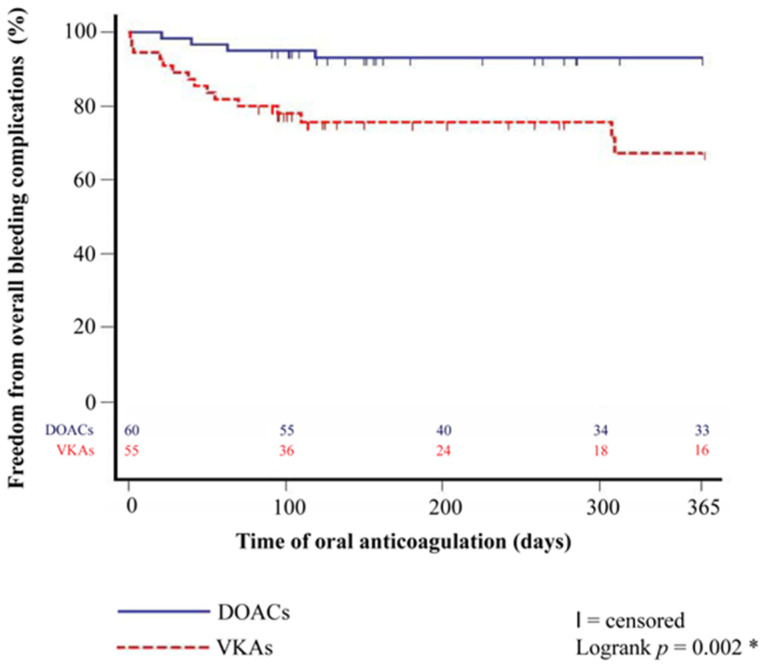
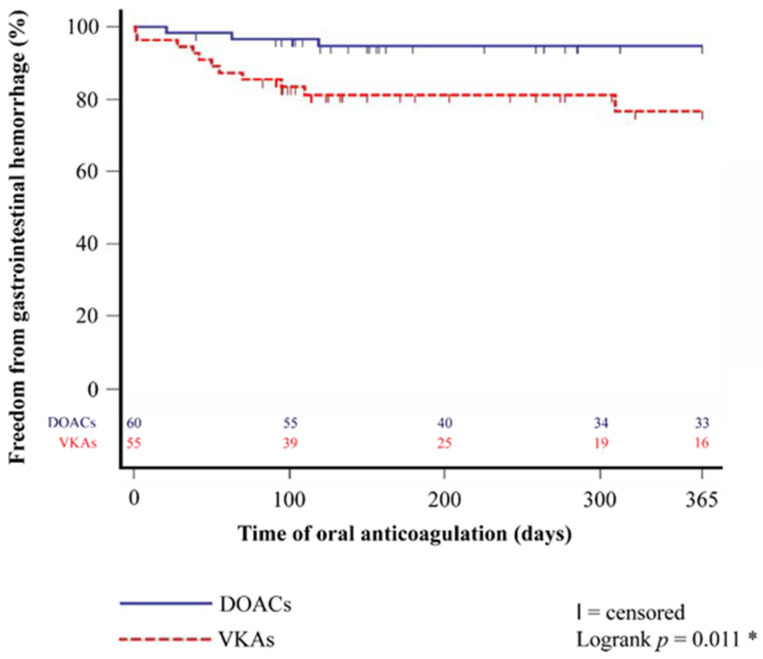
A total of 115 of 459 HTX recipients (25.1%) required OACs, including 60 patients with DOACs (52.2%) and 55 patients with VKAs (47.8%). Concerning DOACs, 28 patients were treated with rivaroxaban (46.7%), 27 patients with apixaban (45.0%), and 5 patients with edoxaban (8.3%). We found no significant differences between both groups concerning demographics, immunosuppressive drugs, concomitant medications, indications for OACs, ischemic stroke, thromboembolic events, or OAC-related death. Patients with DOACs after HTX had a significantly lower one-year rate of overall bleeding complications ( = 0.002) and a significantly lower one-year rate of gastrointestinal hemorrhage ( = 0.011) compared to patients with VKAs after HTX in the Kaplan-Meier estimator.
DOACs were comparable to VKAs concerning the risk of ischemic stroke, thromboembolic events, or OAC-related death but were associated with significantly fewer bleeding complications in HTX recipients.
心脏移植(HTX)后的患者常因房性心律失常或血栓栓塞事件而需要口服抗凝剂(OAC),但关于直接口服抗凝剂(DOAC)在移植后的使用情况知之甚少。我们调查了HTX后DOAC和维生素K拮抗剂(VKA)的使用频率、适应证及并发症。
我们筛选了2000年至2021年在海德堡心脏中心接受HTX的所有成年移植后使用OAC的患者。患者按OAC类型(DOAC或VKA)以及DOAC药物(阿哌沙班、达比加群、依度沙班或利伐沙班)进行分层。OAC的适应证包括房颤、房扑、肺栓塞、上肢和下肢深静脉血栓形成以及心内血栓。
459例HTX受者中有115例(25.1%)需要OAC,其中60例使用DOAC(52.2%),55例使用VKA(47.8%)。关于DOAC,28例患者接受利伐沙班治疗(46.7%),27例接受阿哌沙班治疗(45.0%),5例接受依度沙班治疗(8.3%)。我们发现两组在人口统计学、免疫抑制药物、伴随用药、OAC适应证、缺血性卒中、血栓栓塞事件或OAC相关死亡方面无显著差异。在Kaplan-Meier估计器中,HTX后使用DOAC的患者一年总体出血并发症发生率显著较低(P = 0.002),胃肠道出血一年发生率也显著较低(P = 0.011),与HTX后使用VKA的患者相比。
在缺血性卒中、血栓栓塞事件或OAC相关死亡风险方面,DOAC与VKA相当,但在HTX受者中,DOAC相关的出血并发症明显较少。