Chaudhry-Waterman Nadia, Dara Bharat, Bucholz Emily, Londono Obregon Camila, Grenier Michelle, Snyder Kristen, Cuneo Bettina F
The Division of Cardiology, Department of Pediatrics, University of Colorado School of Medicine, Denver, CO 80045, USA.
Presbyterian Hospital, Albuquerque, NM 87106, USA.
J Clin Med. 2023 Jul 3;12(13):4464. doi: 10.3390/jcm12134464.
Repeated fetal heart rates (FHR) < 3rd percentile for gestational age (GA) with 1:1 atrioventricular conduction (sinus bradycardia) can be a marker for long QT syndrome. We hypothesized that other inherited arrhythmia syndromes might present with fetal sinus bradycardia.
We reviewed pregnancies referred with sinus bradycardia to the Colorado Fetal Care Center between 2013 and 2023. FHR/GA data, family history, medication exposure, normalized isovolumic contraction times (n-IVRT), postnatal genetic testing, and ECGs at 4-6 weeks after birth were reviewed.
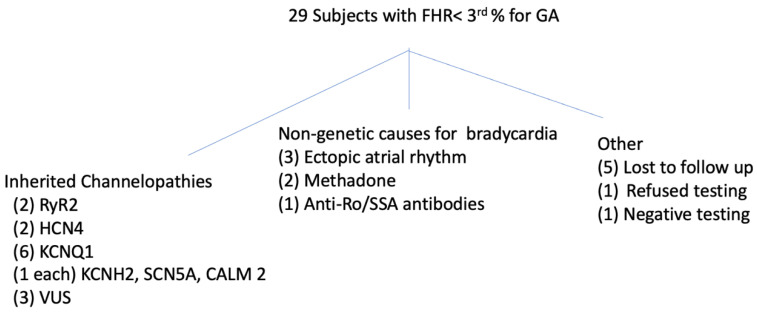
Twenty-nine bradycardic subjects were evaluated by fetal echocardiography. Five were lost to follow-up, one refused genetic testing, and one had negative genetic testing for any inherited arrhythmia. Six had non-genetic causes of fetal bradycardia with normal prenatal n-IVRT and postnatal QTc. Thirteen carried pathogenic variants in RYR2 ( = 2), HCN4 ( = 2), KCNQ1 (6), and other LQTS genes ( = 4). The postnatal QTc was <470 ms in subjects with RYR2, HCN4, and two of those with KCNQ1 mutations, and >470 ms in subjects with CALM 2, KCNH2, SCN5A, and four of those with KCNQ1 mutations. LQTS and RYR2 mutations were associated with prolonged n-IVRT, but HCN4 was not. Two fetuses died in utero with variants of uncertain significance (CACNA1 and KCNE1). Cascade testing uncovered six affected but undiagnosed parents and confirmed familial inheritance in five.
In addition to heralding LQTS, repeated FHR < 3rd percentile for GA is a risk factor for other inherited arrhythmia syndromes. These findings suggest that genetic testing should be offered to infants with a history of FHR < 3rd percentile for GA even if the postnatal ECG demonstrates a normal QTc interval.
胎心率(FHR)反复低于胎龄(GA)的第3百分位数且房室传导比例为1:1(窦性心动过缓)可能是长QT综合征的一个标志。我们推测其他遗传性心律失常综合征可能表现为胎儿窦性心动过缓。
我们回顾了2013年至2023年间转诊至科罗拉多胎儿护理中心的窦性心动过缓妊娠病例。对FHR/GA数据、家族史、药物暴露、标准化等容收缩时间(n-IVRT)、出生后基因检测以及出生后4 - 6周的心电图进行了回顾。
通过胎儿超声心动图评估了29例心动过缓受试者。5例失访,1例拒绝基因检测,1例针对任何遗传性心律失常的基因检测结果为阴性。6例胎儿心动过缓有非遗传原因,产前n-IVRT和产后QTc正常。13例携带RYR2(= 2)、HCN4(= 2)、KCNQ1(6)及其他长QT综合征基因(= 4)的致病变异。RYR2、HCN4以及部分携带KCNQ1突变的受试者产后QTc<470毫秒,而携带CALM 2、KCNH2、SCN5A以及部分携带KCNQ1突变的受试者产后QTc>470毫秒。长QT综合征和RYR2突变与n-IVRT延长有关,但HCN4无关。2例胎儿宫内死亡,携带意义未明的变异(CACNA1和KCNE1)。级联检测发现6名受影响但未确诊的父母,并证实5例为家族性遗传。
除了预示长QT综合征外,FHR反复低于GA的第3百分位数是其他遗传性心律失常综合征的一个危险因素。这些发现表明,即使产后心电图显示QTc间期正常,对于有FHR低于GA第3百分位数病史的婴儿也应进行基因检测。