Spine & Spinal Cord Institute, Department of Neurosurgery, College of Medicine, Yonsei University, Seoul 03722, Republic of Korea.
Graduate Program in Bioindustrial Engineering, Yonsei University, Seoul 03722, Republic of Korea.
Int J Mol Sci. 2023 Jun 30;24(13):10971. doi: 10.3390/ijms241310971.
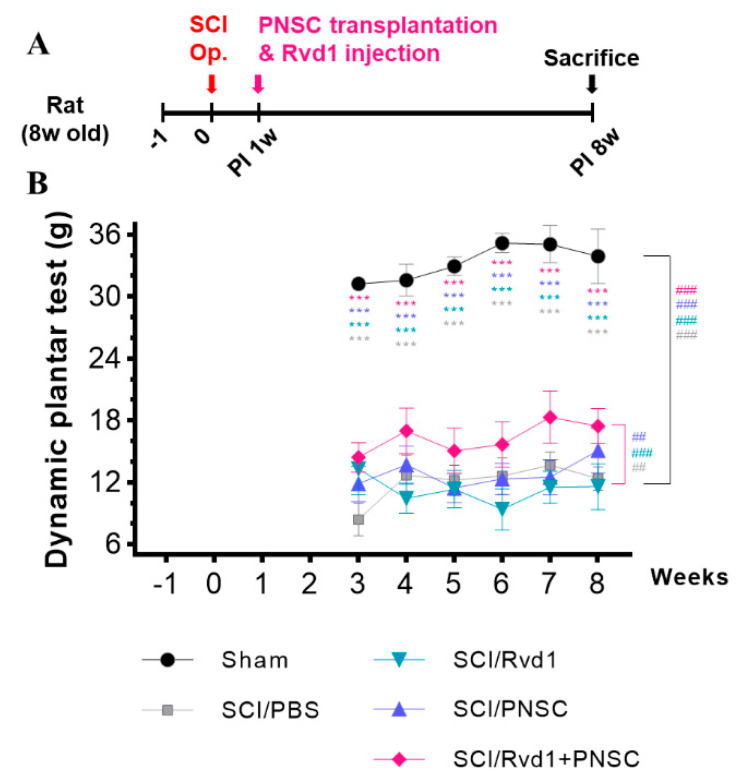
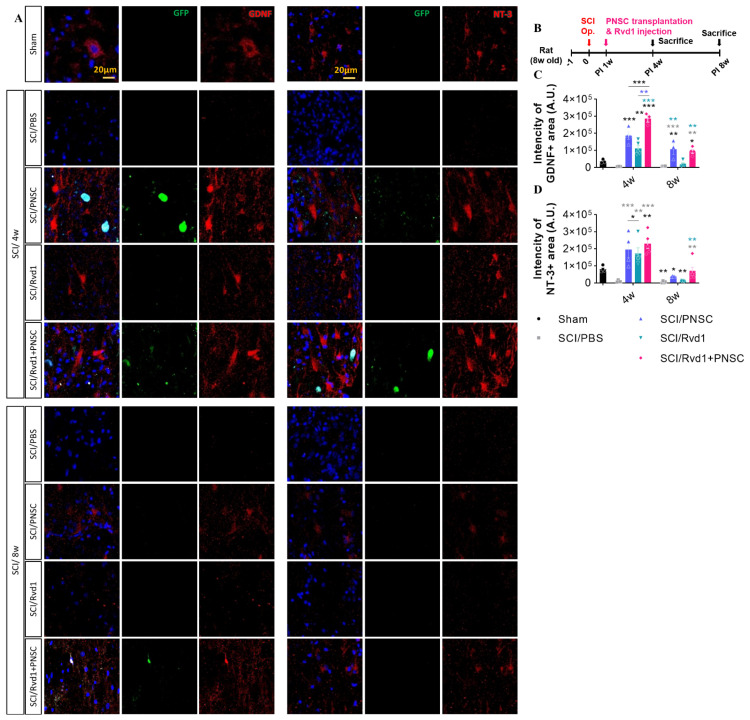
Spinal cord injury (SCI), primarily caused by trauma, leads to permanent and lasting loss of motor, sensory, and autonomic functions. Current therapeutic strategies are focused on mitigating secondary injury, a crucial aspect of SCI pathophysiology. Among these strategies, stem cell therapy has shown considerable therapeutic potential. This study builds on our previous work, which demonstrated the functional recovery and neuronal regeneration capabilities of peripheral nerve-derived stem cell (PNSC) spheroids, which are akin to neural crest stem cells, in SCI models. However, the limited anti-inflammatory capacity of PNSC spheroids necessitates a combined therapeutic approach. As a result, we investigated the potential of co-administering resolvin D1 (RvD1), known for its anti-inflammatory and neuroprotective properties, with PNSC spheroids. In vitro analysis confirmed RvD1's anti-inflammatory activity and its inhibitory effect on pro-inflammatory cytokines. In vivo studies involving a rat SCI model demonstrated that combined therapy of RvD1 and PNSC spheroids outperformed monotherapies, exhibiting enhanced neuronal regeneration and anti-inflammatory effects as validated through behavior tests, quantitative reverse transcription polymerase chain reaction, and immunohistochemistry. Thus, our findings suggest that the combined application of RvD1 and PNSC spheroids may represent a novel therapeutic approach for SCI management.
脊髓损伤(SCI)主要由创伤引起,导致运动、感觉和自主功能的永久性和持久丧失。目前的治疗策略集中在减轻继发性损伤,这是 SCI 病理生理学的一个关键方面。在这些策略中,干细胞治疗显示出相当大的治疗潜力。本研究建立在我们之前的工作基础上,该工作表明类似于神经嵴干细胞的外周神经源性干细胞(PNSC)球体在 SCI 模型中具有功能恢复和神经元再生能力。然而,PNSC 球体的抗炎能力有限,需要联合治疗方法。因此,我们研究了共给予具有抗炎和神经保护特性的分解素 D1(RvD1)与 PNSC 球体的潜力。体外分析证实了 RvD1 的抗炎活性及其对促炎细胞因子的抑制作用。涉及大鼠 SCI 模型的体内研究表明,RvD1 和 PNSC 球体的联合治疗优于单药治疗,通过行为测试、定量逆转录聚合酶链反应和免疫组织化学验证了增强的神经元再生和抗炎作用。因此,我们的发现表明,RvD1 和 PNSC 球体的联合应用可能代表 SCI 管理的一种新的治疗方法。