Department of Biochemistry, Vanderbilt University School of Medicine, Nashville, TN 37232, USA.
Department of Medicine (Hematology/Oncology), Vanderbilt University School of Medicine, Nashville, TN 37232, USA.
Int J Mol Sci. 2023 Jul 7;24(13):11199. doi: 10.3390/ijms241311199.
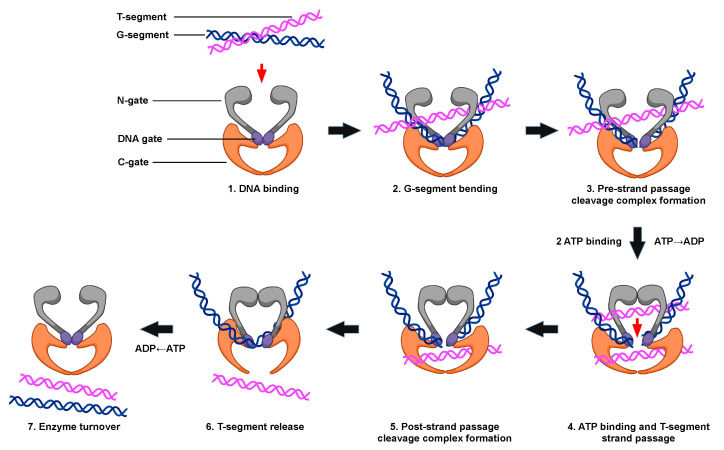
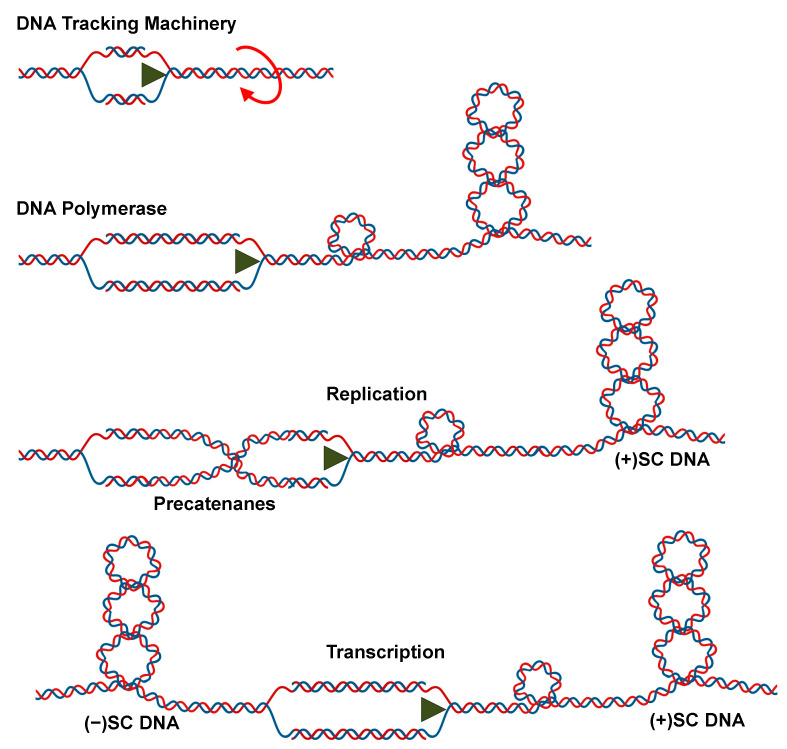
Type II topoisomerases are essential enzymes that modulate the topological state of DNA supercoiling in all living organisms. These enzymes alter DNA topology by performing double-stranded passage reactions on over- or underwound DNA substrates. This strand passage reaction generates a transient covalent enzyme-cleaved DNA structure known as the cleavage complex. Al-though the cleavage complex is a requisite catalytic intermediate, it is also intrinsically dangerous to genomic stability in biological systems. The potential threat of type II topoisomerase function can also vary based on the nature of the supercoiled DNA substrate. During essential processes such as DNA replication and transcription, cleavage complex formation can be inherently more dangerous on overwound versus underwound DNA substrates. As such, it is important to understand the profound effects that DNA topology can have on the cellular functions of type II topoisomerases. This review will provide a broad assessment of how human and bacterial type II topoisomerases recognize and act on their substrates of various topological states.
II 型拓扑异构酶是调节所有生物体内 DNA 超螺旋拓扑状态的必需酶。这些酶通过对超螺旋或欠旋 DNA 底物进行双链通过反应来改变 DNA 拓扑结构。这种链通过反应生成一种称为切割复合物的瞬时共价酶切割 DNA 结构。虽然切割复合物是必需的催化中间体,但它对生物系统中基因组稳定性也是内在危险的。II 型拓扑异构酶功能的潜在威胁也可能因超螺旋 DNA 底物的性质而异。在 DNA 复制和转录等重要过程中,与欠旋 DNA 底物相比,在超旋 DNA 底物上形成切割复合物可能固有地更危险。因此,了解 DNA 拓扑结构对 II 型拓扑异构酶的细胞功能可能产生的深远影响非常重要。本综述将广泛评估人类和细菌 II 型拓扑异构酶如何识别和作用于不同拓扑状态的底物。