Pediatric Gastroenterology and Cystic Fibrosis Unit, Department of Human Pathology in Adulthood and Childhood "G. Barresi", "G. Martino" University Hospital, 98124 Messina, Italy.
Statistical and Mathematical Sciences Unit, Department of Economics, University of Messina, 98122 Messina, Italy.
Nutrients. 2023 Jun 25;15(13):2875. doi: 10.3390/nu15132875.
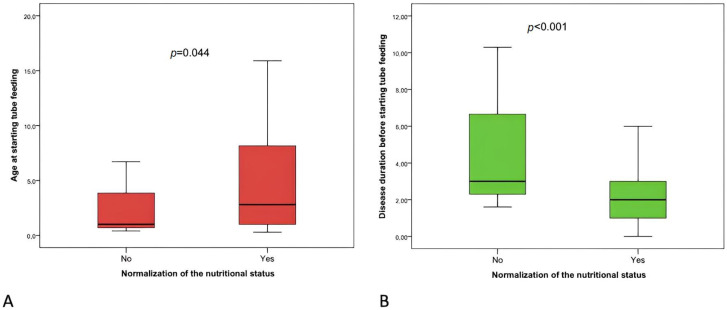
Tube feeding is a life-saving treatment for children with neurological disabilities (ND), who often suffer from malnutrition and feeding disorders. Nonetheless, it is still not widely used. Our aim was to evaluate the outcomes of exclusive tube feeding in a cohort of ND children. All consecutive ND children who started tube feeding at our center within the last 5 years were included in this retrospective study. Weight-for-age, body mass index (BMI), mid-upper arm circumference (MUAC) Z-scores, and symptoms were collected at baseline (V0), 6 (V1), and 12 months (V2) after gastrostomy placement. Fifty children (62% males) were included. The ND-underlying disease was genetic ( = 29, 58%), hypoxic-ischemic encephalopathy ( = 17, 34%), or metabolic ( = 4, 8%). Indications for tube feeding were malnutrition ( = 35, 70%), recurrent respiratory infections ( = 11, 22%), or both ( = 4, 8%). Enteral formulae were polymeric ( = 29, 58%), semi-elemental ( = 17, 34%), hypercaloric ( = 3, 6%), or elemental ( = 1, 2%). Homemade blended feed was offered to three children (6%) in addition to the formula. Weight and BMI increased over the study period. Except for constipation, all symptoms (cough, vomiting, and diarrhea) improved at 6 and 12 months ( < 0.05). Non-serious complications ( = 8; track disruption, granuloma, and skin infection) were observed. Longer disease duration ( < 0.001) at the start of tube feeding was associated with the absence of normalization of nutritional status (BMI Z-score > 2 SD) at 12 months. Tube feeding with commercially available enteral formulae should be started as early as possible for better outcomes.
管饲是治疗神经发育障碍(ND)儿童的救命疗法,这些儿童经常患有营养不良和喂养障碍。尽管如此,它的应用仍然不够广泛。我们的目的是评估最近 5 年内我院接受管饲治疗的 ND 儿童队列的治疗结果。本回顾性研究纳入了所有在我院开始接受管饲治疗的连续 ND 儿童。在胃造口术放置后的基线(V0)、6 个月(V1)和 12 个月(V2),收集体重与年龄比、体质量指数(BMI)、上臂中部周长(MUAC)Z 评分和症状。共纳入 50 名儿童(62%为男性)。ND 的基础疾病为遗传性(=29,58%)、缺氧缺血性脑病(=17,34%)或代谢性疾病(=4,8%)。管饲的适应证为营养不良(=35,70%)、反复呼吸道感染(=11,22%)或两者兼有(=4,8%)。管饲配方包括聚合配方(=29,58%)、半要素配方(=17,34%)、高热量配方(=3,6%)或要素配方(=1,2%)。此外,还向 3 名儿童(6%)提供了自制混合饲料。在研究期间,体重和 BMI 增加。除便秘外,所有症状(咳嗽、呕吐和腹泻)在 6 个月和 12 个月时均得到改善(<0.05)。观察到非严重并发症(=8;轨道中断、肉芽肿和皮肤感染)。管饲开始时疾病持续时间较长(<0.001)与 12 个月时营养状况未正常化(BMI Z 评分>2SD)有关。尽早使用市售肠内配方进行管饲治疗,可获得更好的治疗效果。