National Institute of Nutrition, Jamai-Osmania, Tarnaka, Hyderabad 500007, India.
St. John's Medical College, Bangalore 560034, India.
Nutrients. 2023 Jul 3;15(13):3026. doi: 10.3390/nu15133026.
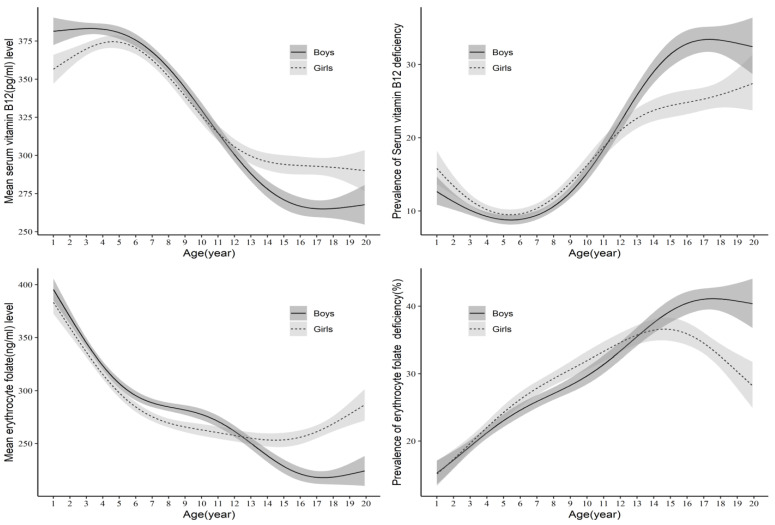
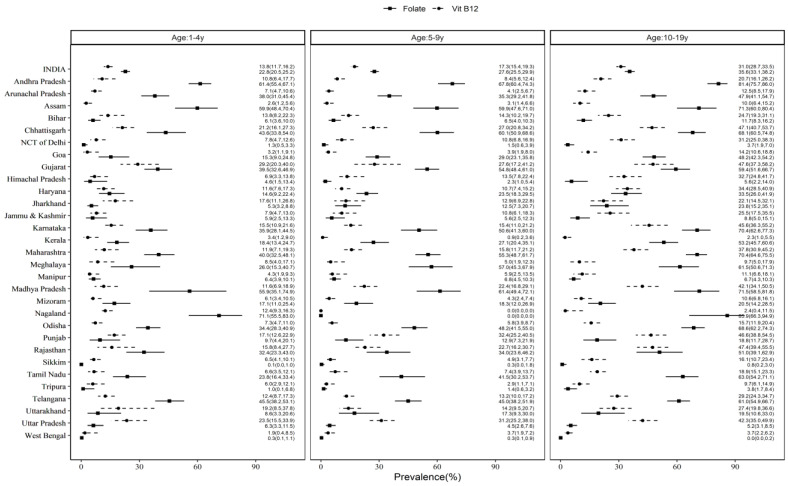
Deficiencies of vitamin B (B) and folate (FA) are of particular interest due to their pleiotropic role in 1-carbon metabolism. In addition to adverse birth outcomes, deficiencies of B and FA, or an imbalance in FA/B status, are linked to metabolic disorders. Indian diets that are predominantly plant food-based could be deficient in these vitamins, but there are no national estimates of the prevalence of B and FA deficiency in Indian children and adolescents, nor their associations with age, sex and growth indicators. The recent Comprehensive National Nutrition Survey (CNNS-2016-18) provided estimates of the prevalence of B and FA deficiency at the national and state levels among preschool (1-4 years: 9976 and 11,004 children, respectively), school-age children (5-9 years: 12,156 and 14,125) and adolescents (10-19 years: 11,748 and 13,621). Serum B and erythrocyte FA were measured by the direct chemiluminescence method and their deficiency was defined using WHO cut-offs. The prevalence of B and FA deficiency was high among adolescents (31.0%, CI: 28.7-33.5 and 35.6%, CI: 33.1-8.2) compared to school-age (17.3%, CI: 15.4-19.3 and 27.6%, CI: 25.5-29.9) and preschool children (13.8%, CI: 11.7-16.2 and 22.8%, CI: 20.5-25.2, respectively). The prevalence of both B and FA deficiency was significantly higher by 8% and 5%, respectively, in adolescent boys compared to girls. There was no association between anthropometric undernutrition and B and FA deficiency. There was wide regional variation in the prevalence of B and FA deficiency, but no rural-urban differences were observed across all age groups. The national prevalence of B deficiency among preschool or school-age children was <20% (the cut-off that indicates a public health problem). However, FA deficiency in these age groups and both FA and B deficiencies in adolescents were >20%, warranting further investigation.
由于维生素 B (B) 和叶酸 (FA) 在 1 碳代谢中的多效作用,它们的缺乏尤其受到关注。除了不良的出生结局外,B 和 FA 的缺乏,或 FA/B 状态的失衡,与代谢紊乱有关。印度的饮食主要以植物性食物为主,这些维生素可能会缺乏,但目前还没有印度儿童和青少年 B 和 FA 缺乏的全国性估计,也没有这些维生素缺乏与年龄、性别和生长指标之间的关联。最近的全国家庭营养调查 (CNNS-2016-18) 提供了全国和各州学龄前儿童 (1-4 岁:9976 人和 11004 人)、学龄儿童 (5-9 岁:12156 人和 14125 人) 和青少年 (10-19 岁:11748 人和 13621 人) B 和 FA 缺乏的患病率估计值。血清 B 和红细胞 FA 采用直接化学发光法测量,采用世界卫生组织的切点定义缺乏。与学龄儿童 (17.3%,置信区间:15.4-19.3 和 27.6%,置信区间:25.5-29.9) 和学龄前儿童 (13.8%,置信区间:11.7-16.2 和 22.8%,置信区间:20.5-25.2) 相比,青少年 (31.0%,置信区间:28.7-33.5 和 35.6%,置信区间:33.1-8.2) 的 B 和 FA 缺乏率较高。与女孩相比,青少年男孩的 B 和 FA 缺乏率分别高出 8%和 5%。在 B 和 FA 缺乏与身体消瘦之间没有关联。B 和 FA 缺乏的流行率在各地区差异很大,但在所有年龄组中,城乡之间没有差异。学龄前或学龄儿童 B 缺乏的全国流行率低于 20%(表示存在公共卫生问题的切点)。然而,这些年龄组的 FA 缺乏以及青少年的 FA 和 B 缺乏均超过 20%,需要进一步调查。