Alzyod Hussein, Ficzere Peter
Department of Railway Vehicles and Vehicle System Analysis, Faculty of Transportation Engineering and Vehicle Engineering, Budapest University of Technology and Economics, Műegyetem rkp.3, H-1111 Budapest, Hungary.
Polymers (Basel). 2023 Jun 29;15(13):2893. doi: 10.3390/polym15132893.
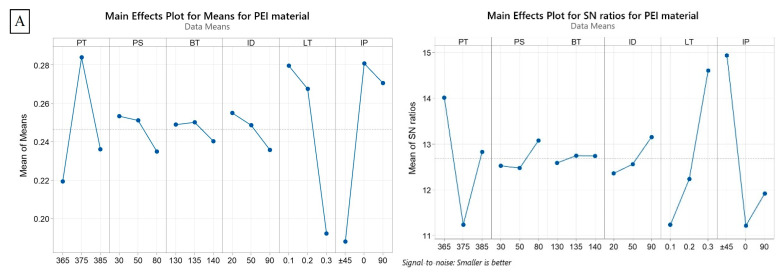
Additive manufacturing (AM), commonly known as 3D printing, has gained significant popularity for its ability to produce intricate parts with high precision. However, the presence of residual stresses and warpage deformation are common issues affecting the quality and functionality of 3D-printed parts. This study conducts a comprehensive finite element analysis (FEA) to investigate the material-dependent impact of key printing parameters on residual stress and warpage deformation in 3D printing. The research focuses on three distinct materials: polyetherimide (PEI), acrylonitrile butadiene styrene (ABS), and polyamide 6 (PA6). Various printing parameters are systematically varied, including printing temperature, printing speed, bed temperature, infill density, layer thickness, and infill pattern. The study employs the Taguchi L27 orthogonal array and employs the analysis of variance (ANOVA) statistical technique to assess the significance of the input parameters. The obtained results reveal that certain parameters exhibit a greater sensitivity to material differences, whereas the layer thickness parameter demonstrates a relatively lower sensitivity. Notably, infill density and printing temperature play a crucial role in reducing residual stress for PA6, while the infill pattern parameter proves to be a significant contributor to minimizing warpage deformation across all three materials. These findings underscore the importance of conducting material-specific analyses to optimize 3D printing parameters and achieve the desired quality outcomes while mitigating residual stress and warpage deformation.
增材制造(AM),通常被称为3D打印,因其能够高精度地制造复杂零件而广受欢迎。然而,残余应力和翘曲变形的存在是影响3D打印零件质量和功能的常见问题。本研究进行了全面的有限元分析(FEA),以研究关键打印参数对3D打印中残余应力和翘曲变形的材料依赖性影响。该研究聚焦于三种不同的材料:聚醚酰亚胺(PEI)、丙烯腈-丁二烯-苯乙烯共聚物(ABS)和聚酰胺6(PA6)。各种打印参数被系统地改变,包括打印温度、打印速度、床温、填充密度、层厚和填充图案。该研究采用田口L27正交阵列,并运用方差分析(ANOVA)统计技术来评估输入参数的显著性。所得结果表明,某些参数对材料差异表现出更高的敏感性,而层厚参数的敏感性相对较低。值得注意的是,填充密度和打印温度在降低PA6的残余应力方面起着关键作用,而填充图案参数被证明是在所有三种材料中最小化翘曲变形的重要因素。这些发现强调了进行材料特定分析以优化3D打印参数并在减轻残余应力和翘曲变形的同时实现所需质量结果的重要性。