College of Science, Wuhan University of Science and Technology, Wuhan 430065, China.
State Key Laboratory of Precision Blasting, Jianghan University, Wuhan 430056, China.
Sensors (Basel). 2023 Jul 7;23(13):6240. doi: 10.3390/s23136240.
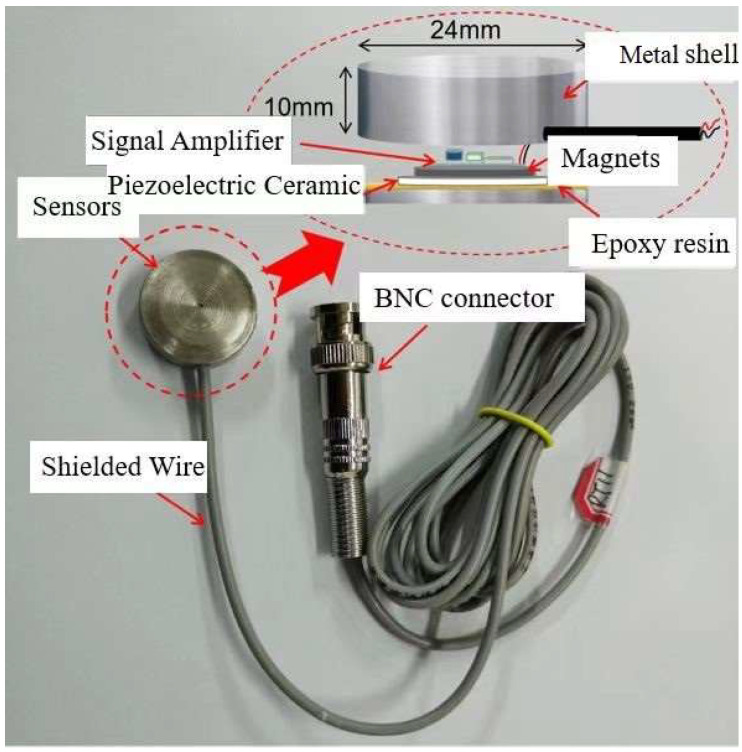
Aiming at the problem of displacement of collapse direction caused by the impact of the high-rise reinforced concrete chimney in the process of blasting demolition, combined with the monitoring methods such as high-speed photography observation, piezoelectric ceramic sensor, and blasting vibration monitor, the impact process of the 180 m high chimney was comprehensively analyzed. The results show that the chimney will experience multiple 'weight loss' and 'overweight' effects during the sit-down process, inducing compressive stress waves in the chimney. When the sit-down displacement is large, the broken reinforced concrete at the bottom can play a significant buffering effect, and the 'overweight' effect gradually weakens until the sit-down stops. The stress of the inner and outer sides of the chimney wall is obviously different in the process of collapsing and touching the ground. The waveform of the monitoring point of the piezoelectric ceramic sensor is divided into three stages, which specifically characterizes the evolution process of the explosion load and the impact of the chimney. The vibration induced by explosive explosion is mainly high-frequency vibration above 50 Hz, the vibration induced by chimney collapse is mainly low-frequency vibration below 10 Hz, and the vibration characteristics are obviously different. In the process of blasting demolition and collapse of high-rise reinforced concrete chimney, due to the impact of sitting down, the wall of the support tube is subjected to uneven force, resulting in the deviation of the collapse direction. In practical engineering, the control measures of chimney impact, blasting vibration, and collapse touchdown vibration should be fully strengthened to ensure the safety of the protection target around the blasting demolition object.
针对高层钢筋混凝土烟囱爆破拆除过程中因坐落在位而导致倒塌方向偏移的问题,结合高速摄影观测、压电陶瓷传感器和爆破振动监测等监测方法,综合分析了 180m 高烟囱的倾倒过程。结果表明,烟囱在坐落后会经历多次“减重”和“超重”效应,在烟囱内诱导压应力波。当坐落后位移较大时,底部破碎的钢筋混凝土可以起到显著的缓冲作用,“超重”效应逐渐减弱,直至坐落后停止。烟囱壁内外侧在倒塌和触地过程中的受力明显不同。压电陶瓷传感器监测点的波形分为三个阶段,具体表征了爆炸荷载和烟囱冲击的演化过程。爆炸爆炸引起的振动主要是 50Hz 以上的高频振动,烟囱倒塌引起的振动主要是 10Hz 以下的低频振动,振动特征明显不同。在高层钢筋混凝土烟囱爆破拆除和倒塌过程中,由于坐落后的冲击,支撑管的管壁受到不均匀的力,导致倒塌方向发生偏离。在实际工程中,应充分加强对烟囱冲击、爆破振动和倒塌触地振动的控制措施,以确保爆破拆除对象周围保护目标的安全。