Pease Sarah K D, Egerton Todd A, Reece Kimberly S, Sanderson Marta P, Onofrio Michelle D, Yeargan Evan, Wood Adam, Roach Amanda, Huang I-Shuo Wade, Scott Gail P, Place Allen R, Hayes Amy M, Smith Juliette L
Virginia Institute of Marine Science, William & Mary, P.O. Box 1346, Gloucester Point, VA, 23062, USA.
Division of Shellfish Safety and Waterborne Hazards, Virginia Department of Health, Norfolk, VA, 23510, USA.
Toxicon X. 2023 Jun 16;19:100166. doi: 10.1016/j.toxcx.2023.100166. eCollection 2023 Sep.
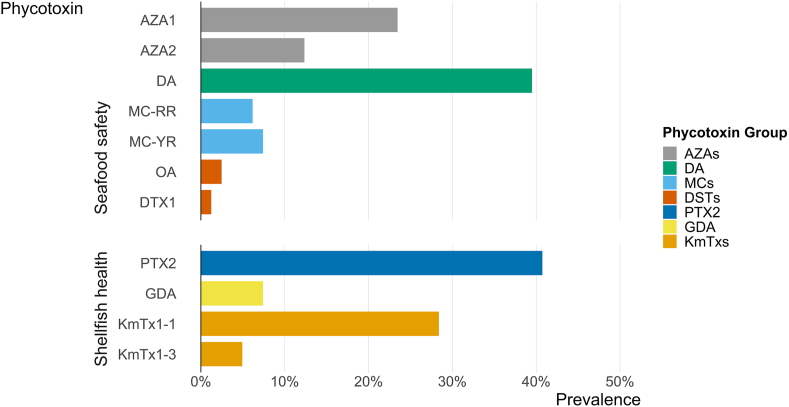
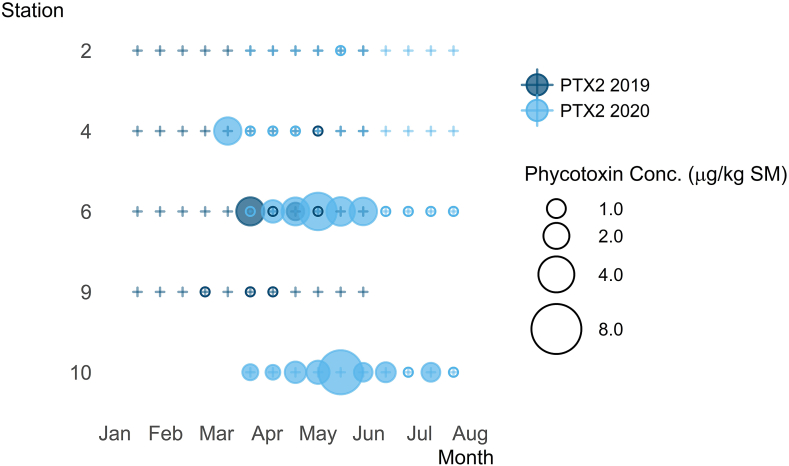
Oysters () were screened for 12 phycotoxins over two years in nearshore waters to collect baseline phycotoxin data and to determine prevalence of phycotoxin co-occurrence in the commercially and ecologically-relevant species. Trace to low concentrations of azaspiracid-1 and -2 (AZA1, AZA2), domoic acid (DA), okadaic acid (OA), and dinophysistoxin-1 (DTX1) were detected, orders of magnitude below seafood safety action levels. Microcystins (MCs), MC-RR and MC-YR, were also found in oysters (maximum: 7.12 μg MC-RR/kg shellfish meat wet weight), warranting consideration of developing action levels for freshwater phycotoxins in marine shellfish. Oysters contained phycotoxins that impair shellfish health: karlotoxin1-1 and 1-3 (KmTx1-1, KmTx1-3), goniodomin A (GDA), and pectenotoxin-2 (PTX2). Co-occurrence of phycotoxins in oysters was common (54%, n = 81). AZAs and DA co-occurred most frequently of the phycotoxins investigated that are a concern for human health (n = 13) and PTX2 and KmTxs co-occurred most frequently amongst the phycotoxins of concern for shellfish health (n = 9). Various harmful algal bloom (HAB) monitoring methods and tools were assessed for their effectiveness at indicating levels of phycotoxins in oysters. These included co-deployed solid phase adsorption toxin tracking (SPATT) devices, toxin levels in particulate organic matter (POM, >1.5 μm) and whole water samples and cell concentrations from water samples as determined by microscopy and quantitative real-time PCR (qPCR). The dominant phycotoxin varied between SPATTs and all other phycotoxin sample types, and out of the 11 phycotoxins detected in oysters, only four and seven were detected in POM and whole water respectively, indicating phycotoxin profile mismatch between ecosystem compartments. Nevertheless, there were correlations between DA in oysters and whole water (simple linear regression [LR]: R = 0.6, p < 0.0001, n = 40), and PTX2 in oysters and SPATTs (LR: R = 0.3, p = 0.001, n = 36), providing additional monitoring tools for these phycotoxins, but oyster samples remain the best overall indicators of seafood safety.
在两年时间里,对近岸水域的牡蛎进行了12种藻毒素的筛查,以收集藻毒素基线数据,并确定商业和生态相关物种中藻毒素共现的发生率。检测到痕量至低浓度的azaspiracid-1和-2(AZA1、AZA2)、软骨藻酸(DA)、冈田酸(OA)和鳍藻毒素-1(DTX1),其含量比海产品安全行动水平低几个数量级。还在牡蛎中发现了微囊藻毒素(MCs)、MC-RR和MC-YR(最高含量:7.12μg MC-RR/千克贝类肉湿重),这使得有必要考虑制定海洋贝类中淡水藻毒素的行动水平。牡蛎含有损害贝类健康的藻毒素:karlotoxin1-1和1-3(KmTx1-1、KmTx1-3)、戈尼多明A(GDA)和pectenotoxin-2(PTX2)。藻毒素在牡蛎中共现很常见(54%,n = 81)。在所研究的对人类健康构成关注的藻毒素中(n = 13),AZAs和DA共现最为频繁,而在对贝类健康构成关注的藻毒素中(n = 9),PTX2和KmTxs共现最为频繁。评估了各种有害藻华(HAB)监测方法和工具在指示牡蛎中藻毒素水平方面的有效性。这些方法包括共同部署的固相吸附毒素跟踪(SPATT)装置、颗粒有机物(POM,>1.5μm)和全水样中的毒素水平以及通过显微镜和定量实时PCR(qPCR)测定的水样中的细胞浓度。SPATT与所有其他藻毒素样品类型之间的主要藻毒素各不相同,在牡蛎中检测到的11种藻毒素中,POM和全水样中分别仅检测到4种和7种,这表明生态系统各部分之间的藻毒素谱不匹配。然而,牡蛎中的DA与全水样之间存在相关性(简单线性回归[LR]:R = 0.6,p < 0.0001,n = 40),牡蛎中的PTX2与SPATT之间也存在相关性(LR:R = 0.3,p = 0.001,n = 36),这为这些藻毒素提供了额外的监测工具,但牡蛎样品仍然是海产品安全总体上最好的指标。