Department of Cardiovascular Medicine, Xiangya Hospital, Central South University, Changsha, Hunan, China.
National Clinical Research Center for Geriatric Disorders, Xiangya Hospital, Changsha, Hunan, China.
J Glob Health. 2023 Jul 14;13:06027. doi: 10.7189/jogh.13.06027.
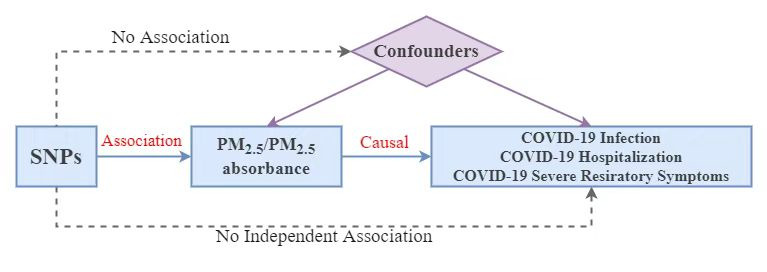
Several observational studies reported on the association between particulate matter ≤2.5μm (PM) and its absorbance with coronavirus (COVID-19), but none use Mendelian randomisation (MR). To strengthen the knowledge on causality, we examined the association of PM and its absorbance with COVID-19 risk using MR.
We selected genome-wide association study (GWAS) integration data from the UK Biobank and IEU Open GWAS Project for two-sample MR analysis. We used inverse variance weighted (IVW) and its multiple random effects and fixed effects alternatives to generally predict the association of PM and its absorbance with COVID-19, and six methods (MR Egger, weighted median, simple mode, weighted mode, maximum-likelihood and MR-PRESSO) as complementary analyses.
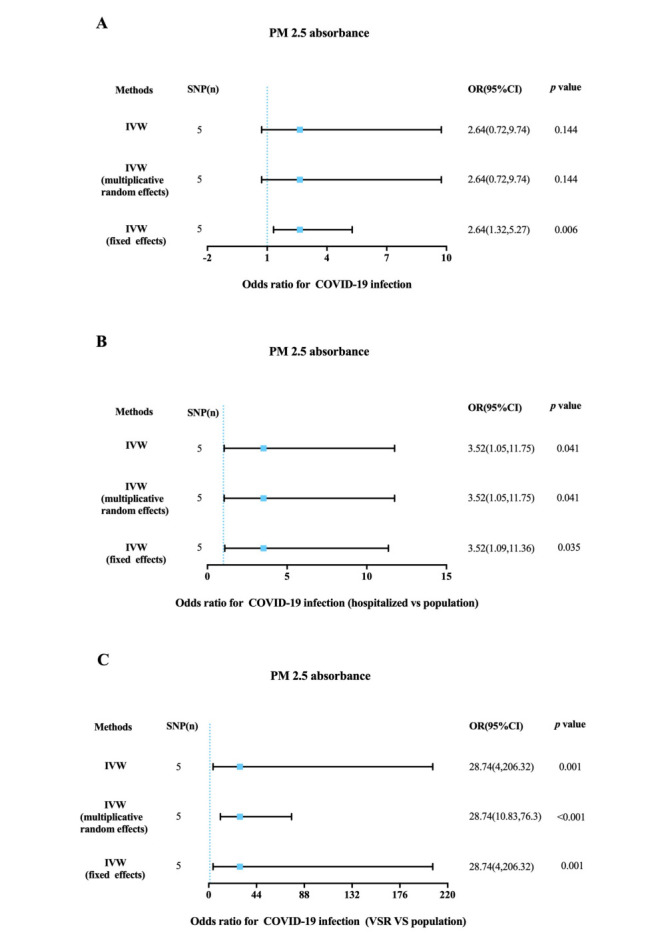
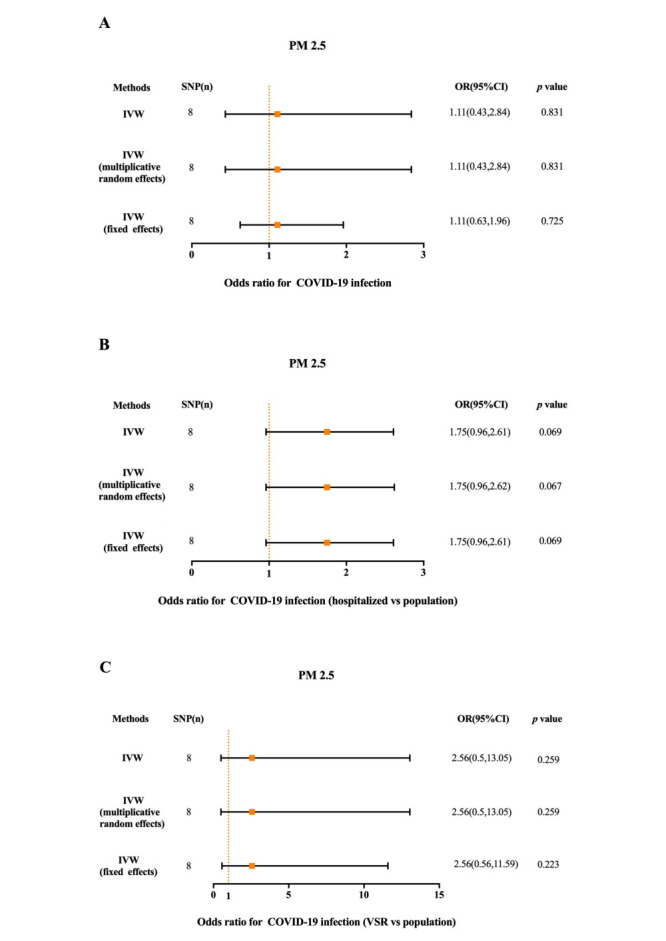
MR results suggested that PM absorbance was associated with COVID-19 infection (odds ratio (OR) = 2.64; 95% confidence interval (CI) = 1.32-5.27, P = 0.006), hospitalisation (OR = 3.52; 95% CI = 1.05-11.75, P = 0.041) and severe respiratory symptoms (OR = 28.74; 95% CI = 4.00-206.32, P = 0.001) in IVW methods. We observed no association between PM and COVID-19.
We found a potential causal association of PM absorbance with COVID-19 infection, hospitalisation, and severe respiratory symptoms using MR analysis. Prevention and control of air pollution could help delay and halt the negative progression of COVID-19.
几项观察性研究报告了颗粒物≤2.5μm(PM)及其吸光度与冠状病毒(COVID-19)之间的关联,但没有一项使用孟德尔随机化(MR)。为了加强对因果关系的认识,我们使用 MR 检验了 PM 及其吸光度与 COVID-19 风险之间的关联。
我们从英国生物库和 IEU 开放 GWAS 项目中选择了全基因组关联研究(GWAS)整合数据进行两样本 MR 分析。我们使用逆方差加权(IVW)及其多种随机效应和固定效应替代方法来普遍预测 PM 及其吸光度与 COVID-19 的关联,并使用六种方法(MR Egger、加权中位数、简单模式、加权模式、最大似然和 MR-PRESSO)作为补充分析。
MR 结果表明,PM 吸光度与 COVID-19 感染相关(比值比(OR)=2.64;95%置信区间(CI)=1.32-5.27,P=0.006)、住院(OR=3.52;95%CI=1.05-11.75,P=0.041)和严重呼吸道症状(OR=28.74;95%CI=4.00-206.32,P=0.001)。我们在 IVW 方法中没有观察到 PM 与 COVID-19 之间的关联。
我们使用 MR 分析发现,PM 吸光度与 COVID-19 感染、住院和严重呼吸道症状之间存在潜在的因果关联。预防和控制空气污染可能有助于延缓和阻止 COVID-19 的负面进展。