Lee Seungju, Kim Hyun Yul, Jung Youn Joo, Kang Seok-Kyung, Kim Jee Yeon, Yun Mi Sook
Department of Surgery, Pusan National University Yangsan Hospital, Pusan National University School of Medicine, Yangsan, Korea.
Department of Pathology, Pusan National University Yangsan Hospital, Pusan National University School of Medicine, Yangsan, Korea.
Korean J Clin Oncol. 2023 Jun;19(1):27-31. doi: 10.14216/kjco.23005. Epub 2023 Jun 30.
Several studies are concerned about the association between bone mineral density (BMD) and the risk of breast cancer in postmenopausal women, but it is controversial. Therefore, we evaluated whether BMD might be a risk factor for recurrences, or metastases in menopausal luminal A breast cancer patients.
In this retrospective study, data of 348 patients with luminal A breast cancer who received treatment at Pusan National University Yangsan Hospital between 2012 and 2016 were analyzed. Patients were divided into two groups: normal BMD and low BMD including osteopenia or osteoporosis in preoperative examination. Patients were also divided into three groups according to BMD changes: no change in BMD; improvement in BMD, and deterioration in BMD. Events were defined as recurrence, occurrence of contralateral breast cancer, and metastasis to any other organ.
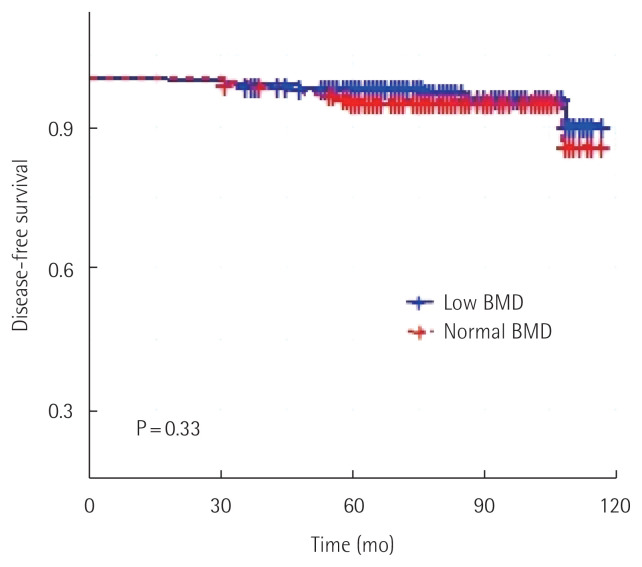
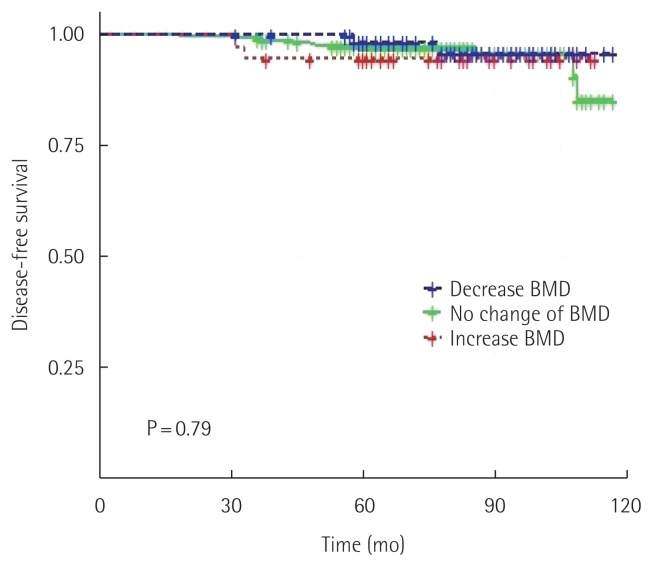
Preoperative examination revealed normal BMD in 129 of 348 patients and low BMD in 219 patients. During a median follow-up period of 78 months, only 14 patients (4.0%) experienced recurrences, distant metastases, or occurrences of contralateral breast cancer. Five-year disease-free survival rate was 98.2% for 219 patients with low BMD and 95.0% for 129 patients with normal BMD (P=0.33). Disease-free survival at 5 years was 97.0% for the no change in the BMD group, 94.6% for the BMD improvement group, and 98.4% for the BMD deterioration group (P=0.79).
In this study, BMD had no statistically significant associations on recurrences, metastases, or incidences of contralateral breast cancer in postmenopausal patients with luminal A breast cancer.
多项研究关注绝经后女性骨矿物质密度(BMD)与乳腺癌风险之间的关联,但存在争议。因此,我们评估了BMD是否可能是绝经后 luminal A型乳腺癌患者复发或转移的危险因素。
在这项回顾性研究中,分析了2012年至2016年期间在釜山国立大学梁山医院接受治疗的348例luminal A型乳腺癌患者的数据。患者分为两组:术前检查中骨密度正常组和骨密度低组(包括骨质减少或骨质疏松)。患者还根据骨密度变化分为三组:骨密度无变化组;骨密度改善组和骨密度恶化组。事件定义为复发、对侧乳腺癌的发生以及转移至任何其他器官。
术前检查显示,348例患者中有129例骨密度正常,219例骨密度低。在中位随访期78个月期间,只有14例患者(4.0%)出现复发、远处转移或对侧乳腺癌的发生。219例骨密度低的患者5年无病生存率为98.2%,129例骨密度正常的患者为95.0%(P = 0.33)。骨密度无变化组5年无病生存率为97.0%,骨密度改善组为94.6%,骨密度恶化组为98.4%(P = 0.79)。
在本研究中,骨密度与绝经后luminal A型乳腺癌患者的复发、转移或对侧乳腺癌的发生率无统计学显著关联。