
降钙素原作为脓毒性膝关节炎的预测因子:一项回顾性队列研究。
Procalcitonin as a Predictor of Septic Knee Arthritis: A Retrospective Cohort Study.
机构信息
From the Department of Orthopaedic Surgery, (Dr. West, Fisher, Dr. Rounds, and Dr. Simpson); the Clinical Research Institute (Dr. Almekdash), Texas Tech University Health Science Center, Lubbock, TX; and the Department of Orthopaedics and Rehabilitation, University of Florida School of Medicine, Gainesville, FL (Dr. Murphree).
出版信息
J Am Acad Orthop Surg Glob Res Rev. 2023 Jan 9;7(1). doi: 10.5435/JAAOSGlobal-D-22-00261. eCollection 2023 Jan 1.
INTRODUCTION
Differentiating septic arthritis from aseptic arthritis (AA) of the knee is difficult without arthrocentesis. Although procalcitonin (PCT) has shown diagnostic value in identifying bacterial infections, it has not been established as a reliable marker for identifying septic arthritis (SA). Recent studies have shown promise in the use of PCT as a useful systemic marker for identifying septic arthritis versus AA. This observational retrospective review compares PCT with routine inflammatory markers as a tool for differentiating septic arthritis versus AA in patients with acute, atraumatic knee pain.
METHODS
Fifty-three consecutive patients (24 SA, 29 AA) were retrospectively reviewed at one institution with concern for SA. SA was diagnosed based on a physical examination, laboratory markers, and arthrocentesis. Laboratory indices were compared between the septic arthritis and AA groups. Data analysis was conducted to define sensitivity and specificity. Receiver operator characteristic curve analysis and regression were conducted to determine the best marker for acute SA of the knee.
RESULTS
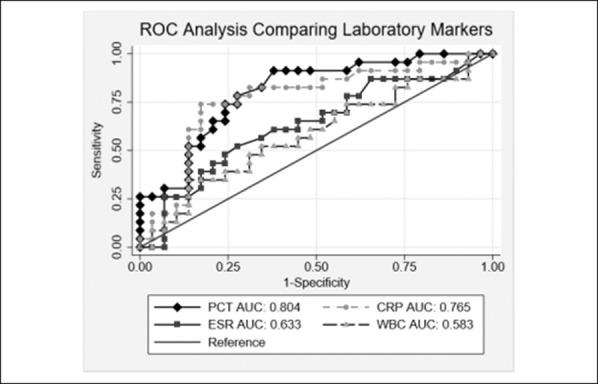
Using multiple logistic regression, bacteremia (OR 6.75 ± 5.75) was determined to be the greatest predictor of SA. On linear regression, concomitant bacteremia (coef 3.07 ± 0.87), SA (coef 2.18 ± 0.70), and the presence of pseudogout crystals (coef 1.80 ± 0.83) on microscopy predicted an increase in PCT. Using a PCT cutoff of 0.25 ng/mL yields a sensitivity of 91.7% and specificity of 55.2% for predicting SA; however, the ideal cutoff in our series was 0.32 ng/mL with a sensitivity of 79.2% and specificity of 72.4%. PCT was superior to the white blood cell count, erythrocyte sedimentation rate, and C-reactive protein in the area under the receiver-operating characteristic curve analysis.
DISCUSSION
Procalcitonin seems to be the most sensitive and specific systemic marker in differentiating septic from AA.
简介
如果不进行关节穿刺,很难将脓毒性关节炎与无菌性关节炎(AA)区分开来。降钙素原(PCT)在识别细菌感染方面具有诊断价值,但尚未被确立为识别脓毒性关节炎(SA)的可靠标志物。最近的研究表明,PCT 作为一种有用的全身标志物,可用于识别化脓性关节炎与 AA。本观察性回顾性研究比较了 PCT 与常规炎症标志物,以作为鉴别急性创伤性膝关节疼痛患者中化脓性关节炎与 AA 的工具。
方法
在一家机构回顾性分析了 53 例连续患者(24 例 SA,29 例 AA),这些患者均因疑似 SA 而就诊。SA 的诊断依据为体格检查、实验室标志物和关节穿刺。比较了化脓性关节炎组和 AA 组的实验室指标。进行数据分析以确定灵敏度和特异性。进行受试者工作特征曲线分析和回归,以确定用于诊断急性膝关节化脓性关节炎的最佳标志物。
结果
使用多元逻辑回归,菌血症(OR 6.75±5.75)被确定为 SA 的最大预测因子。在线性回归中,同时存在菌血症(系数 3.07±0.87)、SA(系数 2.18±0.70)和显微镜下存在假性痛风晶体(系数 1.80±0.83)可预测 PCT 升高。使用 PCT 截断值 0.25ng/mL 时,预测 SA 的灵敏度为 91.7%,特异性为 55.2%;然而,在本研究系列中,最佳截断值为 0.32ng/mL,灵敏度为 79.2%,特异性为 72.4%。PCT 在受试者工作特征曲线分析中的面积比白细胞计数、红细胞沉降率和 C 反应蛋白更优越。
讨论
降钙素原似乎是鉴别脓毒性和 AA 的最敏感和特异的全身标志物。

 Zotero 插件