Department of Neurology, Xiangya Hospital, Central South University, Changsha, Hunan, China.
Clinical Research Center for Cerebrovascular Disease of Hunan Province, Central South University, Changsha, Hunan, China.
Front Endocrinol (Lausanne). 2023 Jun 29;14:1218905. doi: 10.3389/fendo.2023.1218905. eCollection 2023.
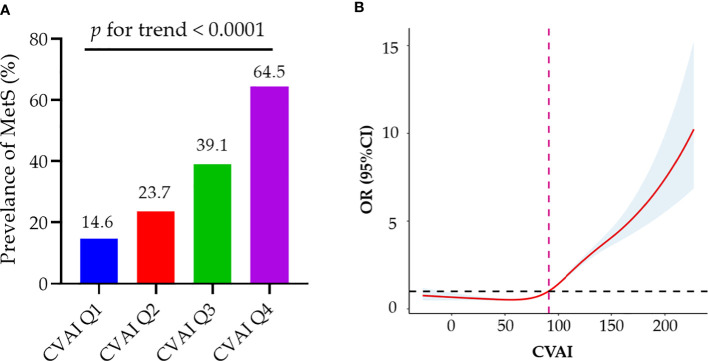
Patients with Metabolic Syndrome (MetS) are considered at high-risk for incident stroke. An indicator of visceral adiposity dysfunction, the Chinese Visceral Adiposity Index (CVAI) is used to evaluate the dysfunction of visceral fat. Given the impact of visceral adiposity dysfunction on elevating cardiovascular hazards, this study aimed to examine the association between CVAI and stroke risk in MetS patients.
Between November 2017 and December 2018, a total of 18,974 individuals aged ≥40 underwent standardized in-person clinical interviews in Hunan Province, with 6,732 meeting the criteria for MetS. After the baseline survey was completed, subsequent surveys were conducted biennially. The study was split into two stages performed at baseline and after two years. During the former, receiver-operating characteristic curves were used to assess the accuracy of using baseline CVAI in diagnosing MetS. After two years, we examined the association between CVAI and incident stroke in MetS patients using logistic regression, subgroup analysis, and restricted cubic spline (RCS) analysis.
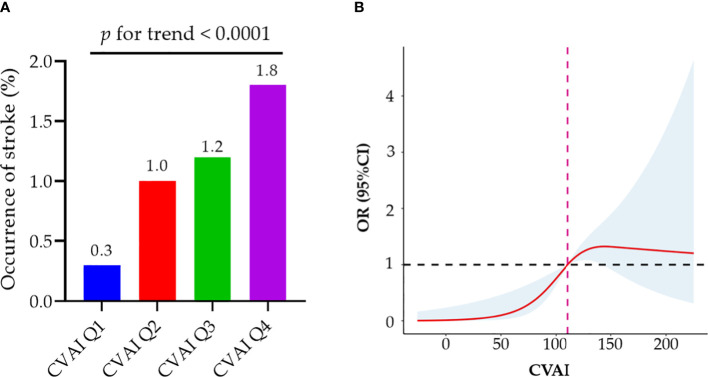
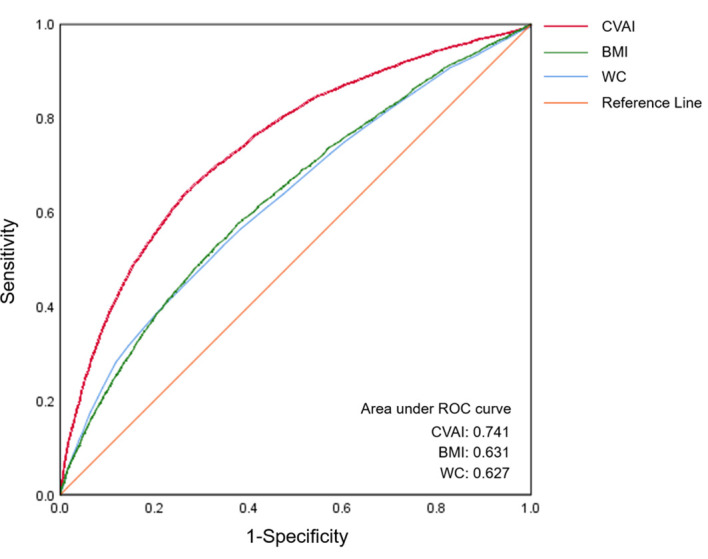
As evidenced by a higher AUC (AUC:0.741), CVAI demonstrated superior diagnostic performance relative to body mass index (AUC:0.631) and waist circumference (AUC:0.627) in diagnosing MetS. After a 2-year follow-up, 72 MetS patients had a stroke event. There was a robust positive correlation between incident stroke and CVAI in patients with MetS. Each 1 SD increase in CVAI was associated with a 1.52-fold higher risk of stroke after adjustment for confounding factors (aOR=1.52, 95%CI: 1.18-1.95). The RCS demonstrated a reduced risk of stroke for MetS patients when the CVAI was below 110.91. However, no significant correlation was detected between CVAI and stroke in non-MetS patients.
Our findings recommend CVAI as a superior screening tool for detecting MetS and suggest that reducing CVAI can mitigate the risk of stroke in patients with MetS.
患有代谢综合征(MetS)的患者被认为有较高的中风风险。中国内脏脂肪指数(CVAI)是评估内脏脂肪功能障碍的一个指标,用于评估内脏脂肪功能障碍。鉴于内脏脂肪功能障碍对心血管危害的影响,本研究旨在探讨 CVAI 与 MetS 患者中风风险之间的关系。
2017 年 11 月至 2018 年 12 月,湖南省共有 18974 人接受了标准化的现场临床访谈,其中 6732 人符合 MetS 标准。基线调查完成后,每两年进行一次后续调查。研究分为基线和两年后两个阶段进行。在前者中,使用受试者工作特征曲线评估基线 CVAI 诊断 MetS 的准确性。两年后,我们使用逻辑回归、亚组分析和限制立方样条(RCS)分析检查 CVAI 与 MetS 患者中风事件之间的关系。
CVAI 在诊断 MetS 方面的 AUC(AUC:0.741)高于体质量指数(AUC:0.631)和腰围(AUC:0.627),表现出更好的诊断性能。两年后随访,72 例 MetS 患者发生中风事件。CVAI 与 MetS 患者的中风事件呈显著正相关。在校正混杂因素后,CVAI 每增加 1 个标准差,中风风险增加 1.52 倍(aOR=1.52,95%CI:1.18-1.95)。RCS 显示,CVAI 低于 110.91 时,MetS 患者中风的风险降低。然而,CVAI 与非 MetS 患者的中风之间没有显著相关性。
我们的研究结果建议 CVAI 作为一种检测 MetS 的更好的筛查工具,并表明降低 CVAI 可以降低 MetS 患者中风的风险。