Savić Veljko, Topalović Vladimir, Nikolić Jelena, Jevtić Sanja, Manić Nebojša, Komatina Mirko, Grujić Snežana
Institute for Technology of Nuclear and Other Mineral Raw Materials, Bulevar Franš D'Eperea 86, 11000, Belgrade, Serbia.
University of Belgrade, Faculty of Technology and Metallurgy, Karnegijeva 4, 11000, Belgrade, Serbia.
Heliyon. 2023 Jul 3;9(7):e17664. doi: 10.1016/j.heliyon.2023.e17664. eCollection 2023 Jul.
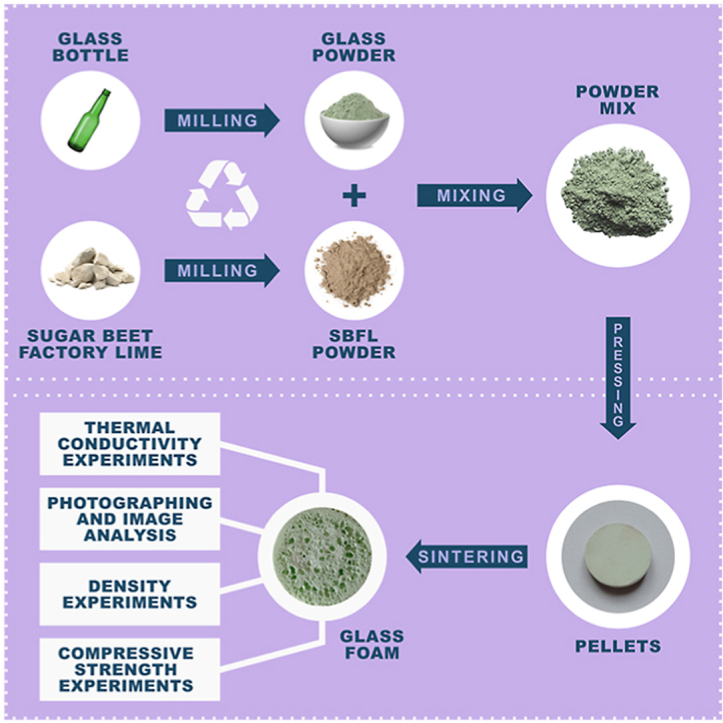
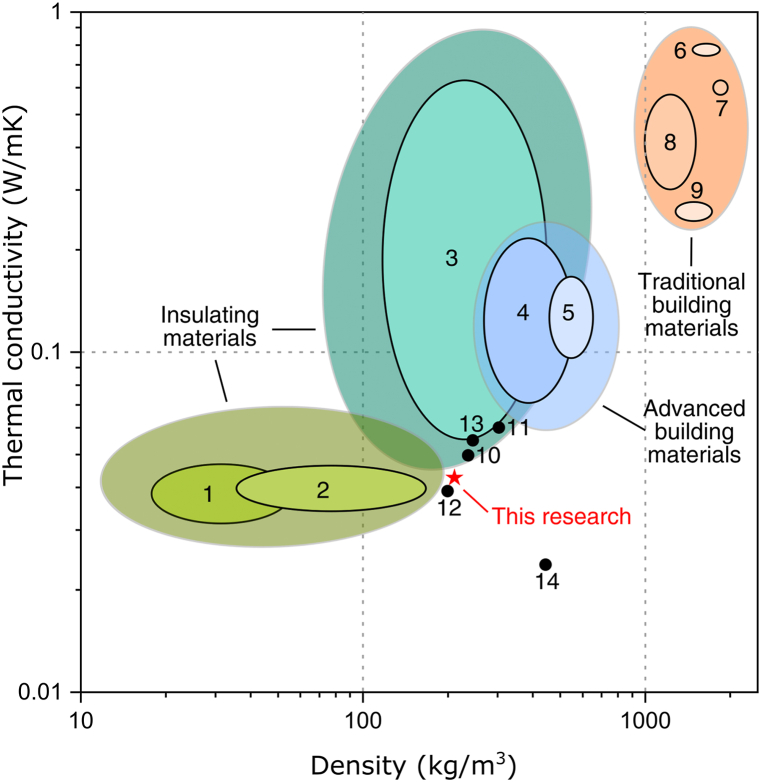
Great waste production alongside limited natural resources represents huge environmental and economic problems worldwide. Sustainable waste management and industrial production can reduce pollution and gain some economic benefits. Eco-friendly thermal insulators such as foam glasses can be produced using secondary raw materials in open-loop recycling. Foam glasses were successfully produced using green bottle glass and sugar beet factory lime (SBFL), CaCO-rich waste as a novel foaming agent. Glass powder was mixed with different amounts of SBFL, uniaxially pressed at 20 MPa, and sintered at different temperatures. The influence of sintering temperature and the addition of a foaming agent was examined. Obtained samples were mechanically, thermally, and microstructurally characterized. Results showed that samples sintered at 800 C have the best properties. Obtained foam glasses can be used in a variety of industries where thermal insulation, non-flammability, and non-toxic materials are required.
大量的废物产生与有限的自然资源并存,这在全球范围内构成了巨大的环境和经济问题。可持续的废物管理和工业生产可以减少污染并获得一些经济效益。诸如泡沫玻璃之类的环保隔热材料可以在开环回收中使用二次原料来生产。使用绿色瓶玻璃和富含碳酸钙的甜菜工厂石灰(SBFL)作为新型发泡剂,成功生产出了泡沫玻璃。将玻璃粉与不同量的SBFL混合,在20MPa下单轴压制,并在不同温度下烧结。研究了烧结温度和发泡剂添加量的影响。对获得的样品进行了力学、热学和微观结构表征。结果表明,在800℃烧结的样品具有最佳性能。所获得的泡沫玻璃可用于各种需要隔热、不燃和无毒材料的行业。