Luscan Romain, Malheiro Emeline, Sisso Fiona, Wartelle Sébastien, Parc Yann, Fauroux Brigitte, Bégué Thierry, Johanet Hubert, Denoyelle Françoise, Garabédian Erea-Noël, Simon François
Université Paris Cité, Faculté de Médecine, Paris, France.
Department of Paediatric Otolaryngology, AP-HP, Hôpital Necker-Enfants Malades, Paris, France.
Front Med (Lausanne). 2023 Jun 28;10:1210915. doi: 10.3389/fmed.2023.1210915. eCollection 2023.
The definition of a is usually reported by surgeons themselves. The objective of the study was to define a multifaceted definition of a , by confronting patients', healthcare workers', and surgeons' perspectives.
An online open-ended questionnaire was created to identify three qualities and three shortcomings defining a . Age, gender, and profession of respondents were collected. Responses with a similar meaning were combined into word groups and labeled within four themes: human qualities, technical surgical skills (TSS), non-technical skills (NTS), and knowledge. Multivariate analyses were conducted between themes and respondent characteristics.
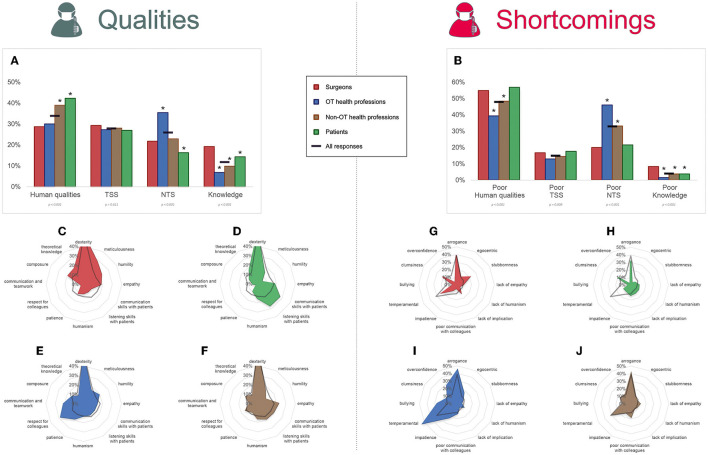
Four thousand seven hundred and sixty qualities and 4,374 shortcomings were obtained from 1,620 respondents including 385 surgeons, 291 patients, 565 operating theater (OT) health professionals, and 379 non-OT health professionals. The main three qualities were dexterity (54% of respondents), meticulousness (18%), and empathy (18%). There was no significant difference between professional categories for TSS. Compared with surgeons, non-OT health professionals and patients put more emphasis on human qualities (29 vs. 39% and 42%, respectively, < .001). OT health professionals referred more to NTS than surgeons (35 vs. 22%, < 0.001). Knowledge was more important for surgeons (19%) than for all other professional categories ( < 0.001).
This survey illustrates the multifaceted definition of a . Even if dexterity is a major quality, human qualities are of paramount importance. Knowledge seems to be underestimated by non-surgeons, although it essential to understand the disease and preparing the patient and OT team for the procedure.
的定义通常由外科医生自己报告。本研究的目的是通过对比患者、医护人员和外科医生的观点,来定义一个多方面的 的定义。
创建了一份在线开放式问卷,以确定定义 的三个优点和三个缺点。收集了受访者的年龄、性别和职业。将具有相似含义的回答合并为词组,并在四个主题下进行标注:人文素质、手术技术技能(TSS)、非技术技能(NTS)和知识。对主题和受访者特征进行了多变量分析。
从1620名受访者中获得了4760个优点和4374个缺点,其中包括385名外科医生、291名患者、565名手术室(OT)医护人员和379名非OT医护人员。主要的三个优点是灵巧性(54%的受访者)、细致(18%)和同理心(18%)。TSS在专业类别之间没有显著差异。与外科医生相比,非OT医护人员和患者更强调人文素质(分别为29%对39%和42%,<0.001)。OT医护人员比外科医生更倾向于提及NTS(35%对22%,<0.001)。知识对外科医生(19%)比所有其他专业类别更重要(<0.001)。
这项调查说明了 的多方面定义。即使灵巧性是一个主要优点,人文素质也至关重要。非外科医生似乎低估了知识,尽管理解疾病并为患者和OT团队做好手术准备至关重要。