Boccara Ethel, Golan Sapir, Beeri Michal Schnaider
Department of Psychology, Bar-Ilan University, Ramat Gan, Israel.
The Joseph Sagol Neuroscience Center, Sheba Medical Center, Tel HaShomer, Israel.
Front Med (Lausanne). 2023 Jun 30;10:1160426. doi: 10.3389/fmed.2023.1160426. eCollection 2023.
Adiposity has been previously associated with cognitive impairment and Alzheimer's disease and related disorders (ADRD). Body mass index (BMI) is the most common measure of global adiposity, but inconsistent results were found since it is a global measurement. BMI does not represent regional fat distribution which differs between sexes, race, and age. Regional fat distribution may contribute differently to cognitive decline and Alzheimer's disease (AD)-related brain changes. Fat-specific targeted therapies could lead to personalized improvement of cognition. The goal of this systematic review is to explore whether regional fat depots, rather than central obesity, should be used to understand the mechanism underlying the association between adiposity and brain.
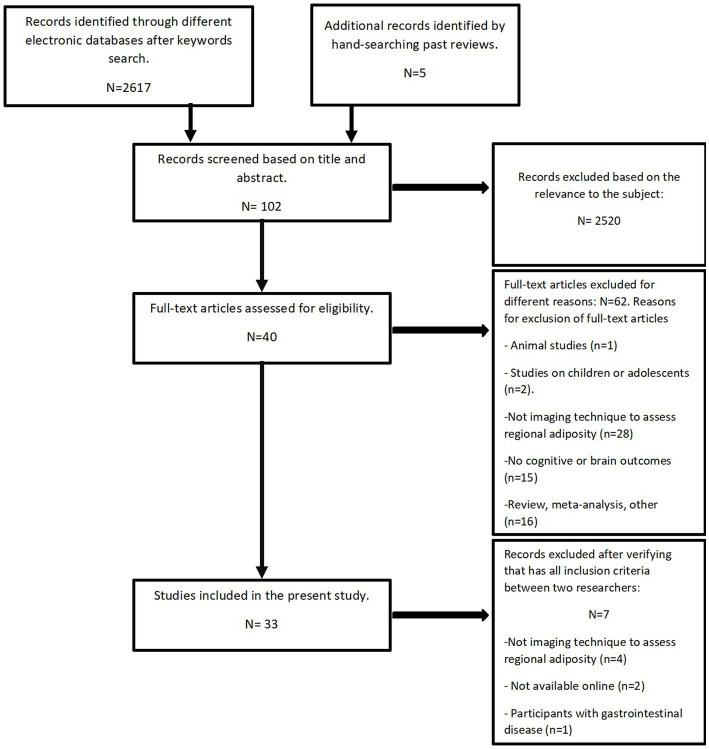
This systematic review included 33 studies in the English language, conducted in humans aged 18 years and over with assessment of regional adiposity, cognitive function, dementia, and brain measures. We included only studies that have assessed regional adiposity using imaging technics and excluded studies that were review articles, abstract only or letters to editor. Studies on children and adolescents, animal studies, and studies of patients with gastrointestinal diseases were excluded. PubMed, PsychInfo and web of science were used as electronic databases for literature search until November 2022.
Based on the currently available literature, the findings suggest that different regional fat depots are likely associated with increased risk of cognitive impairment, brain changes and dementia, especially AD. However, different regional fat depots can have different cognitive outcomes and affect the brain differently. Visceral adipose tissue (VAT) was the most studied regional fat, along with liver fat through non-alcoholic fatty liver disease (NAFLD). Pancreatic fat was the least studied regional fat.
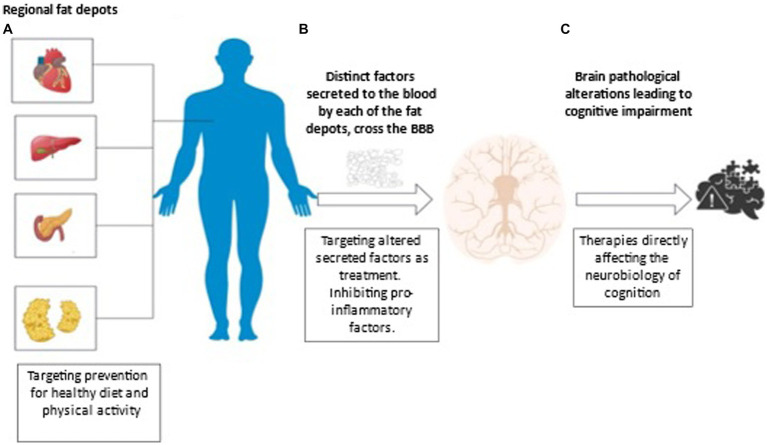
Regional adiposity, which is modifiable, may explain discrepancies in associations of global adiposity, brain, and cognition. Specific regional fat depots lead to abnormal secretion of adipose factors which in turn may penetrate the blood brain barrier leading to brain damage and to cognitive decline.
肥胖先前已被认为与认知障碍以及阿尔茨海默病和相关疾病(ADRD)有关。体重指数(BMI)是衡量总体肥胖程度最常用的指标,但由于它是一种整体测量方法,所以研究结果并不一致。BMI并不能代表不同性别、种族和年龄之间存在差异的局部脂肪分布情况。局部脂肪分布对认知衰退和阿尔茨海默病(AD)相关的脑部变化可能有不同的影响。针对脂肪的靶向治疗可能会带来个性化的认知改善。本系统评价的目的是探讨是否应使用局部脂肪储存而非中心性肥胖来理解肥胖与大脑之间关联的潜在机制。
本系统评价纳入了33项英文研究,研究对象为18岁及以上的成年人,评估内容包括局部肥胖、认知功能、痴呆和脑部测量。我们仅纳入了使用成像技术评估局部肥胖的研究,排除了综述文章、仅摘要或给编辑的信件等研究。排除了关于儿童和青少年的研究、动物研究以及胃肠道疾病患者的研究。使用PubMed、PsychInfo和科学网作为电子数据库进行文献检索,检索截至2022年11月。
基于目前可得的文献,研究结果表明不同的局部脂肪储存可能与认知障碍、脑部变化和痴呆风险增加有关,尤其是AD。然而,不同的局部脂肪储存可能会有不同的认知结果,对大脑的影响也不同。内脏脂肪组织(VAT)是研究最多的局部脂肪,同时通过非酒精性脂肪性肝病(NAFLD)对肝脏脂肪的研究也较多。胰腺脂肪是研究最少的局部脂肪。
可改变的局部肥胖可能解释了总体肥胖、大脑和认知之间关联的差异。特定的局部脂肪储存会导致脂肪因子异常分泌,进而可能穿透血脑屏障,导致脑损伤和认知衰退。