Yan Hongmei, An Fuyu, Liu Quansheng, Chi Qingsheng, Wang Kai, Xu Xuelin, Kuang Yingjie, Zhang Zhidong, Hua Yan
Guangdong Provincial Key Laboratory of Silviculture, Protection, and Utilization, Guangdong Academy of Forestry, 233 Guang Shan Yi Road, Tian He District, Guangzhou 510520, China.
Guangdong Key Laboratory of Animal Conservation and Resource Utilization, Guangdong Public Laboratory of Wild Animal Conservation and Utilization, Institute of Zoology, Guangdong Academy of Sciences, 105 Xingang West Road, Haizhu District, Guangzhou 510520, China.
Conserv Physiol. 2023 Jul 13;11(1):coad049. doi: 10.1093/conphys/coad049. eCollection 2023.
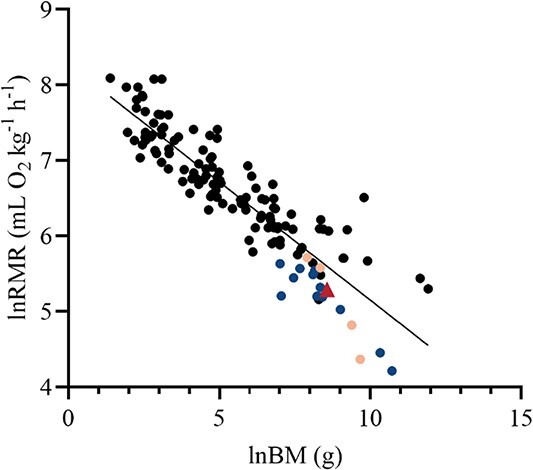
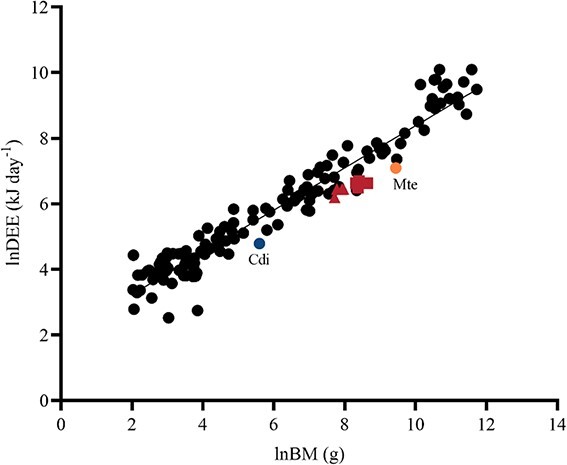
The Chinese pangolin is an endangered species, and conservation and captive rescue are important conservation measures. This requires reliable information on nutritional energy requirements and expenditure characteristics. However, we lack sufficient knowledge of their energy physiology to determine their energy requirements for maintenance and growth. An open-flow respirometry system was used to measure the resting metabolic rate (RMR) and the daily energy expenditure (DEE) of Chinese pangolins (), and the dietary digestive energy was measured. The average RMR in Chinese pangolins was 3.23 ml O kg min at an ambient temperature () of 24.5-30°C, which was only 73.0% of the expected value based on body mass (BM). The average DEE values were 744.9 kJ day in animals with BM >3 kg and 597.3 kJ day in those with BM <3 kg, which were only 52.4% and 60.6% of the predicted values, respectively. The RMR and DEE levels of the Chinese pangolin were lower than those of similar-sized eutherian mammals and close to those of anteaters. These characteristics suggest that the Chinese pangolin has a low demand for energy in its diet. Although metabolic level data alone cannot be used to calculate the energy requirements of each Chinese pangolin, we believe they can provide a tangible reference for the relocation of Chinese pangolins. These results provide a scientific basis for future research on the physiology and ecology of endangered wildlife such as the Chinese pangolin.
中华穿山甲是一种濒危物种,保护和圈养救助是重要的保护措施。这需要有关营养能量需求和消耗特征的可靠信息。然而,我们对它们的能量生理学了解不足,无法确定其维持和生长所需的能量。采用开放式流体呼吸测定系统测量了中华穿山甲的静息代谢率(RMR)和每日能量消耗(DEE),并测量了其食物消化能量。在环境温度为24.5 - 30°C时,中华穿山甲的平均RMR为3.23毫升氧气·千克⁻¹·分钟⁻¹,仅为基于体重(BM)预期值的73.0%。体重>3千克的动物平均DEE值为744.9千焦/天,体重<3千克的动物为597.3千焦/天,分别仅为预测值的52.4%和60.6%。中华穿山甲的RMR和DEE水平低于体型相似的真兽类哺乳动物,与食蚁兽相近。这些特征表明中华穿山甲对食物能量的需求较低。虽然仅代谢水平数据不能用于计算每只中华穿山甲的能量需求,但我们认为它们可为中华穿山甲的易地放归提供切实参考。这些结果为今后对中华穿山甲等濒危野生动物的生理学和生态学研究提供了科学依据。